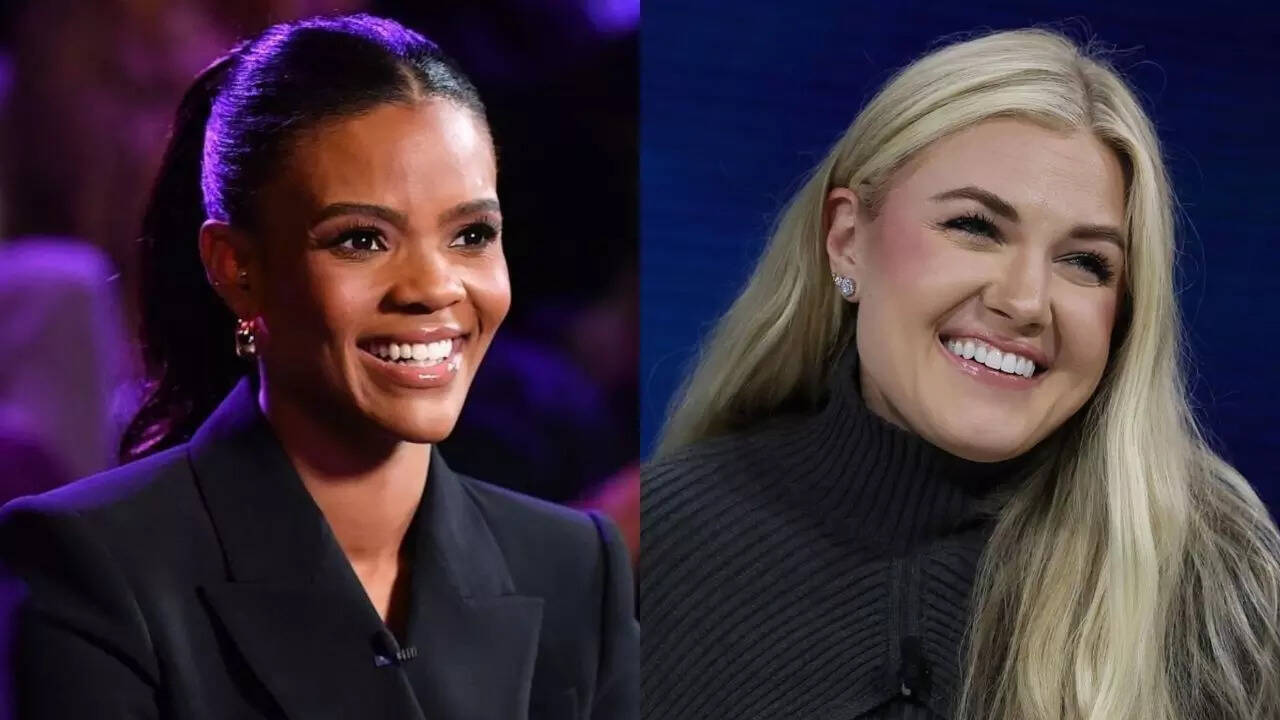
Candace Owens has pivoted from partisan politics to a brand of esoteric investigation that defies traditional categorization. Her recent public confrontation with Erika Kirk, centered on the bizarre allegation that Kirk might be a "hybrid" or a "half-human, half-robot" entity, is not merely a viral moment of internet friction. It represents a significant shift in the creator economy where the line between skepticism and clinical obsession has vanished. This isn't about policy anymore. It is about the fundamental definition of what it means to be a biological human in an era dominated by surgical enhancement and artificial intelligence.
The spectacle began when Owens scrutinized Kirk’s physical appearance and vocal patterns, suggesting they were too precise to be natural. While the internet reacted with predictable mockery, the exchange signals a deeper, more unsettling trend in modern discourse. We are witnessing the birth of "humanity gatekeeping," where public figures use the looming threat of transhumanism to cast doubt on the very existence of their rivals. For an alternative look, consider: this related article.
The Mechanics of the Hybrid Accusation
To understand why Owens would stake her reputation on such a fringe theory, one must look at the current climate of technological distrust. We are currently living through a period where deepfakes are indistinguishable from reality and neural interfaces are moving from science fiction to clinical trials. Owens is tapping into a primal fear. By questioning if Erika Kirk is a "hybrid," she isn't just insulting a person; she is auditioning a new form of digital McCarthyism.
The "evidence" cited in these circles usually involves minor glitches in video feeds, unusual pupillary responses, or perceived "uncanny valley" aesthetics. In Kirk's case, the accusations focused on her skin texture and the supposed lack of micro-expressions. It is a biological audit conducted by amateurs. This methodology ignores the reality of high-definition cameras, studio lighting, and the ubiquitous nature of cosmetic procedures that intentionally mimic a "perfected" or non-human look. Further insight on this matter has been provided by Variety.
The irony is thick. The very technology used to broadcast these theories—the algorithms, the filters, and the compression codecs—is what creates the visual "anomalies" used as proof of a non-human presence.
Beyond the Viral Clip
Critics argue that this is a calculated move to maintain relevance in a saturated market. When traditional political commentary becomes stale, the stakes must be raised. Moving the goalposts from "my opponent is wrong" to "my opponent is not a biological human" is the ultimate escalation. It creates a closed loop of logic. If the accused denies it, they are simply "programmed" to do so. If they ignore it, they are "hiding the truth."
This strategy has a history. From the "lizard people" tropes of the late nineties to the more recent "clone" theories surrounding various celebrities, the goal is always the same. It is to dehumanize the subject so completely that their arguments no longer require a response. You do not debate a machine. You dismantle it.
Erika Kirk's reaction—a mix of confusion and defiance—is the only possible human response to a prompt that questions your DNA. However, in the ecosystem of the "Great Reset" and transhumanist anxiety, Kirk's humanity is secondary to the narrative Owens is building. That narrative posits that an elite class is already merging with silicon, and that the public is being "conditioned" to accept these hybrids as peers.
The Business of Disbelief
There is a financial engine behind these claims. High-conflict content drives engagement rates that standard news reporting cannot match. Every "shocked" reaction video and every debunking thread serves to feed the original creator's reach. Owens has mastered the art of the "just asking questions" defense. By framing her accusations as an inquiry into the "hybrid" phenomenon, she avoids the legal pitfalls of direct defamation while reaping the rewards of sensationalism.
We have to look at the collateral damage of this trend. When we begin to treat physical traits as "software bugs," we lose the ability to have a shared reality. The "hybrid" theory is a symptom of a society that has become so detached from physical labor and face-to-face interaction that it can no longer recognize the variations of a human face.
The Uncanny Valley as a Weapon
The Uncanny Valley is a hypothesis in aesthetics which holds that when human features look and move almost, but not exactly, like natural human beings, it causes a response of revulsion among human observers. Owens is weaponizing this psychological trigger. By pointing at Kirk and shouting "Uncanny Valley," she is triggering a neurological "ick" factor in her audience.
- Filter Dysmorphia: The widespread use of AI-driven beauty filters has warped our baseline for what a human face looks like on screen.
- Surgical Precision: Modern aesthetics often aim for a symmetry that is mathematically perfect but biologically rare.
- Video Compression: High-speed streaming often smooths out skin textures to save bandwidth, inadvertently creating the "plastic" look cited by conspiracy theorists.
These three factors create a perfect storm for the "hybrid" narrative. Owens isn't discovering robots; she is discovering the limitations of digital video and the excesses of modern dermatology.
The Transhumanist Shadow
While the "hybrid" theory regarding Kirk is baseless, it thrives because real transhumanist goals are being discussed in boardrooms and tech hubs. Figures like Elon Musk with Neuralink or Ray Kurzweil with his "Singularity" predictions provide the factual foundation upon which these wilder theories are built. The error Owens makes is one of timing and scale.
She is presenting as a current reality what is currently a fragmented and failing experimental field. Integrating silicon with biology is a messy, invasive, and largely unsuccessful endeavor in 2026. The idea that a "hybrid" could walk among us, conduct interviews, and live a public life without a massive medical and technical support team is a fantasy. It ignores the sheer complexity of the human nervous system.
A New Era of Character Assassination
This incident marks a turning point in how public figures will be attacked in the future. We are moving past the era of digging up old tweets. The new frontier is the biological smear. We can expect to see more of this as AI becomes more integrated into our lives. "Is this person real?" will become the standard retort for any inconvenient voice.
It is a scorched-earth tactic. By the time the accused proves their "humanity"—a ridiculous requirement in itself—the news cycle has moved on, leaving a permanent stain of "otherness" on their reputation. It is the ultimate "othering" mechanism. It strips the target of their civil rights, their emotions, and their standing in the community.
The audience, meanwhile, is left in a state of perpetual hyper-vigilance. They are taught to watch for the blink that is too slow or the smile that is too wide. This creates a paranoid viewership that is more focused on the "pixels" of a person than the content of their character. It is a distraction of the highest order, turning the pursuit of truth into a digital scavenger hunt for non-existent robotic parts.
If you want to understand the future of the culture war, look at the Kirk-Owens exchange. It isn't about policy, or even about personhood. It is about the destruction of the mirror. When we can no longer look at another person and see a fellow human being, the conversation is over.
The next time a commentator suggests a rival is a "hybrid" or an "android," ask what they are trying to hide. Usually, it is the fact that they have no actual argument left to make. They have traded their credibility for a headline, and in doing so, they have become the very thing they claim to fear: a creature driven by an algorithm, devoid of empathy, performing for a crowd of ghosts.
Verify the source of your own skepticism before you let someone else program it for you.
Would you like me to investigate the specific technological limitations of current neural-link prototypes to further debunk the "stealth hybrid" theory?