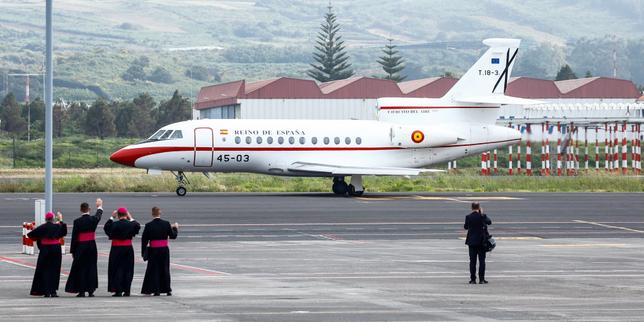
Pope Leo XIV remains stranded in the Canary Islands following a critical mechanical failure aboard his chartered aircraft. The incident, which occurred during a refueling stop after a grueling pastoral tour of Latin America, has grounded the papal entourage and exposed significant vulnerabilities in the Holy See’s logistical infrastructure. While the Vatican Press Office initially downplayed the event as a minor scheduling hiccup, sources within the Spanish civil aviation authority confirm the aircraft suffered a severe hydraulic system failure just prior to its scheduled departure from Gran Canaria Airport. This was not a routine delay. It was a failure that compromises the tight, high-security schedule of a global head of state.
The breakdown forced the 82-year-old pontiff into an unplanned overnight stay at a local seminary, while engineers scrambled to source replacement parts from mainland Europe. For an institution that relies on precision timing and absolute security, the grounding represents a rare, highly public breakdown in operational execution.
The Hidden Mechanics of a Papal Logistical Nightmare
Moving a pope across continents requires a level of coordination that rivals the deployment of a small military unit. When Pope Leo XIV wrapped up his multi-nation tour, the expectation was a seamless flight back to Rome. The Canary Islands, long used as a strategic refueling hub for transatlantic flights, became the bottleneck.
The aircraft in question, a modified commercial jetliner leased for the tour, experienced a catastrophic drop in hydraulic pressure during pre-flight checks. Had this occurred thirty minutes later during takeoff, the outcome could have been disastrous.
Aviation protocols for VVIP (Very Very Important Person) flights are notoriously rigid. Unlike standard commercial flights, you cannot simply book the pontiff onto the next available budget airline seat. The security apparatus alone requires dedicated cargo space for encrypted communication gear, medical supplies, and Swiss Guard armaments.
The Sourcing Dilemma
The primary reason for the extended delay traces back to supply chain constraints. The specific valves required to repair the aging aircraft's hydraulic lines were not stocked in the Canary Islands.
- Part Procurement: A replacement component had to be flown in from a maintenance hub in Seville.
- Crew Rest Mandates: The delay quickly pushed the flight crew past their legally mandated duty hours, requiring a secondary crew to be flown in.
- Security Sweeps: Every new mechanic and crew member introduced to the aircraft required immediate vetting by Spanish intelligence and Vatican security officers.
This creates a compounding delay effect. Every hour the plane sits on the tarmac, the logistical web untangles further, requiring a complete restructuring of the Pope's upcoming itinerary in Rome, including scheduled audiences with foreign diplomats.
Why the Vatican Avoids Private Fleets
Critics frequently ask why the Holy See, an institution with immense historical wealth, does not maintain a permanent, state-of-the-art private fleet for the pontiff. The answer lies in a mix of public relations management and financial pragmatism.
Vatican Aviation Strategy: Cost vs. Public Perception
┌─────────────────────────┬─────────────────────────┐
│ Private Papal Fleet     │ Commercial Charter      │
├─────────────────────────┼─────────────────────────┤
│ High capital cost       │ Pay-per-use structure   │
│ Constant maintenance    │ Maintenance outsourced  │
│ Optics of luxury        │ Modest, pastoral image  │
│ High security control   │ Complex vetting needed  │
│ Zero backup flexibility │ Secondary options exist │
└─────────────────────────┴─────────────────────────┘
The optics of a multi-million-dollar private papal jet would clash violently with Pope Leo XIV’s emphasis on a "church for the poor." Therefore, the Vatican relies on a rotating system of charters, usually utilizing national carriers from the countries visited, or Alitalia’s successor, ITA Airways, for the outbound journey.
The flaw in this strategy is the lack of redundancy. When a chartered aircraft fails in a territory outside its primary hub, the operational support system is dangerously thin. The Vatican’s Secretariat of State assumes the airline's standard maintenance protocols will suffice, an assumption that this incident proves wrong.
The Security Vacuum of Unplanned Layovers
An unscheduled stopover is a security detail's absolute worst nightmare. The Vatican Gendarmerie, working alongside the Spanish Policía Nacional, had less than two hours to secure a secure perimeter around the Diocesan Seminary of Las Palmas, where the Pope was moved for rest.
The Vulnerability Window
When a route is planned months in advance, safe houses, transit routes, and local hospitals are thoroughly vetted. Radiation sweeps are conducted. Food supply lines are verified.
An emergency grounding strips away these layers of preparation.
- Route Exposure: The route from Gran Canaria Airport to the seminary had to be mapped using real-time traffic data without prior physical reconnaissance.
- Communication Scrambling: Mobile encryption units had to be hastily deployed to ensure the Pope remained in secure contact with the Secretariat of State in Vatican City.
- Crowd Management: Word of the Pope's presence leaked onto local social media channels within an hour of his arrival, drawing hundreds of onlookers to a facility never designed to handle crowd control.
The Swiss Guard contingent traveling with the Pope found themselves relying heavily on local Spanish authorities who had no prior briefing on the pontiff's specific security protocols. It was a stark reminder that even the most protected figures are at the mercy of mechanical reliability.
The Broader Implications for Papal Diplomacy
This incident is not merely about a delayed flight. It raises serious questions about the physical toll of global travel on an aging papacy and the resilience of the Vatican's diplomatic apparatus.
Pope Leo XIV has maintained a grueling travel schedule, aiming to visit peripheral nations that have historically been overlooked by Rome. However, an 82-year-old leader sitting on a hot tarmac for four hours before being shuttled to an impromptu lodging is a recipe for physical exhaustion. The Vatican medical team traveling with the Pope reportedly advised against any further long-haul travel until a complete review of the logistical framework is completed.
The fallout from this incident will likely change how future papal voyages are structured. We are looking at the end of the hyper-efficient, fast-paced papal tour.
Expect future trips to include mandatory rest days built into the schedule at key transit hubs, explicitly designed to handle potential mechanical or physical failures. The cost of these tours will inevitably rise as a result, forcing the Church to choose between fewer trips or deeper reliance on wealthy benefactors to fund more resilient transportation options.
The aircraft has finally been cleared for departure after a grueling 26-hour delay. The Pope is currently en route to Rome, but the smooth, untouchable mystique of the Vatican's global travel apparatus remains firmly grounded in the tarmac of Gran Canaria.