Beltway pundits love a neat calendar. They look at a second-term president after the midterms, slap the "lame duck" label on his forehead, and assume Beijing and Moscow are licking their chops at a weakened American executive.
That narrative is dangerously naive.
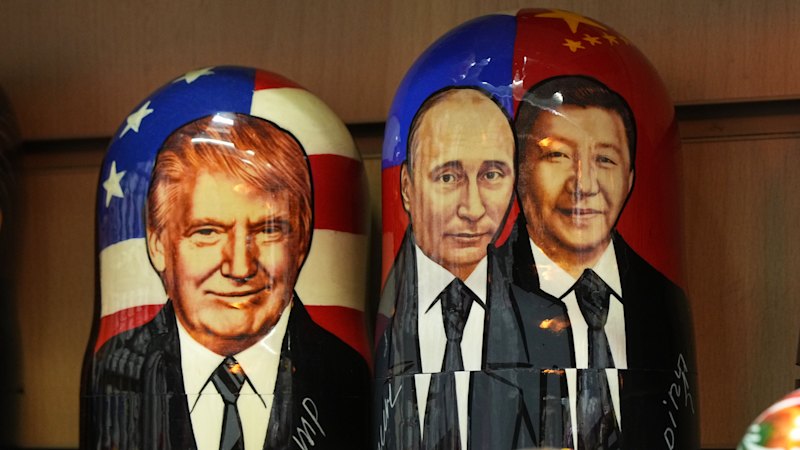
When Xi Jinping rolls out the red carpet in Beijing for both Vladimir Putin and Donald Trump, he is not hosting a victory lap over a neutered Washington. He is walking straight into the most volatile, unconstrained phase of American foreign policy. If you think a term-limited president with zero re-election incentives is weak, you fundamentally misunderstand how executive power operates in the United States.
The Myth of the Weakened Second-Term Executive
Standard diplomatic commentary relies on a comforting fiction: that a president losing domestic legislative momentum automatically loses international bargaining power. Reporters in Washington watch gridlock on Capitol Hill and project that paralysis onto the global stage.
I have watched foreign ministries burn millions of dollars and years of diplomatic capital betting on this exact miscalculation. During past administrations, European and Asian negotiators routinely stalled trade talks in year six or seven, convinced they could wait out a weakened White House or extract cheap concessions from a president desperate for a legacy win. Every single time, they misread the room.
In the American constitutional system, domestic weakness creates foreign policy aggression. When a president can no longer pass major bills through Congress, the executive branch turns inward toward the powers it owns outright: tariffs, sanctions, export controls, military deployments, and unilateral executive agreements.
A first-term president has to worry about how a trade war affects swing-state soybean farmers in Iowa or manufacturing workers in Pennsylvania. A second-term president—especially one operating post-midterms—answers to no electorate. The political guardrails vanish. What pundits call a "lame duck" is actually an unchained executive with nothing left to lose and absolute statutory authority over trade and national security.
Why Beijing Is Actually Playing Defense
Look past the choreographed handshakes in the Great Hall of the People. The conventional wisdom frames this trilateral convergence as a triumph of Chinese diplomacy, positioning Xi as the indispensable power broker bridging Moscow and Washington.
Strip away the pageantry, and Beijing's position looks far more precarious.
China's economy is still grinding through structural headwinds—a protracted property sector unwind, weak domestic consumption, and local government debt loads that restrict massive stimulus. Xi cannot afford a sudden, chaotic decoupling triggered by a White House that no longer cares about Wall Street's quarterly reactions or midterm blowback.
- Tariff Authority: Under Section 301 of the Trade Act of 1974 and the International Emergency Economic Powers Act, the U.S. president holds sweeping unilateral power to impose tariffs and block capital flows without a single vote from Congress.
- Tech Chokepoints: The Bureau of Industry and Security can tighten semiconductor and AI export controls overnight, starving Chinese tech champions of high-end compute.
- Secondary Sanctions: Treasury can threaten Chinese financial institutions handling Russian dual-use trade with exclusion from the dollar-clearing system.
Xi knows that a politically unencumbered Trump is uniquely unpredictable. Traditional diplomacy relies on predictable, institutional signaling—the kind of slow, bureaucratic statecraft practiced by career diplomats at the State Department and China's Ministry of Foreign Affairs. Trump rejects institutional signaling entirely. He treats geopolitical alliances like distressed real estate negotiations, introducing maximum uncertainty to force the counterparty to bid against themselves.
Beijing isn't welcoming a weakened rival. Beijing is trying to manage an existential risk before the White House decides to blow up the remaining pillars of U.S.-China trade.
Putin’s Real Objective in the Room
The lazy consensus also misreads Vladimir Putin's presence in Beijing. Mainstream coverage paints Putin and Xi as an unbreakable authoritarian axis, standing shoulder-to-shoulder to dictate terms to a fading American empire.
Realists like John Mearsheimer and Stephen Walt have long pointed out that great powers do not have permanent friends; they have permanent interests. Moscow and Beijing share a tactical goal—diluting American unipolarity—but their long-term strategic interests collide across Central Asia, the Arctic, and the Russian Far East.
Putin is currently the junior partner in a lopsided relationship. Cut off from Western capital and technology, Russia relies on Chinese markets for its discounted energy and Chinese factories for machine tools and microelectronics. No Russian leader wants to be a vassal to Beijing.
By engaging directly in a high-stakes Beijing summit alongside Trump, Putin isn't just celebrating Sino-Russian solidarity. He is attempting to re-establish strategic triangulation. If Putin can dangle a bilateral ceasefire framework in Ukraine, strategic arms control talks, or Arctic energy cooperation directly in front of Trump, he instantly regains leverage against Xi.
The nightmare scenario for Beijing isn't American hostility; it is a sudden bilateral deal between Washington and Moscow that leaves China isolated as America's sole primary adversary. When Nixon went to Beijing in 1972, he split Moscow and Beijing to Washington's advantage. Trump understands the mechanics of triangulation instinctively, even if he doesn't use Henry Kissinger's vocabulary.
Dismantling the "Legacy Trap" Fallacy
Ask any foreign policy analyst in Washington what drives a second-term president, and they will cite the "legacy trap"—the idea that aging leaders become desperate for a Nobel Peace Prize or a grand historical bargain, making them easy marks for hardened autocrats like Xi and Putin.
This theory assumes all leaders define legacy the same way.
Career politicians define legacy through multilateral treaties, institutional stability, and editorial praise from The New York Times and The Economist. For them, walking away from a summit without a joint communiqué feels like failure. Autocrats exploit that desperation by dragging out talks until the final hours and demanding last-minute concessions.
Trump operates on an entirely different incentive structure. His political brand was built on breaking multilateral agreements—NAFTA, the JCPOA, the Paris Accord, the INF Treaty—and walking away from tables when the terms didn't suit him, just as he did in Hanoi with Kim Jong Un in 2019.
Walking out of Beijing empty-handed costs Trump nothing with his base. In fact, blowing up a summit over unfair trade practices or fentanyl precursors plays directly to his core narrative of strength. Xi and Putin, conversely, operate in tightly controlled political systems where hosting a high-profile summit that ends in public acrimony damages domestic prestige. The asymmetric cost of failure actually favors Washington, not Beijing.
What Everyone Gets Wrong About Trilateral Diplomacy
If you are trying to understand what happens next in U.S.-China-Russia relations, stop asking who has the better domestic approval rating. Start asking who holds the structural choke points.
Does a divided U.S. Congress weaken Trump's hand in Beijing?
No. It strengthens his unilateral leverage. When Congress is gridlocked, foreign leaders know they cannot lobby Capitol Hill to soften White House policies. In the 1990s and 2000s, Beijing routinely bypassed the White House by leaning on American business lobbies and sympathetic senators to protect Most Favored Nation trading status. Today, anti-China hawkishness is the only truly bipartisan consensus left in Washington. Congress won't rescue Beijing from executive tariffs; if anything, lawmakers will push to make them permanent.
Can China and Russia replace the U.S. consumer market?
Not even close. Despite years of "de-risking" and Belt and Road expansion, the United States remains the world's premier consumer of last resort, absorbing massive trade deficits that keep export-driven economies afloat. Russia's economy is roughly the size of Italy's or Texas's. Moscow can supply Beijing with cheap oil, gas, and grain, but it cannot buy the trillions of dollars in manufactured electronics, machinery, and consumer goods that China's industrial overcapacity produces. Beijing needs access to Western markets far more than Washington needs cheap Chinese imports.
What is the biggest blind spot in this contrarian view?
Unintended escalation and alliance fracture. Relying on unilateral executive unpredictability works brilliantly for extracting short-term tactical concessions, but it terrifies American allies in Tokyo, Seoul, Taipei, and Brussels. If Trump treats mutual defense treaties as transactional bargaining chips during talks in Beijing, Japan and South Korea may hedge their bets—either by accommodating Beijing or accelerating their own nuclear weapons debates. You cannot run a purely transactional foreign policy without eroding the trust that keeps America's global alliance network intact.
How Strategists and Investors Should Read the Summit
Stop trading on the theatrical optics coming out of Beijing. State media photos of smiling leaders standing in front of flags are designed for domestic consumption, not market reality. If you manage capital, supply chains, or geopolitical risk, watch the hard operational signals instead of the diplomatic rhetoric.
- Ignore joint statements; track export control lists. Diplomatic communiqués are written in deliberately vague language meant to appease everyone and bind no one. Watch the Federal Register for new additions to the Commerce Department's Entity List and changes to tariff schedules. That is where actual policy lives.
- Watch the yuan-ruble settlement mechanics. If Beijing truly believes it is insulated from Washington's "lame duck" president, Chinese state-owned banks will openly clear Russian defense-related transactions. If major Chinese banks quietly restrict Russian payments behind the scenes, it proves Beijing still fears U.S. Treasury secondary sanctions far more than it admits publicly.
- Monitor Taiwanese defense procurement and transit diplomacy. The true barometer of whether Trump struck a grand bargain in Beijing isn't trade—it's Taiwan. If Washington quietly delays approved arms sales or restricts high-level diplomatic transits to appease Xi, the transactionalists won. If arms deliveries accelerate alongside tariff hikes, the hawks maintained control.
- Price in currency volatility, not stability. A president unconstrained by re-election cares little about the short-term shockwaves of a trade spat. Expect sharp, sudden swings in the offshore yuan (CNH) and emerging market currencies whenever bilateral talks hit a snag.
The pundits calling Trump a lame duck are reading an outdated political playbook from the 1990s. In modern geopolitics, a second-term American president with unilateral tariff authority, a bipartisan hawkish Congress behind him, and zero electoral constraints isn't a sitting target. He is a wrecking ball—and nobody in Beijing or Moscow is standing still.