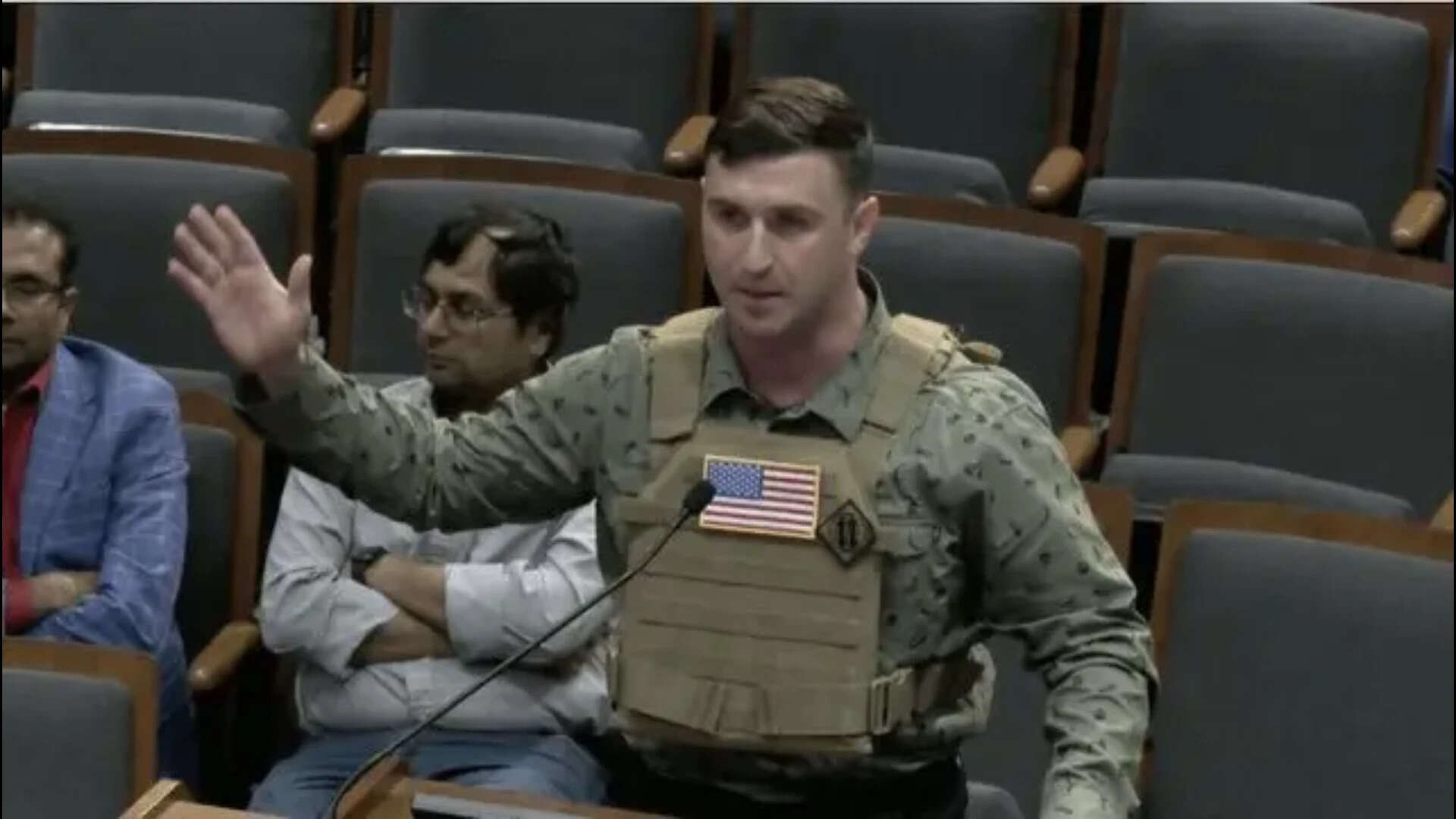
Local government meetings used to be the place you went to complain about unpaved potholes, delayed trash collection, or neighborhood zoning disputes. Not anymore. Step into a city council meeting in Frisco, Texas, and you are just as likely to walk into a full-blown culture war featuring conspiracy theories, viral outrage bait, and national political figures fighting over the demographic future of the American suburbs.
The latest escalation hit the fan during a heated public comment session. Edward Jacob Lang, a prominent conservative activist and pardoned January 6 rioter who is currently running a US Senate campaign out of Florida, took to the microphone to launch a fierce tirade against the local immigrant population.
Lang didn't hold back. He claimed that Hindus and Muslims are teaming up to take over Texas to eradicate the Christians and drive them out of their homeland. He went on to describe their countries of origin as third-world shitholes and openly yelled that if he lived in Texas, he would burn down one of these mosques before security finally escorted him out of the building.
This isn't an isolated incident of a political firebrand looking for social media clout. It is part of a massive, coordinated pushback against the changing demographics of North Texas, where the rapid growth of the Indian-American and South Asian communities has turned quiet suburbs into the epicenter of a fierce political tug-of-war.
The Boring Bureaucracy Behind the Sudden Outrage
If you look past the screaming matches and the viral video clips, the actual trigger for this specific meeting was incredibly mundane. The Frisco City Council was meeting to handle a routine procedural vote. On the agenda was the standard administrative approval for site plans involving three separate houses of worship: a mosque, a Hindu temple, and a Jain temple.
A massive crowd of more than 40 people signed up to testify, transforming a dry zoning update into a referendum on American identity.
Frisco Mayor Jeff Cheney tried to inject some reality into the room. He pointed out that the City Council wasn’t making a grand policy gesture or changing the rules on the fly. The land being discussed had been explicitly zoned to allow any place of worship for decades. Specifically, the plots for the Jain temple, the Hindu temple, and the mosque were zoned back in 1984, 1993, and 2000 respectively.
The council’s job was simply to verify if the architectural and engineering plans met the city’s standard building codes. If a project checks every box on the municipal checklist, the city is legally required to approve it. The actual policymaking happened 25 to 30 years ago, long before the current wave of residents even moved to the area.
When the Strategy to Court Suburban Voters Backfires
The friction in Frisco highlights a massive ideological fracture inside the Texas conservative movement. For the last decade, state Republicans have spent an immense amount of time, money, and political capital courting the rapidly growing Indian-American diaspora. It makes perfect sense on paper. Many Indian immigrants in the tech and medical sectors are affluent, highly educated, entrepreneurial, and hold traditional family values that align neatly with standard fiscal conservatism.
Look no further than Burt Thakur. He is a US Navy veteran, an ardent Trump supporter, and a conservative who won a seat on the Frisco City Council. Born in New Delhi, Thakur now finds himself sitting on the dais, forced to listen to a steady stream of out-of-town activists lecturing him about an alien invasion of legal immigrants.
The political strategy of building a big-tent conservative coalition is running head-first into a loud, nativist faction of the party. This group doesn't care about legal status, tax contributions, or military service. Figures like Representative Brandon Gill have openly complained on conservative platforms that areas like Frisco have been totally transformed by Asian and Islamic immigration, claiming that walking through these neighborhoods makes people feel like they are in a foreign country.
Spotting the Playbook of Local Council Hijacking
This isn't just happening in Texas, and it isn't happening by accident. There is a very specific playbook being used to turn boring local government forums into high-yield content farms for political influencers.
If you watch enough of these clips, you see the exact same patterns play out every single week.
- The Out-of-Town Surge: A significant percentage of the people driving the most aggressive public comments don't even pay property taxes in the municipality they are targeting. They travel from city to city, using the open-mic structure of public comments to deliver pre-written monologues.
- The Weaponization of Visas: Activists routinely blur the lines between illegal border crossings and high-skilled legal immigration programs like the H-1B visa. They frame legal corporate transfers and tech sector employment as a coordinated scheme to undercut American wages and manipulate local housing markets.
- The Social Media Feedback Loop: The goal isn't to convince the local city council to change a zoning law. The goal is to get a two-minute clip of a screaming match, an offensive impersonation, or a shocking statement that can be uploaded to social media to drive algorithmic engagement, follower counts, and campaign donations.
Local Indian-American residents aren't just sitting back and taking the hits anymore. Second-generation community members and local students have started showing up en masse to these meetings to push back against the standard talking points. They are actively using their time at the podium to dismantle myths about housing scams, clarify the rigorous realities of the legal immigration system, and point out the sheer economic power their households bring to the municipal tax base.
Defusing the Suburban Culture War
If you want to protect your local community from turning into a toxic, hyper-polarized battleground, you have to change how you engage with local government.
Stop consuming city council coverage through highly edited, 15-second clips on your social feed. Go directly to your city’s official website and look at the actual meeting agendas. When a controversial issue pops up, read the attached staff reports to see what the vote is actually about. Understanding whether an item is a mandatory administrative procedure or a genuine policy change completely changes the context of the debate.
Show up to the meetings, but don't take the bait. The individuals trying to disrupt these forums thrive on loud counter-protests, dramatic walkouts, and emotional shouting matches. The most effective way to neutralize an inflammatory speaker is to counter them with dry, undeniable facts, concrete economic data, and a calm, professional presence at the microphone.
Reach out to your local elected officials outside of the high-drama environment of a Tuesday night voting session. Write concise, polite emails or schedule brief meetings with your council members to express your support for fair, legally compliant local governance. When local leaders know they have a quiet, rational majority of actual residents backing them up, they are far less likely to be intimidated by the loud, out-of-town political theater that dominates the public comment microphone.