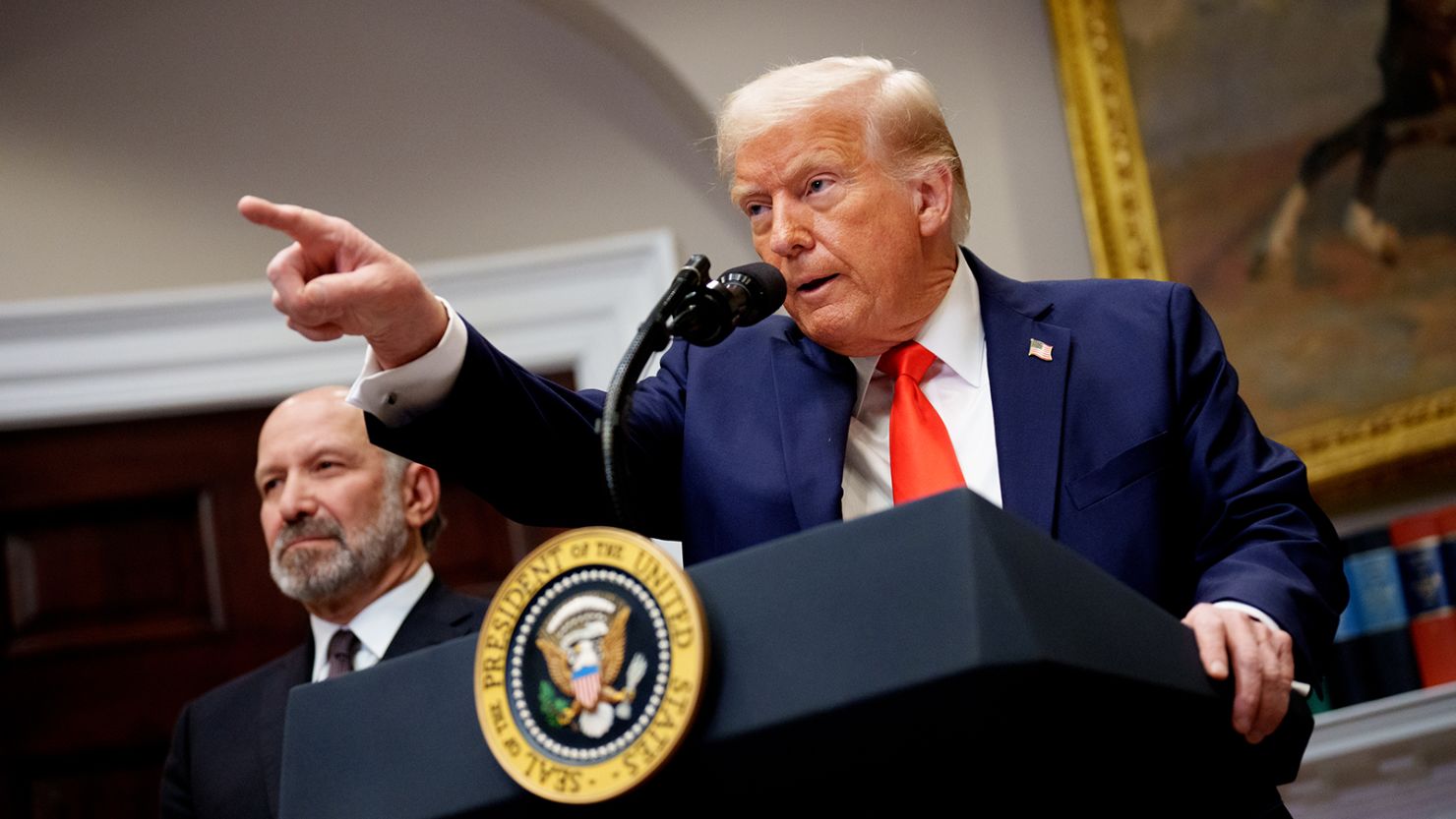
Donald Trump is betting the global economy on a contradiction. By claiming he can resolve the long-standing hostility with Iran "peacefully or otherwise" while simultaneously predicting a massive drop in inflation, the former president is signaling a return to a high-stakes geopolitical doctrine that treats war and markets as a single, fluid negotiation. This isn't just campaign rhetoric; it is a fundamental shift in how the United States approaches the Middle East, moving away from managed containment and toward a "shock and awe" style of economic diplomacy.
The core premise is simple. Trump argues that a decisive resolution to the Iran conflict—whether through a new, more restrictive deal or a definitive military conclusion—would remove the "geopolitical risk premium" that has kept oil prices volatile for decades. He believes that by ending the threat of Iranian interference in the Strait of Hormuz, global energy markets will stabilize at a lower baseline, effectively crushing inflation at its source.
The Oil Price Paradox
Energy markets do not like uncertainty. When Trump speaks of winning "peacefully or otherwise," he is intentionally leaning into that uncertainty to force a concession. This is the "Madman Theory" applied to 21st-century macroeconomics. If the market believes a hot war is imminent, prices spike. However, if the market believes one side will win quickly and decisively, it begins to price in a post-conflict era of stability.
The mechanics of this are tied to the global supply chain. Iran currently exports roughly 1.5 million barrels of oil per day, mostly to China. Under a "maximum pressure" 2.0 scenario, the goal isn't just to stop those exports, but to replace them with increased domestic production from the United States and Saudi Arabia. Trump’s theory suggests that a neutralized Iran would allow for a more cooperative OPEC+, leading to a flood of cheap energy that would drive down the cost of everything from shipping to plastic manufacturing.
The Cost of Cold Wars
We have lived in a state of proxy conflict with Tehran since 1979. This "Cold War" in the desert has a hidden tax. Every time a tanker is seized or a drone strikes a refinery, the price of a gallon of gas in Ohio or a liter of diesel in Berlin ticks upward.
- Shipping Insurance: Rates for transit through the Persian Gulf can double overnight during periods of high tension.
- Defense Spending: The U.S. maintains a massive naval presence in the region solely to keep sea lanes open.
- Market Speculation: Hedge funds bet on chaos, driving up futures prices even when physical supply remains steady.
By suggesting he can "win" this conflict, Trump is promising to eliminate this tax. It is a bold claim, especially given that military interventions rarely result in the immediate price drops politicians promise.
The Inflation Gambit
Inflation is the most potent political weapon in the modern world. Trump knows this. By linking a potential conflict with Iran to the price of eggs and milk at home, he is attempting to reframe "war" from a costly foreign entanglement into a domestic economic solution.
The logic follows a specific path. High energy costs are the primary driver of the Consumer Price Index (CPI). If energy prices fall, the cost of transporting goods falls. When transportation costs fall, retailers can lower prices while maintaining margins. It is a domino effect that looks great on paper but faces significant friction in reality.
Why Peacefully Might Not Work
Negotiating a "better deal" with Tehran assumes the Iranian leadership is willing to capitulate on its nuclear ambitions and regional influence in exchange for sanctions relief. History suggests otherwise. The Iranian economy has proven remarkably resilient to isolation. They have built a "resistance economy" that relies on gray-market oil sales and deep ties with Moscow and Beijing.
If a peaceful resolution fails, the "otherwise" becomes the focus. A military escalation would, in the short term, send oil prices to record highs. To mitigate this, a Trump administration would likely have to coordinate a massive release from the Strategic Petroleum Reserve while simultaneously deregulating the American fracking industry to its absolute limits.
The Regional Power Shift
You cannot discuss Iran without discussing the Abraham Accords. This is the structural backbone of Trump’s Middle East policy. By aligning Israel with Gulf monarchies like the UAE and Bahrain, the U.S. created a bloc designed to isolate Iran.
This alliance is built on shared economic interests as much as security. A "post-war" Iran—or a neutralized Iran—would allow for the construction of pipelines and trade routes that currently have to bypass the Persian Gulf. We are talking about an integrated Middle Eastern economy that looks more like the EU than the fractured region we see today.
The Saudi Factor
Riyadh is the silent partner in this strategy. For the "inflation drop" to happen, Saudi Arabia must be willing to turn on the taps. In previous years, the relationship between Trump and Crown Prince Mohammed bin Salman was characterized by a transactional understanding. If the U.S. provides the security umbrella against Iran, Saudi Arabia provides the price stability for oil.
However, the world has changed since 2020. Saudi Arabia is now pursuing its "Vision 2030" and has shown a willingness to cooperate with Russia through OPEC+ to keep prices high enough to fund their massive domestic projects. Trump’s plan requires breaking that Russian-Saudi bond or offering the Saudis something even more valuable than high oil prices—total regional dominance.
The Risk of Miscalculation
The "otherwise" in Trump’s statement is the variable that keeps analysts up at night. A conflict with Iran would not be a localized affair. It would involve the Hezbollah network in Lebanon, the Houthis in Yemen, and various militias in Iraq. This is the asymmetric threat that the traditional economic model fails to account for.
If the "peaceful" route fails and the U.S. pivots to a military solution, the disruption to global trade could be catastrophic before it ever becomes beneficial. The Suez Canal and the Strait of Hormuz are the jugular veins of the global economy. If they are constricted, even for a few weeks, the resulting supply chain shock would make the post-COVID inflation look like a minor correction.
The China Variable
China is Iran's biggest customer. Any attempt to "win" against Iran, peacefully or otherwise, is a direct challenge to Beijing’s energy security. If Trump moves to completely block Iranian oil exports, he is effectively imposing a massive secondary sanction on China. This would likely trigger a trade war that could negate any deflationary gains from lower oil prices.
- Currency Wars: China could respond by devaluing the Yuan.
- Resource Hoarding: Beijing could restrict exports of rare earth minerals used in American technology.
- Diplomatic Friction: A total collapse of U.S.-China relations would ensure that global markets remain in a state of permanent turmoil.
The Domestic Production Shield
To make this strategy work, Trump would need to turn the United States into the world's undisputed energy hegemon. This means removing all barriers to drilling, refining, and exporting. The goal is to make the U.S. "energy independent" in a way that doesn't just mean we produce what we consume, but that we produce enough to dictate the global price.
When the U.S. is the swing producer, the geopolitical power of Iran evaporates. This is the "peaceful" path Trump is actually betting on. If he can make Iranian oil irrelevant through American abundance, the Iranian regime loses its only leverage.
Refineries and Regulations
It isn't just about pulling oil out of the ground. The U.S. hasn't built a major new refinery in decades. To truly lower inflation through energy, the entire downstream infrastructure must be overhauled. This requires a level of deregulation that would face massive legal and environmental challenges.
The "inflation drop" Trump forecasts is predicated on the idea that the market will react to the potential of this new energy era. Markets are forward-looking. If they see a path toward $40 or $50 a barrel oil, they will begin to adjust prices long before the first new refinery is even built.
The Hidden Deflationary Engine
There is another factor at play here: the dollar. A "strongman" foreign policy often leads to a flight to quality. Investors flock to the U.S. Dollar when global tensions rise. A stronger dollar makes imports cheaper, which is naturally deflationary for the American consumer.
However, a dollar that is too strong can hurt American exports and cause debt crises in emerging markets. It is a delicate balance. Trump’s "America First" approach suggests he is willing to accept some global instability if it results in lower costs for the American voter.
The Realism of "Winning"
Can you actually "win" a war against a nation-state like Iran? If winning means regime change, the cost would be trillions of dollars and a decade of occupation—a scenario that would be hyper-inflationary. If winning means a total blockade and neutralization of their regional proxies, the cost is lower but the risk of a "black swan" event is higher.
The most likely outcome of a Trump victory in this arena is not a hot war, but a forced realignment. He is betting that the threat of "otherwise" will be so credible that Tehran, faced with total economic collapse and a regional alliance against them, will choose the peaceful path.
The Strategic Bottom Line
Trump’s forecast of an inflation drop after an Iran conflict is based on a "hard reset" of the Middle East. He views Iran as the friction point in the global machine. Remove the friction, and the machine runs smoother and cheaper.
This strategy ignores the human and diplomatic costs that have traditionally guided U.S. policy. It treats the Middle East as a ledger of assets and liabilities rather than a complex web of history and religion. If he is right, he could usher in a period of low-cost energy and relative stability. If he is wrong, he could trigger a global depression and a regional war that lasts for a generation.
The markets are currently pricing in a "wait and see" approach. But as the election cycle nears its peak, the volatility in energy futures tells a different story. Traders are beginning to realize that the era of "managed decline" in the Middle East is over. Whether it is replaced by a peaceful prosperity or a chaotic conflict depends entirely on whether Trump’s "otherwise" is a bluff or a promise.
Success in this arena requires more than just tough talk. It requires a level of coordination with global allies and domestic producers that has rarely been seen. The American voter is being asked to bet that a more aggressive posture abroad will lead to a cheaper life at home. It is the ultimate "guns or butter" gamble, and the stakes have never been higher.
Demand for cheap energy is the only thing that outweighs the fear of war in the modern political mind. By promising both—victory and lower prices—Trump is tapping into a deep-seated desire for a return to a world where American power ensures American prosperity. The reality, as always, will be significantly more complicated.
The path to lower inflation through geopolitical dominance is paved with risks that no economist can fully model. It requires a perfect alignment of oil production, diplomatic pressure, and military deterrence. If any one of those pillars fails, the entire structure collapses, taking the global economy with it.
Stop looking at the tweets and start looking at the tankers. The movement of oil in the Persian Gulf over the next 24 months will tell you more about the future of the U.S. economy than any Federal Reserve report ever could. The war, "peaceful or otherwise," has already begun in the futures markets. Trump is simply the first one to say it out loud.