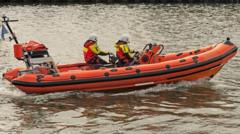
Altruistic intervention in aquatic emergencies routinely yields a counterintuitive and tragic outcome: the extraction of the original victims alongside the mortality of the rescuers. This phenomenon was documented at Seaton Carew beach in Hartlepool on July 12, 2026, when two men entered the North Sea to assist two children in distress. While the children were successfully rescued and stabilized at a hospital, both adult interveners succumbed to the environment despite rapid extraction and immediate medical treatment by the Royal National Lifeboat Institution (RNLI) and the North East Ambulance Service.
This operational breakdown analyzes the structural mechanics behind the Bystander Drowning Paradox. By evaluating the biophysical strains of sudden aquatic entry during heatwaves and the behavioral economic principles that dictate flawed risk calculations, we can systematically deconstruct why untrained rescue attempts exhibit such high failure rates for the rescuer.
The Biophysical Strains of Sudden Aquatic Entry
The incident occurred during an extended UK heatwave, where ambient air temperatures exceeded 30°C. This creates a severe thermal gradient between the atmosphere and the surrounding open water. The human physiological response to this gradient is governed by two distinct mechanisms that drastically impair physical capacity within seconds of immersion.
Cold Water Shock and the Respiratory Gasp Reflex
Even during prolonged summer heatwaves, coastal waters around the UK maintain low baseline temperatures, typically ranging from 12°C to 15°C. When a human body accustomed to 30°C air undergoes sudden immersion, the rapid cooling of skin receptors triggers an involuntary cardiac and respiratory reflex arc.
- Involuntary Hyperventilation: The immediate response is a gasp reflex followed by uncontrolled tachypnea (rapid breathing). If a rescuer's mouth is cleared by less than a few inches of turbulent surf, this hyperventilation leads to immediate aspiration of seawater.
- Vasoconstriction and Cardiac Stress: Peripheral blood vessels constrict instantly to preserve core thermal energy. This shifts blood volume to the thoracic cavity, driving a spike in blood pressure. For individuals under intense physical exertion, this acute workload increase can induce sudden cardiac arrhythmia.
The Divergent Autonomic Conflict
Entering surf to conduct a rescue requires immediate, high-intensity physical exertion, which stimulates the sympathetic nervous system, driving up the heart rate. Simultaneously, immersion of the face in cold water triggers the trigeminal nerve, activating the parasympathetic diving reflex, which attempts to slow the heart rate down.
This conflicting neurological signaling—demanding tachycardia and bradycardia simultaneously—creates an unstable cardiac environment. The resulting autonomic conflict significantly degrades muscular efficiency and stroke volume, exhausting the rescuer before they even reach the target location.
The Behavioral Economics of Flawed Risk Calculation
Untrained bystanders rarely perform a calculated risk assessment before entering dangerous surf. Instead, their choices are governed by cognitive biases that obscure the true boundary limits of human physical performance.
[Perceived Crisis] ---> (Hyper-Altruistic Surge) ---> [Immediate Action]
                                                             |
[Physical Reality] <--- (Asymmetric Capabilities) <-----------+
The Hyper-Altruistic Surge
When a bystander witnesses a child in distress, the psychological cost of inaction is perceived as infinitely high. This triggers a hyper-altruistic surge that overrides the standard survival instinct. In behavioral economics, this is a severe manifestation of present bias, where the immediate emotional compulsion to alter the visible scene outweights a realistic evaluation of secondary risks.
Asymmetric Hydrodynamic Capabilities
A critical flaw in bystander intervention is the failure to distinguish between pool swimming competency and open-water survival capability. Open-water environments introduce dynamic variables that completely invalidate standard swimming strokes:
- Rip Currents: Narrow channels of fast-moving water that move away from the shore. Attempting to swim directly against a rip current exhausts an athlete within minutes.
- Wave Energy and Turbidity: Breaking waves reduce the oxygen content of the surface air-water interface, meaning a rescuer inhales a high proportion of spray rather than clean air.
- Towing Resistance: Managing the deadweight of another human being increases fluid drag exponentially. A swimmer operating near their maximum aerobic capacity will cross their anaerobic threshold almost instantly when attempting to pull a second person through breaking surf.
Because the children survived while the adult rescuers perished, it is highly probable that the adults expended their total remaining metabolic reserves keeping the children buoyant or pushing them toward safety, leaving zero reserve capacity to combat the hydrodynamic forces acting on themselves.
Systemic Vulnerabilities in Public Safety Frameworks
The Hartlepool fatalities are not isolated incidents; they represent a predictable spike within a broader seasonal pattern. Data from the UK Health Security Agency (UKHSA) and water safety organizations outlined a steep rise in open-water fatalities during the mid-2026 heatwaves, including multiple teenager drownings at Dovestone Reservoir and Darley Abbey Mills.
These repeating tragedies highlight structural limitations in current public safety infrastructure.
The Limits of Emergency Response Latency
Emergency services arrived at Seaton Carew at approximately 3:45 pm, deploying an integrated team of Cleveland Police, HM Coastguard, the RNLI, and ambulance crews. Despite a highly coordinated, professional extraction, the window of survival in open-water drowning is exceptionally narrow.
Once a rescuer's airway is compromised and hypoxia sets in, irreversible neurological and cardiac degradation occurs within four to six minutes. Even if an RNLI vessel extracts a victim within ten minutes of submersion, the physiological toll of cold-water immersion and massive seawater aspiration frequently defeats advanced life support interventions. Public safety frameworks cannot rely solely on reactive rescue assets; the latency period is fundamentally too long.
The Ineffectiveness of Absolute Prohibition Messaging
Following the incident, local authorities reiterated standard advice: encourage the public to refrain from entering open water entirely. From a behavioral science perspective, absolute prohibition messaging fails during extreme heat events. When urban and coastal populations face severe thermal discomfort, the immediate cooling utility of open water consistently overrides abstract, signposted warnings.
The Strategic Framework for Bystander Intervention
To reduce the incidence of double-drowning tragedies, public safety frameworks must shift from unrealistic zero-tolerance mandates to a structured, tiered protocol for bystander behavior. If an individual encounters an aquatic emergency, they must execute an operational checklist designed to maximize victim survival while preserving their own safety.
1. Maintain Shoreline Position and Secure Floatation
A bystander must never enter the water without a dedicated, high-buoyancy flotation device. If no rescue tube, life ring, or improvised float (like a surfboard or cooler) is available, the bystander must remain on land. Entering the water empty-handed simply adds another casualty to the scene, dividing the focus of incoming professional rescue assets.
2. Leverage Dynamic Surveillance
The bystander's primary value lies in maintaining a continuous line of sight on the victims. Rip currents and lateral drifts can move a distressed swimmer dozens of meters in a few minutes. When professional lifesavers arrive, having a shore-based spotter pointing directly at the target location reduces search latency to zero, saving critical minutes.
3. Implement the Reach, Throw, Row Protocol
Direct swimming contact is the final, most dangerous option in any life-saving matrix. Rescuers should systematically exhaust safer extraction methodologies first:
- Reach: Extend clothing, branches, or poles from a secure structure or shallow wading position.
- Throw: Deploy a throw bag, life ring, or buoyant object directly to the victim to provide immediate resting buoyancy.
- Row: Utilize a watercraft (kayak, paddleboard, or boat) to close the distance, keeping a physical barrier between the rescuer and the panicked victim.