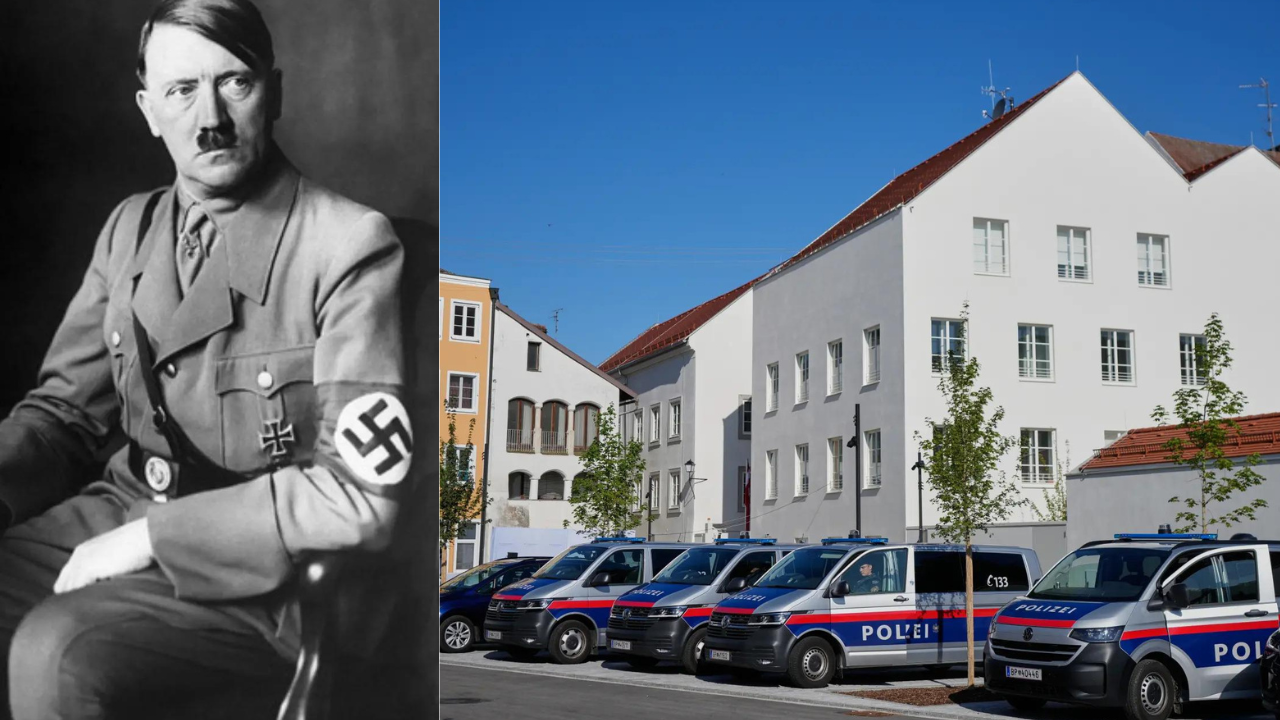
Austria is turning the yellow three-story building where Adolf Hitler was born into a regional police headquarters. The ministry of the interior insists that housing law enforcement at Salzburger Vorstadt 15 in the border town of Braunau am Inn will neutralize the site forever, stripping away its pull for far-right extremists. It is an administrative solution to a profound historical nightmare. By occupying the structure with uniformed officers and adding a human rights training module for recruits, state officials claim they are transforming a symbol of tyranny into a safeguard of democracy.
Yet this strategy of state-enforced normalization raises a troubling question. Is Austria taking responsibility for its totalitarian history, or is it simply attempting to pave over it with municipal bureaucracy?
The decision follows decades of hesitation, legal warfare, and public embarrassment. For generations, the Austrian government paid premium rent to a private owner just to ensure the building sat vacant. When that arrangement collapsed into a bitter court battle, parliament took the unprecedented step of expropriating the property. Now, after years of architectural competitions and bureaucratic debates, heavy machinery is altering the facade.
A Century of Contested Brick and Mortar
Adolf Hitler spent only the first few months of his life in an apartment on the upper floor of the building, then an inn called the Gasthof zum Pommer. That brief occupancy was enough to stain the town of Braunau for more than a century.
During the Third Reich, the Nazi party purchased the building, converted it into a cultural center, and turned the street into a pilgrimage route. After the Second World War, American forces briefly used the site before returning ownership to the original local family, the Pommers.
For decades, the Austrian interior ministry leased the building from Gerlinde Pommer. The state paid thousands of euros each month to prevent the owner from selling to an ideological buyer or making alterations that could attract unwanted attention.
The strategy was passive containment.
The building housed a workshop for adults with disabilities until 2011, when Pommer refused to allow renovations required for accessibility standards. The site sat empty. Windows were shuttered. Neo-Nazis continued to travel to the quiet town, taking discreet photographs outside the unmarked facade. The state was paying roughly 4,700 euros a month to guard a silent shell.
The gridlock ended in 2016 when the Austrian parliament passed a custom law to expropriate the house from Pommer. A prolonged legal fight over compensation followed, ending with Austria’s supreme court ordering the government to pay 812,000 euros to the former owner. The state finally held the keys. It had no clear plan for what to do with them.
Neutralization or State-Sponsored Amnesia
The interior ministry assembled a commission of historians, political scientists, and government officials to decide the building's future. Their mandate was clear: prevent the location from serving as a shrine or a gathering point for right-wing extremists.
The winning concept came from Vorarlberg-based architectural firm Marte.Marte. Their plan strips away visual alterations made during the Nazi period, returning the exterior to a simple, late nineteenth-century appearance. The building will receive a uniform facelift, losing any distinct architectural features that might evoke its darkest chapter.
That is precisely what worries critical historians and memory workers.
neutralization sounds like a clinical, sensible objective on paper. In practice, wiping away the physical markers of a site's history risks creating a convenient silence. By placing a police station inside, the government uses state power to declare the matter settled. Police officers will park their cruisers where pilgrims once gathered, effectively putting the building off-limits to the public.
Consider a hypothetical comparison. If a city attempted to resolve the historical burden of a former secret police interrogation center by turning it into a routine tax assessment office without any public access or historical context, citizens would view it as an effort to avoid uncomfortable questions. The government would be using mundane administration to bury a difficult reality.
Opponents of the current plan argue that an active educational center, a museum dedicated to the perpetrators of National Socialism, or an international human rights institute would have served a far higher purpose. Such an institution would force visitors to confront the mechanisms of totalitarianism directly. Instead, the current blueprint keeps the public outside the gates.
The Myth of the First Victim
To understand why the police station plan gained such momentum inside government ministries, one must look at Austria’s complex relationship with its twentieth-century history.
For decades after 1945, the official national narrative framed Austria as the first victim of Adolf Hitler’s aggression. The nation pointed to the 1938 Anschluss, the annexation of Austria into the German Reich, as an act of external conquest. This narrative allowed the post-war republic to avoid the painful process of national self-examination that West Germany was forced to undergo.
The reality was far darker. Countless Austrians welcomed the annexation with open enthusiasm. Austrians served in disproportionate numbers in the SS, managed concentration camps, and enforced the machinery of the Holocaust.
It was not until 1991 that Chancellor Franz Vranitzky publicly acknowledged Austrian complicity in the crimes of the Nazi regime.
The drive to neutralize the Braunau site reflects traces of that older impulse to move on. By converting the house into an operational government office, the state attempts to close a chapter rather than engage with its contents. It replaces a difficult national discussion with a concrete renovation project.
The memorial stone sitting on the sidewalk outside the building highlights this tension. Cut from granite taken from the quarry at the Mauthausen concentration camp, the stone reads: "For Peace, Freedom, and Democracy. Never Again Fascism. Millions of Dead Warn Us."
Under initial government proposals, this stone was to be removed or relocated to a museum in Vienna, on the grounds that it conflicted with the concept of complete neutralization. Local protests forced the ministry to back down, ensuring the granite block remains on the pavement in Braunau. The stone now stands as a lone counter-voice to the neutral facade behind it.
Security Concerns versus Historical Responsibility
Security officials defend the police station plan with pragmatic logic. They point out that any open memorial, museum, or exhibition space would require constant, heavy security to guard against vandalism, far-right rallies, and counter-demonstrations.
A police station, by its very nature, provides built-in security. No far-right group can organize a rally on the doorstep of an active police facility without immediate intervention.
Security logic is efficient. It solves a police problem with a police presence.
Yet this approach mistakes security management for historical reflection. Protecting a perimeter is not the same as educating a society. When a government prioritizes physical containment over public engagement, it chooses the path of least political resistance.
Anti-fascist organizations in Upper Austria have consistently criticized the plan. They point out that placing police officers in the building creates a strange symbolic paradox. The police represent the monopoly on state violence. Transforming the origin point of a totalitarian dictator into a command center for armed agents of the modern state creates an uncomfortable ideological overlap, no matter how democratic the modern Austrian republic may be.
The government attempted to address this criticism by announcing that the regional police headquarters will host regular human rights training sessions for officers. While training police in constitutional rights is a noble endeavor, using it to justify the location of an administrative office feels like a late addition designed to silence critics.
The Failure of the Neutralization Doctrine
History is rarely erased by architectural redesign.
The idea that changing a roofline and plastering over a facade will cause people to forget what happened inside a building relies on a fundamental misunderstanding of memory. In the digital age, mapping tools, online forums, and historical databases render physical neutralization obsolete. Anyone with a smartphone knows the precise coordinates of Salzburger Vorstadt 15. A new coat of paint will not alter the search results.
By attempting to make the building invisible, the Austrian government may inadvertently ensure it remains a point of contention. The construction work itself has drawn fresh international scrutiny to Braunau am Inn, forcing the very debate the authorities hoped to avoid.
The debate over the house in Braunau is not an isolated event. Across Europe, governments are wrestling with how to handle physical structures connected to twentieth-century atrocities. From fascist headquarters in Italy to totalitarian monuments across Eastern Europe, the central question remains the same: Do you preserve these sites as warnings, demolish them to prevent worship, or repurpose them for administrative utility?
Demolition was considered for the Braunau house, but experts warned that destroying the building would be viewed as an attempt to deny history. Complete demolition would have created a void that far-right groups could fill with mythologies of martyrdom.
Repurposing was the chosen path, but the specific form of repurposing reveals a preference for administrative control over historical engagement.
What the Building Leaves Behind
The renovation project in Braunau am Inn is expected to cost over twenty million euros by the time work is fully completed. Contractors will restructure the interior, install modern communications infrastructure, and establish offices for district law enforcement officers.
The physical structure will survive. The memory will persist. What will be lost is an opportunity to build an active, confronting space that forces successive generations to confront how ordinary towns give rise to extraordinary evil.
Converting a dictator’s birthplace into a police station does not solve the problem of memory. It simply puts a uniform on it.


