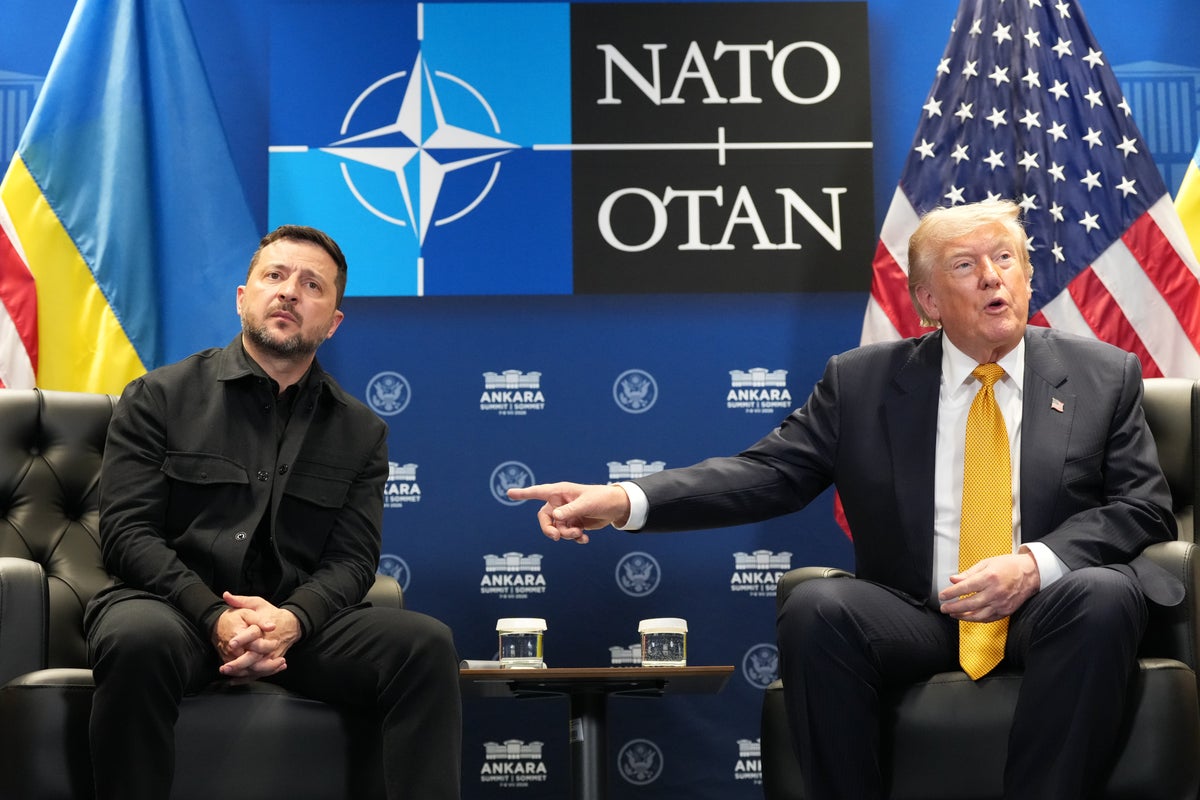
While U.S. President Donald Trump and Ukrainian President Volodymyr Zelenskyy flashed broad smiles and touted a very good relationship at the recent NATO summit in Ankara, a devastating disconnect is widening on the ground in Ukraine. For all the theater of diplomatic breakthroughs, the cold data reveals an uncomfortable reality: ordinary Ukrainians have almost entirely lost faith in American leadership. A recent Gallup poll shows Ukrainian approval of Washington has plummeted to a historic low of just 7 percent, down from 66 percent at the start of the full-scale war. The political elite in Kyiv may be forced to play along with the White House's transactional diplomacy to keep the weapons flowing, but the citizens enduring the daily bombardment see a transactional betrayal.
The diplomatic performance art reached its peak in Turkey when Trump announced that Washington would grant Kyiv a license to manufacture Patriot missile interceptors locally. It sounded like a massive victory for Ukraine. Yet, under the surface, this agreement exposes the true nature of the current Washington-Kyiv dynamic. It is no longer an alliance built on shared democratic values, but rather a corporate-style vendor agreement where Ukraine must pay its own way through third-party NATO buyers.
The Mirage of the Ankara Breakthrough
The warm rhetoric in Ankara was designed to erase the memory of the disastrous, fiery confrontation between Trump and Zelenskyy in the Oval Office the previous year. During that closed-door meeting, which ended abruptly without a resolution, the Trump administration attempted to force an immediate ceasefire and freeze the front lines without offering concrete security guarantees. When Zelenskyy balked, Washington temporarily frozen intelligence sharing and military aid.
The new agreement to allow Ukraine to build its own Patriot interceptors is a direct consequence of that clash. To the casual observer, it looks like a sign of deepening trust. To defense insiders, it is an exit strategy for American taxpayers.
By shifting to the Prioritized Ukraine Requirements List system, the White House has effectively outsourced Ukraine's defense to Europe. Other NATO allies now buy the American weapons, and Ukraine is left to manufacture what it can on its own war-torn territory. It is a brilliant political move for a U.S. administration determined to boast that no new direct aid legislation has been passed since returning to power. But for a factory worker in Dnipro or a soldier in a trench near Pokrovsk, a manufacturing license does not stop a Russian ballistic missile today.
What the Seven Percent Means on the Ground
National mood cannot be sustained on optics alone. The staggering collapse of U.S. approval from 66 percent to 7 percent within four years is the sharpest decline Gallup has ever recorded in any nation. This is not a subtle shift in public opinion; it is a total collapse of trust.
Ukrainians remember when Washington promised to stand with them for as long as it takes. They watched as that promise dissolved into partisan bickering, month-long delays in ammunition deliveries, and explicit restrictions on their ability to defend themselves.
Even though the White House eventually relented on letting Ukraine use long-range missiles inside Russian territory, the initial hesitation cost thousands of lives and allowed Moscow to fortify its positions. The subsequent refusal to provide Tomahawk cruise missiles further cemented the view in Kyiv that Washington wants Ukraine to survive, but not to win.
This exhaustion has fundamentally altered how Ukrainians view the conflict. Today, 66 percent of adults say Ukraine should seek to negotiate an end to the war as soon as possible, a complete mirror image of the 73 percent who demanded fighting until total victory at the start of the invasion. They are not giving up because they approve of Vladimir Putin; they are shifting because they realize the international support they were promised is a volatile, transactional commodity dependent on the whims of the American electoral cycle.
The Mineral Wealth Undercurrent
The transactional nature of the relationship is hidden in plain sight. Before the Oval Office relationship disintegrated last year, negotiations were underway for the Ukraine-United States Mineral Resources Agreement.
The United States has its eyes on Ukraine's vast, untapped reserves of rare-earth minerals, lithium, and titanium. Zelenskyy's government offered to stake half of all future revenues from these resources into a joint investment fund to rebuild the country in exchange for immediate, ironclad security guarantees. Washington, however, wanted the resources without the liability of a formal defense pact.
When Vice President JD Vance told Zelenskyy that the path to prosperity meant engaging in diplomacy rather than demanding endless military backing, the message was clear. Ukraine was expected to act like a corporation, offering up its natural wealth to secure the favor of an American administration that views geopolitical alliances through the lens of a balance sheet.
Europe Steps into the Vacuum
While Washington congratulates itself on brokering manufacturing licenses and avoiding new spending, continental Europe has been forced to shoulder the real burden. European nations have significantly increased their financial and military commitments, collectively outpacing the United States in total aid delivered since the shift in White House policy.
This has created a bizarre, fragmented reality for the Ukrainian defense forces. They are relying on European cash to buy American hardware through complex bureaucratic workarounds, all while their own factories attempt to build high-tech missile defense components under constant threat of Russian drone strikes.
U.S. Aid Allocation Status (as of 2026)
---------------------------------------
Disbursed:                   $116 Billion
Obligated but Undisbursed:   $62 Billion
Appropriated / Unobligated:  $12 Billion
Expired:                     $4 Billion
The data from the Special Inspector General for Operation Atlantic Resolve shows that while billions of dollars appropriated during the previous U.S. administration are still slowly trickling through the pipeline, the well has effectively run dry for new American funding.
The Illusion of a Quick Peace
The core of the very good relationship celebrated in Ankara is Trump's insistence that a deal to end the war is on the horizon. He has consistently branded himself as the ultimate dealmaker who can stop the bloodshed in twenty-four hours.
But the people living under the sirens are deeply skeptical. Only 5 percent of Ukrainians believe it is very likely that active fighting will come to a lasting end within the next twelve months. They know that any peace brokered without explicit, hard security guarantees is simply a intermission for the Russian military to regroup, rearm, and strike again.
By treating the war as a personal dispute that can be settled over a handshake with Putin, Washington ignores the structural reality of the Kremlin's existential campaign against Ukrainian statehood. The smiles on the stage in Turkey cannot mask the smell of burning infrastructure in Kyiv, where residents were digging through the rubble of a ballistic missile strike just days before the summit. Ukraine will keep smiling for the cameras because it has no choice; it needs the interceptor licenses to survive. But the trust is gone, buried under a 7 percent approval rating that should haunt American strategists for a generation.