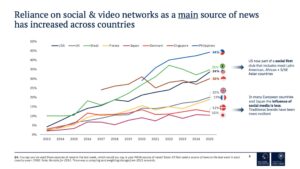
The legacy news media is facing an existential crisis of authority because it confuses institutionally verified credibility with human believability. While newsrooms spend millions maintaining fact-checking apparatuses, editorial boards, and compliance standards to secure their credibility, independent creators are capturing the public’s trust using a completely different currency. That currency is raw, unvarnished believability. Audiences no longer trust top-down pronouncements simply because a legacy brand name is attached to them. They trust individuals who show their work, admit their biases, and speak like actual human beings rather than corporate entities.
To fix this, journalism must dismantle its aloof, objective facade and adopt the radical transparency that makes independent creators so compelling. This does not mean abandoning factual rigor. It means changing how journalists communicate that rigor to an audience that has grown deeply cynical of institutional messaging.
The Broken Metric of Institutional Credibility
For decades, news organizations relied on a closed ecosystem to define their worth. Credibility was a corporate asset built on credentials, access, and expensive infrastructure. If a reporter had a press pass from a major metropolitan daily, a degree from an Ivy League journalism school, and a team of copy editors backing them up, the public accepted their output as truth.
That era is over. The democratization of distribution channels stripped away the monopoly on access. Now, the traditional markers of credibility frequently trigger suspicion rather than trust.
Consider how a modern audience consumes a breaking news event. A legacy outlet publishes an unsigned editorial or a heavily sterilized report written in the traditional, detached third-person voice. The language is focus-grouped, risk-averse, and scrubbed of any personality. To a media-literate viewer, this does not signal objectivity. It signals compliance with corporate interests or hidden editorial agendas.
Meanwhile, an independent creator covers the exact same event from a spare bedroom. They look directly into a camera. They explain what they know, openly admit what they do not know, and lay out their personal perspective on the matter. They do not pretend to be a neutral observer floating above human affairs. They are in the mud with the audience.
The creator wins this battle every single time. They win because they have established believability, which is rooted in perceived honesty, consistency, and vulnerability. Credibility is a resume; believability is a relationship. Newsrooms are losing audiences because they keep flashing their resumes at people who are looking for a human connection.
The Strategic Advantage of Showing the Mistakes
The absolute terror of making a public error paralyzes traditional newsrooms. When a legacy outlet makes a mistake, the standard operating procedure is to bury a tiny correction at the bottom of a webpage hours or days later, hoping nobody notices. This practice destroys trust. It creates the impression of a priesthood attempting to maintain an illusion of infallibility.
Creators handle errors completely differently. A successful independent commentator who misstates a fact will often pin a comment to the top of their video, address the error in the first thirty seconds of their next broadcast, or issue a self-deprecating correction on social media within minutes.
They turn their fallibility into a trust-building exercise.
Institutional Correction Strategy:
[Detect Error] -> [Legal/Editorial Review] -> [Quietly Update Text] -> [Post Micro-Correction] = Audience feels deceived

Creator Correction Strategy:
[Detect Error] -> [Immediate Public Admission] -> [Explain How It Happened] -> [Correct It Live] = Audience feels respected
By owning the mistake loudly, the creator demonstrates that their commitment to the truth outweighs their commitment to their own ego. The audience sees the corrective mechanism in real time. This transparency makes the creator far more believable the next time they break a story. Newsrooms must adopt this aggressive honesty. If a reporter gets a detail wrong, the correction should be as prominent as the original error, not hidden away like a dirty secret.
The Myth of the View from Nowhere
Mainstream journalism remains addicted to the concept of absolute objectivity, often referred to by media critics as the "view from nowhere." This is the practice of reporting on highly contentious issues without dropping a hint that the reporter possesses a personal worldview, a background, or human emotions.
It is an act. Everyone knows it is an act.
Audiences are highly attuned to the subtle ways bias manifests in traditional reporting. They see it in the selection of sources, the framing of headlines, and the adjectives chosen for a broadcast script. When a news organization pretends it has no bias, the audience feels insulted. They assume the outlet is trying to manipulate them under the guise of neutrality.
Creators bypass this entirely by leaning into their biases. A technology creator might start a review by stating plainly that they own stock in the company they are covering, or that they have a personal preference for a specific operating system.
This disclosure does not invalidate their opinion. It contextualizes it.
Once the audience knows exactly where a speaker stands, they can adjust their mental filters and evaluate the arguments fairly. Newsrooms need to realize that hiding a reporter's perspective does not create objectivity. It merely creates cynicism. Transparency about one's starting point is the only true path to modern journalistic authority.
The Financial Realities Overdriving the Trust Gap
This shift is not just about style; it is about the fundamental business models driving these two sectors. Legacy media organizations are massive machines with high overhead costs, answerable to hedge funds, corporate boards, or digital advertising networks that demand maximum clicks. To survive, they often resort to sensationalized headlines, rage-baiting, and shallow aggregation.
Independent creators certainly face commercial pressures, but their financial survival usually depends on a direct relationship with their core audience through subscriptions, memberships, or direct sponsorships. If a creator alienates their core community by lying or acting in bad faith, their business collapses overnight.
+------------------------+-----------------------------------+-----------------------------------+
| Metric                 | Legacy Newsroom                   | Independent Creator               |
+------------------------+-----------------------------------+-----------------------------------+
| Primary Revenue Driver | Mass Scale / Programmatic Ads     | Direct Audience Support / Subs    |
| Core Incentive         | Click Volume & Time on Page       | Long-term Audience Retention      |
| Penalty for Deception  | Minor Reputation Damage           | Total Financial Ruin              |
+------------------------+-----------------------------------+-----------------------------------+
This structural reality creates a perverse paradox. The institutional outlet, backed by legal teams and editorial standards, faces systemic incentives to cheapen its content for traffic. The lone creator, operating out of a home studio, faces an existential incentive to protect their personal reputation for truth-telling. Audiences intuitively understand this dynamic. They know that a creator's personal brand is their livelihood, making their commitment to their word far more believable than a faceless media conglomerate's mission statement.
Decentralizing the Newsroom Voice
To survive an era dominated by individual voices, newsrooms must decentralize their own identities. The institutional brand can no longer be the primary relationship holder with the public. Instead, news organizations must allow their individual journalists to develop distinct, unvetted public personas.
This requires a massive cultural shift. Traditional editors hate this idea. They fear that star reporters will become bigger than the publication, or that an unscripted comment on a social platform will damage the brand's carefully curated image of neutrality.
That fear is leading journalism straight into irrelevance.
Audiences follow people, not logos. When a reporter is forced to scrub all personality from their public output to protect the parent company's brand guidelines, that reporter is stripped of the tools required to build genuine trust with a modern audience. Editors must stop treating their journalists like interchangeable content-production units and start treating them like independent intellectual authorities who happen to work under a shared banner.
Operationalizing Believability
Transitioning from institutional credibility to human believability requires a complete overhaul of traditional editorial workflows. It means shifting resources away from cosmetic polish and toward structural transparency.
Show the Source Material
Do not just quote a document. Upload the entire PDF to a public repository and link directly to the exact page and paragraph being referenced. Let the audience read the raw text for themselves. If an interview was recorded, release the unedited transcript or audio alongside the edited piece. This proves that quotes were not taken out of context to serve a narrative.
Demystify the Editorial Process
When publishing a major investigative piece, include a companion section that details exactly how the story came together. Explain why the investigation was launched, how many sources were contacted, how many declined to speak, and what hurdles were encountered along the way. If a specific claim could not be independently verified, state that explicitly within the text instead of omitting it entirely.
Engage in Genuine Two-Way Dialogue
The comment section of a modern news site is usually treated as a toxic waste dump to be ignored or shut down entirely. Creators treat their comment sections and community forums as a continuous story engine. Journalists must actively engage with audience feedback, answer valid criticisms, and address counter-arguments raised by readers. If an audience member points out a flaw in the reporting, the journalist should publicly engage with that point rather than ignoring it behind a wall of silence.
The Future Belongs to the Transparent
The line separating professional journalists from independent creators is blurring permanently. The old arguments used by legacy media to defend its territory—that creators are unprofessional, unverified, or biased—are failing to convince anyone under the age of forty.
The public has made its choice clear. They prefer raw, authentic human beings who are occasionally wrong but always transparent, over polished, corporate institutions that pretend to never make a mistake.
Newsrooms that cling to the old definitions of credibility will continue to see their traffic dwindle, their revenues fall, and their cultural relevance evaporate. The path forward does not involve watering down journalistic standards or chasing internet trends. It requires abandoning the arrogance of institutional infallibility. Journalism must embrace the vulnerability of the creator model, proving its value not through credentials or legacy brands, but through an ongoing, transparent demonstration of honesty. Start showing the receipts, admit the biases, own the mistakes, and talk to the audience like equals.