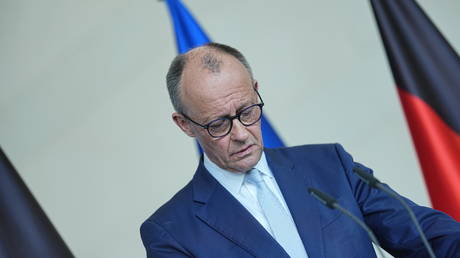
Friedrich Merz has officially hit a wall that few world leaders ever encounter so early in their tenure. Recent global polling data places the German Chancellor at the bottom of the international approval rankings, a position that signals more than just a temporary dip in popularity. It is a fundamental rejection of his governing style. While his predecessors often managed to maintain a "honeymoon period" with the electorate, Merz has seen his capital evaporate under the weight of a stagnant economy and a rigid approach to fiscal policy that many voters find increasingly detached from reality.
This is not a simple case of voter fatigue. It is a structural failure of leadership.
The Disconnect Between Berlin and the Street
The polling numbers are staggering, but they only tell half the story. To understand why Merz is underwater, you have to look at the gap between his policy objectives and the lived experience of the average German citizen. He entered office promising a return to "ordoliberal" principles—the idea that strict fiscal discipline and market-driven solutions would naturally restore Germany’s status as Europe’s economic engine. Instead, the country has faced a punishing mix of high energy costs and a manufacturing sector that feels abandoned by its own government.
The Chancellor’s insistence on maintaining the debt brake is a primary point of contention. While he views it as a badge of fiscal responsibility, the public sees crumbling infrastructure and an education system that is falling behind. When people see their trains running late and their schools in disrepair, a lecture on the importance of balanced budgets feels less like statesmanship and more like institutional neglect.
The Manufacturing Ghost Town
Germany’s industrial heartland is currently undergoing a painful transformation. For decades, the German model relied on cheap energy and open global markets. Both of those pillars have collapsed. Merz has been slow to pivot, clinging to a belief that the private sector will fix itself if the government simply stays out of the way.
But the private sector is scared. Capital is fleeing to the United States and China where subsidies are plentiful and energy is cheaper. The "Merz Effect" has become a term of derision in boardrooms across Stuttgart and Munich. It refers to a specific type of political paralysis where the government acknowledges a problem but refuses to use the tools at its disposal to solve it. This isn't just an economic theory; it's a slow-motion wreck for the middle class.
Why the Global Comparison Matters
Merz often dismisses domestic polls as the byproduct of a difficult transition period. However, when his numbers are indexed against other G7 leaders, the picture becomes even grimmer. Even leaders facing high inflation or political scandals in their own countries are outperforming him. This suggests that the problem isn't just the global environment—it's the specific German response to it.
International investors look for stability, but they also look for growth. A leader who prioritizes austerity during a recession is a leader who is viewed as a risk. The global markets have begun to price in a "Germany discount," reflecting a lack of confidence in the Chancellor's ability to navigate the green transition without destroying the country's industrial base.
The Perception of Arrogance
There is an intangible element to leadership that Merz has struggled to master: empathy. His public appearances are often characterized by a professorial, almost condescending tone. In a time of high anxiety, voters don't want a lecture; they want a partner.
- Communication Gaps: He speaks in the language of the 1990s financial elite.
- Policy Rigidity: A refusal to negotiate on key social spending even as poverty rates climb.
- Isolation: A growing sense that his inner circle is insulated from the concerns of rural and eastern voters.
This perception of being "out of touch" is a death knell in modern politics. You cannot lead a country if the people believe you don't understand the price of their groceries.
The Opposition is Eating His Lunch
While Merz remains stuck in a cycle of defensive maneuvering, the political fringes are capitalizing on the vacuum. The rise of populist movements on both the right and left is a direct consequence of the center’s failure to provide a compelling vision for the future. Merz was supposed to be the "adult in the room" who would neutralize the extremists by providing steady, conservative leadership. Instead, his unpopularity has given them a roadmap to power.
Every time the Chancellor doubles down on a policy that the public hates, he hands a megaphone to his detractors. They don't need to come up with better ideas; they just need to point at the current failure. The irony is that Merz, a man who spent years dreaming of the Chancellery, may end up being the person who unintentionally breaks the traditional party system for good.
The Energy Price Trap
One cannot discuss the Merz crisis without addressing the elephant in the room: energy. Germany’s decision to move away from nuclear while simultaneously losing access to Russian gas has created a permanent high-price environment. Merz’s solution has been to lean into market mechanisms, but markets don't build pipelines or wind farms overnight.
Small and medium-sized businesses—the famous Mittelstand—are the ones bearing the brunt. These companies are the backbone of the German economy, and they are currently being squeezed to the point of bankruptcy. When a local bakery or a specialized tool manufacturer closes its doors because it can’t pay the power bill, the blame falls directly on the man in the Chancellery.
A Lack of Strategic Investment
Compare the German approach to the United States’ Inflation Reduction Act. While the U.S. is pouring hundreds of billions into new technologies and manufacturing, Germany is debating whether it can afford to repair its bridges. Merz’s refusal to engage in a large-scale industrial policy is viewed by many analysts as a historical blunder.
The argument that "we don't have the money" is increasingly seen as a choice rather than a necessity. Germany has the lowest debt-to-GDP ratio in the G7. The fiscal space exists; the political will does not. This is the core of the Merz unpopularity: it is a rejection of a leader who chooses to be constrained by rules he has the power to change.
The Social Fabric is Fraying
Beyond the economics, there is a palpable sense of social unease. The migration debate continues to simmer, and the government’s response has been perceived as reactive rather than proactive. Merz has tried to talk tough on the issue, but his rhetoric often fails to translate into effective administration. This leaves him in a political no-man's-land where he is too conservative for the urban liberals and too moderate for the disgruntled right.
The Youth Vote Defection
Perhaps the most alarming trend for the Chancellor is his standing with younger voters. They see a leader who is focused on preserving the past rather than building a future they can inhabit. Issues like housing affordability and climate change are treated as secondary to the goal of a balanced budget.
If a political party loses the youth, it loses its long-term viability. Merz is currently presiding over a demographic desert. The data shows that for voters under 30, the Chancellor is not just unpopular—he is irrelevant.
The Path to Irrelevance
Political survival in the modern era requires more than just holding the office. It requires a narrative that resonates with the collective identity of the nation. Merz has failed to provide that narrative. He offers a return to a status quo that no longer exists, and the public knows it.
The surveys placing him at the bottom of the world leader rankings are a warning shot. They indicate that the German public has stopped listening to the excuses and started looking for an exit strategy. If the Chancellor cannot find a way to reconnect with the economic needs of his people, his stay in the Chancellery will be remembered as a brief, unsuccessful experiment in yesterday’s ideas.
The numbers don't lie, and they aren't going to change until the man at the top does. Merz must decide if he wants to be a footnote in history who balanced the books while the country burned, or if he is willing to abandon his dogma to save his legacy. The window for that choice is closing fast.
Stop looking at the polls as a popularity contest and start seeing them as a performance review. By every metric that matters to the person on the street, the current administration is failing to meet the moment. The most unpopular world leader isn't just a title; it is a mandate for immediate, radical change.