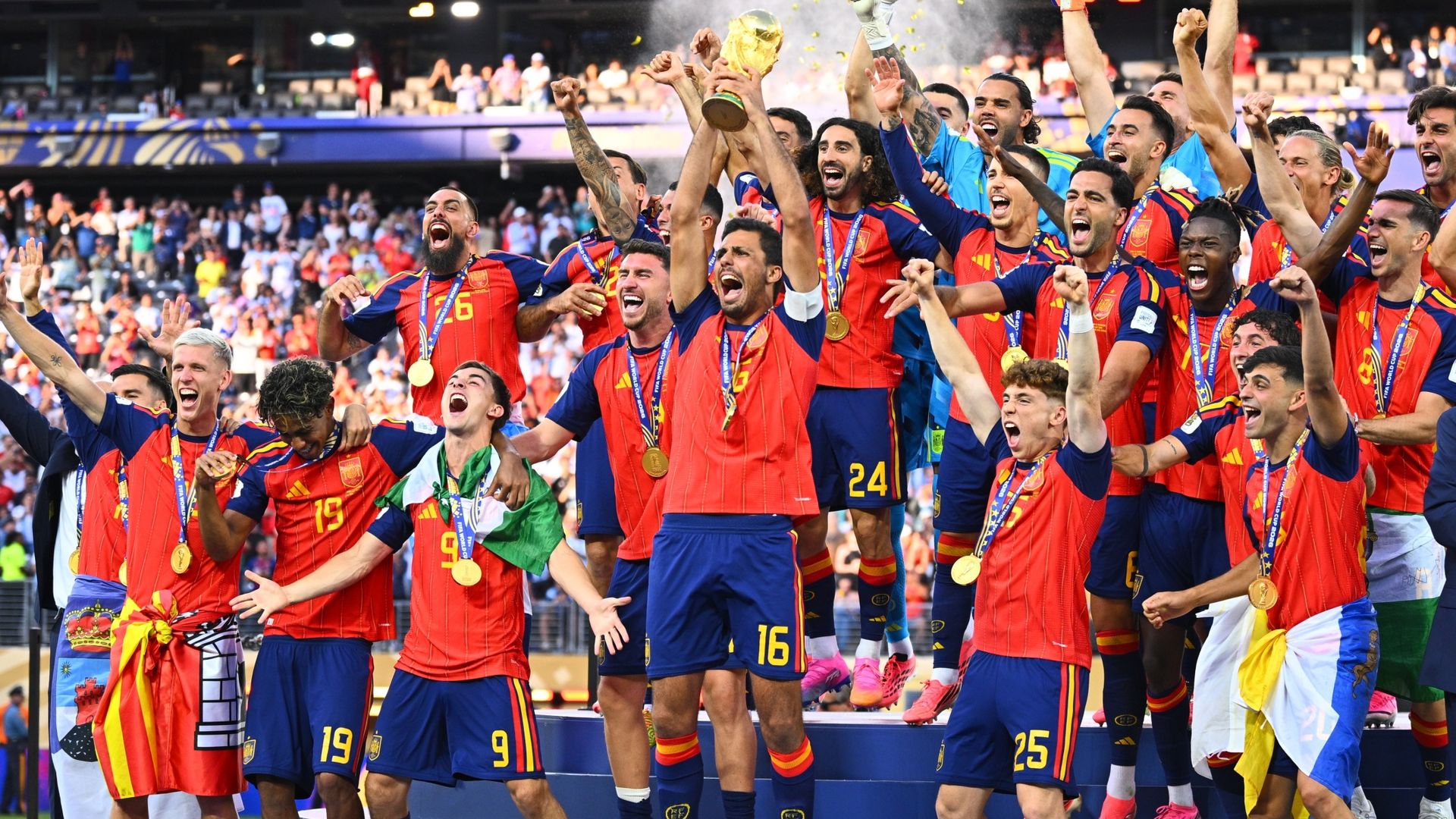
España is a team that still has a long way to go, and they have proved it by completing an unprecedented treble in world football by capturing the 2026 FIFA World Cup. Following victories in the 2023 Nations League and Euro 2024, Luis de la Fuente’s squad secured the ultimate prize at the MetLife Stadium with a grueling 1–0 extra-time victory over Argentina. While the immediate reaction focuses on the historic achievement, the structural reality of this squad suggests that this tournament was not the peak of a cycle, but rather the foundational baseline for a generation capable of sustained international dominance.
The Architecture of an Unprecedented Cycle
To understand how a manager once viewed as a temporary caretaker achieved what Vicente del Bosque, Luis Aragonés, or any other modern tactician could not, one must analyze the institutional continuity of the Royal Spanish Football Federation (RFEF). De la Fuente did not inherit a golden generation; he actively curated it over thirteen years within the youth ranks.
The squad that neutralized Argentina in New Jersey is almost entirely composed of players who have progressed under De la Fuente’s direct supervision since their teenage years.
- The 2019 Euro Sub-21 Core: Unai Simón, Mikel Merino, Fabián Ruiz, Dani Olmo, and Mikel Oyarzabal.
- The 2021 Tokyo Olympic Silver Medallists: Eric García, Marc Cucurella, Martín Zubimendi, and Pedri.
This deep-rooted familiarity explains why España executed their tactical framework with absolute precision under maximum pressure. They defended systematically with possession, conceding just one single goal throughout the entire 2026 tournament.
Tactical Suffocation at MetLife Stadium
The final against Argentina showcased a stark contrast in footballing philosophies. Argentina relied heavily on emotional momentum and structural resilience. España countered with systematic positional choking.
The metrics from the final reveal an absolute control of the pitch. España dominated possession, but more importantly, they completely suffocated Argentina's transitions. Over 120 minutes of high-intensity football, Argentina failed to record a single shot on target.
Final Match Statistics: España 1 - 0 Argentina (AET)
+-----------------------------------+----------+-----------+
| Metric                            | España   | Argentina |
+-----------------------------------+----------+-----------+
| Shots on Target                   | 8        | 0         |
| Pass Completion Rate              | 91%      | 79%       |
| Total Expected Goals (xG)         | 2.41     | 0.34      |
+-----------------------------------+----------+-----------+
The only element keeping the match alive until the 106th minute was an extraordinary performance by Argentine goalkeeper Emiliano Martínez, who single-handedly denied clear goal-scoring opportunities from Lamine Yamal and Nico Williams. The deadlock was finally broken in the second half of extra time when Ferran Torres capitalized on a loose ball inside the penalty area, firing past Martínez to secure the trophy.
Why This Squad Has Not Reached Its Peak
The most terrifying prospect for international rivals is De la Fuente’s post-match declaration that this team has still not touched its ceiling. This is not standard managerial hyperbole; it is a cold statistical reality dictated by the squad’s age profile.
Unlike the iconic 2008–2012 Spanish side that aged out simultaneously after the 2014 collapse in Brazil, the current roster features an incredibly balanced distribution of experience and youth. Core pillars like Rodri provide tactical maturity, while generational talents are nowhere near their physiological or technical primes. Lamine Yamal completed this historic tournament run at just 19 years old. Nico Williams and Pedri are entering their mid-twenties, meaning their peak competitive years will coincide with the next European Championship cycle.
The infrastructure behind the senior team continues to produce high-caliber replacements seamlessly. Because the tactical language remains identical across all youth categories, incorporating new talent into the senior setup requires minimal adaptation time. The system is completely independent of individual names.
The Evolution Beyond Traditional Tiki-Taka
The historical significance of this treble highlights how De la Fuente modernized the traditional identity of Spanish football. The possession-obsessed, low-risk style that characterized España’s exits in 2018 and 2022 has been permanently replaced.
This team retains the technical capacity to complete 800 passes a match, but they do so with vertical intent. The integration of dynamic, elite wingers altered the geometry of the team’s attack. España no longer just shifts defensive blocks from side to side; they actively break them open through isolated 1v1 situations on the flanks. When opponents attempt to press high, the midfield possesses the physical press-resistance to play through the pressure or exploit space directly behind the defensive line.
By combining the structural possession principles of the past with vertical athleticism, De la Fuente has constructed a highly adaptable tactical machine capable of dismantling low blocks or surviving chaotic transitional matches. With the World Cup secured, the rest of the footballing world is left chasing a standard that looks set to endure for seasons to come.