Who is winning the artificial intelligence race? The standard Western narrative answers with a tally of billions of dollars and mountains of advanced silicon, awarding a comfortable trophy to Washington. That answer is wrong. Look past the marketing announcements from Silicon Valley boardrooms, and a different reality emerges. The capability gap between American and Chinese frontier models has effectively vanished. Stanford University data confirms that the performance delta between top-tier systems from both nations has compressed to a margin of statistical noise. Money does not equal intelligence.
Let us break down the actual mechanics of this global clash. For a deeper dive into similar topics, we suggest: this related article.
The Spending Fallacy and Capital Efficiency
Goldman Sachs projects that American hyperscalers will pour roughly $764 billion into artificial intelligence infrastructure. Chinese cloud giants trail far behind that capital injection, expected to spend around $102 billion. On paper, this is a rout. Capital wins wars. Capital buys data centers, cooling systems, and massive clusters of advanced graphics processing units.
Yet numbers obscure the truth. The crucial metric is not how many billions are spent, but how much intelligence is extracted per dollar. Chinese laboratories have mastered algorithmic efficiency out of sheer necessity. Cut off from unfettered access to premier western hardware by successive waves of export controls, engineers in Beijing optimized. They refined mixture-of-experts architectures, mastered aggressive model distillation, and discovered how to train competitive reasoning models on a fraction of the compute budget. For further background on this issue, extensive analysis can also be found at Engadget.
Consider a hypothetical scenario to illustrate this dynamic. Imagine two construction companies tasked with building identical skyscrapers. Company A has an unlimited budget, importing heavy machinery from across the globe. Company B faces strict equipment limits, forcing its architects to redesign structural joints, optimize internal weight distribution, and invent lighter, stronger composite materials. When both companies finish their towers on schedule, Company A spent a fortune on brute force. Company B learned how to build smarter. That is the exact divergence currently playing out between Silicon Valley and eastern technology hubs.
The Compute Illusion and Physical Constraints
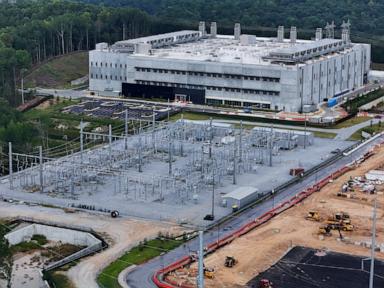
American data centers house processing power that dwarfs Chinese installations on paper. The United States boasts thousands of dedicated artificial intelligence facilities, consuming vast quantities of electrical energy. Officials point to this metric as an unassailable moat.
That moat has cracks. American electrical grids are buckling under the sudden, colossal power demands of modern server farms. Securing new grid interconnection queues takes years, throwing sand into the gears of rapid data center expansion. Meanwhile, China maintains a vast structural advantage in power generation capacity, producing more electricity than any other nation by a wide margin and backing it with unmatched control over critical minerals.
Look at the raw materials. China controls the processing and refining pipeline for a massive majority of critical minerals listed as vital for modern high-tech manufacturing. If the artificial intelligence supply chain relies on these elements, then possessing the raw compute servers matters very little if you cannot secure the underlying supply lines. Furthermore, almost every advanced silicon chip powering both American and Chinese models relies on a single manufacturing bottleneck in Taiwan. The physical foundation of the global artificial intelligence economy rests on a razor's edge, independent of national borders or trade restrictions. Advanced packaging facilities, high-bandwidth memory chips, and extreme ultraviolet lithography machines form a tightly wound web where a single broken thread halts production everywhere.
The Talent Equation and the Shifting Brain Drain
For years, the standard critique of Chinese research output was that it suffered from quantity over quality. Millions of papers, thousands of patents, but few breakthroughs that fundamentally shifted the frontier.
That critique expired. Independent analysis from research groups like MacroPolo demonstrates that nearly half of the world's elite artificial intelligence researchers earned their undergraduate degrees in China. Historically, a staggering majority of those brilliant minds migrated to the United States for graduate school and subsequent employment in corporate laboratories.
The pipeline is changing. Tightening immigration policies, shifting geopolitical incentives, and aggressive domestic funding within Chinese academic institutions have altered career trajectories. Top-tier researchers are increasingly staying home or returning after brief stints abroad. They are building domestic ecosystems that rival Western counterparts in rigor and speed. When you combine this concentrated talent pool with the sheer volume of scholarly publications pouring out of Asian institutions, the notion that America holds a permanent monopoly on innovation becomes untenable.
Open Weight Dominance and Developer Mindshare
Proprietary walls are expensive to maintain. While major American players protect their frontier models behind closed application programming interfaces, Chinese firms have embraced an open-weight strategy that floods the global developer ecosystem.
The market votes with its downloads. Millions of developers across Europe, Latin America, and Southeast Asia download and deploy open models originating from Chinese developer hubs because they offer high performance at zero licensing cost. This creates an invisible sphere of influence. When a startup in Jakarta or a research team in Berlin builds their products on top of Chinese open architecture, they adopt those underlying standards, safety frameworks, and optimization tools.
This adoption pattern changes the geopolitical balance. Soft power in the technology sector does not belong to the nation that builds the most expensive walled garden. It belongs to the nation whose tools developers choose to build with when no one is watching. By capturing a commanding share of open-source downloads, Chinese labs are embedding their technology into the daily workflows of global developers who have little interest in nationalist tech rivalries.
The Real Vulnerability
Neither superpower has figured out how to make the public trust their oversight. Survey data from global populations reveals deep skepticism toward both Washington and Beijing when it comes to regulating an intelligence explosion. Trust in governance sits at historic lows.
This trust deficit creates space for middle powers and independent coalitions to establish alternative frameworks. It also exposes a critical flaw in the obsession over benchmark scores and capital expenditure tallies. An artificial intelligence model can score at the absolute peak of human academic benchmarks while remaining brittle, expensive to run, and fundamentally unsuited for messy real-world deployment.
The race is not won by whoever crosses some imaginary finish line of general artificial intelligence first. It is won by whoever integrates intelligence into the physical and economic fabric of society without breaking the electrical grid, alienating the workforce, or exhausting their financial reserves.
Washington is betting everything on brute-force capital expenditure and hardware restrictions. Beijing is betting on algorithmic ingenuity, massive open-source distribution, and supply chain control. One strategy relies on endless wealth. The other relies on ruthless adaptation. History suggests that wealth eventually runs out, while adaptation learns how to survive anything.
The gap is gone. The illusion of an uncatchable American lead has evaporated. The contest is now a grueling marathon of efficiency, supply chain dominance, and global developer adoption, and the scoreboard reads much closer than anyone in Washington wants to admit.