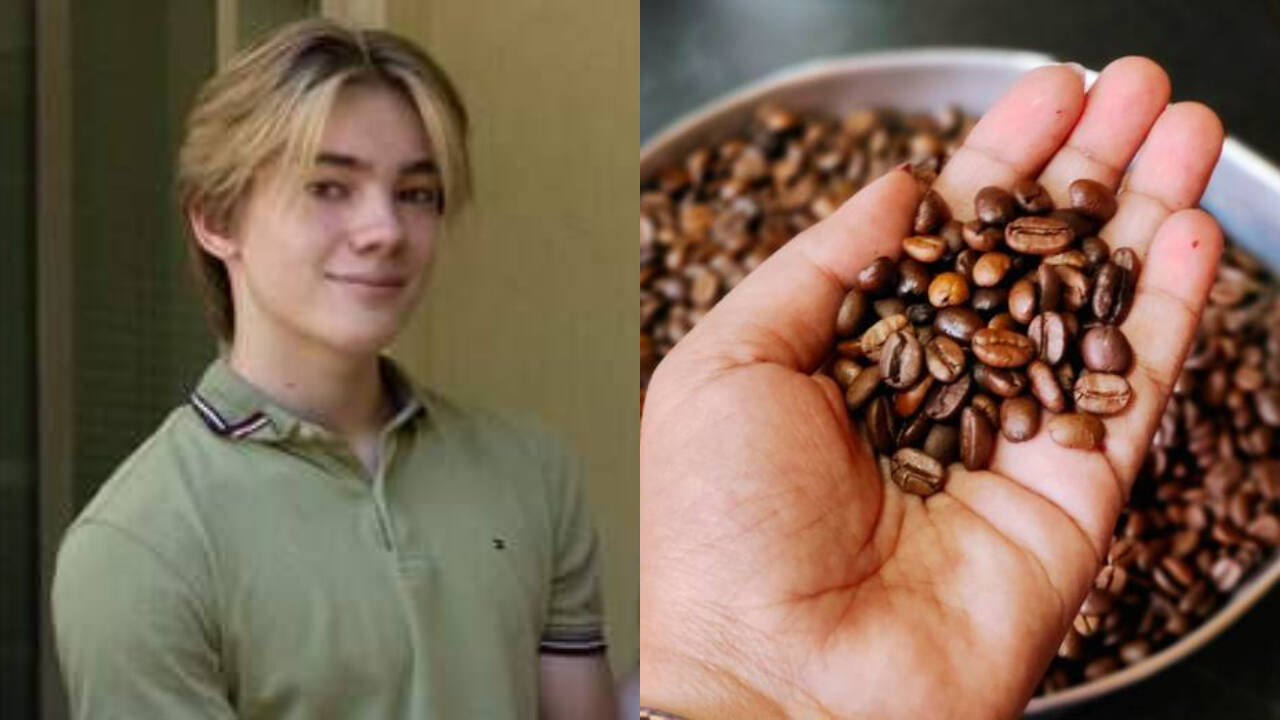
At an age when most teenagers treat high school as a holding pattern between video games and mandatory track practice, Harvey Uyeyama spends his afternoons managing logistics, roasting beans on a machine built over a century ago, and fulfilling subscription orders across the United States.
Operating out of Davis, California, Harvey's Coffee is not a school project designed to satisfy an indifferent economics teacher. It is a functioning, legally complex micro-enterprise born out of sudden personal tragedy. While local profiles frequently frame the story through a lens of sentimental inspiration, the reality of running a food-production business as a minor involves a grueling intersection of bureaucratic hurdles, mechanical unpredictability, and grief management.
To understand how a sixteen-year-old commands a growing subscriber base while preparing for early college graduation, one must look past the novelty of his age and examine the mechanics of old-school craftsmanship in a digital marketplace.
The Irony of the Antique Roaster
Modern commercial roasting facilities rely on computerized profiles, automated drum speeds, and digital temperature loggers that track the Rate of Rise with clinical precision. Harvey operates on a machine from the early 1900s that relies entirely on human sensory input.
The machinery utilizes rotating metal chambers suspended above open propane burners. There are no digital dashboards or automated cooling trays. The operator must listen for the distinct auditory cues of first and second crack, watch the color transformation of the chaff, and smell the subtle shifts in bean chemistry as sugars caramelize.
This sensory-driven approach was passed down by his father, John Uyeyama, who formerly operated a coffee shop in Lafayette before continuing his craft at home. When John died suddenly of a heart attack on Harvey's fifteenth birthday, the machine sat idle in the backyard.
Weeks later, when mourners needed coffee for a memorial service, Harvey stepped up to the burner. The initial batches were uneven, marred by uneven heat distribution and temperature spikes. Yet those flawed first attempts catalyzed a transition from passive grief to active preservation. Roasting became a method of retaining a physical connection to a lost mentor.
Navigating the Bureaucracy of Childhood
Running a physical product business as a minor creates immediate structural walls that standard entrepreneurial guides ignore. A sixteen-year-old cannot legally sign commercial leases, open traditional corporate bank accounts without adult co-signers, or file certain municipal permits independently.
To bypass these legal bottlenecks, the operation relies on a collaborative framework. Abby Merchant, an eighteen-year-old student at UC San Diego, handles critical administrative and financial operations requiring adult authorization, alongside graphic design and marketing. Meanwhile, childhood friend Dash Voskuhl assists with local deliveries and heavy manual lifting.
This division of labor highlights a stark reality for young founders. Success requires acknowledging personal limitations and building a trusted support system early. Independence is a myth; operational execution relies entirely on coordination.
The Economics of Micro-Batch Scaling
At a production capacity of roughly twelve bags an hour, Harvey's Coffee rejects the core tenets of modern industrial scaling. Mass-market roasters optimize for velocity, pushing thousands of pounds through fluidized-bed systems daily.
Micro-batch operations trade volume for exclusivity. By focusing on single-origin rotational beans—frequently highlighting East African varietals known for distinct acidity and fruit notes—the business appeals to consumers exhausted by homogenized commercial blends. Local customers receive product within twenty-four hours of dropping out of the cooling bin, preserving volatile aromatic compounds that degrade during standard grocery store distribution cycles.
Subscription retention depends entirely on rotating offerings. Customers do not buy bags blindly; they subscribe to a curation process. Changing the origin profile monthly forces the consumer to relinquish control, trusting the palate of a teenage roaster who evaluates acidity, body, and regional history before every batch.
The Reality Beyond the Headline
Media coverage often reduces young business owners to feel-good human interest snippets, ignoring the sheer monotony required to sustain traction. Behind every artisanal label is hours of sweeping chaff, scrubbing oily residue from cast-iron drums, and dealing with payment gateway errors.
Harvey plans to graduate high school early, compressing his final semester to carve out a narrow window of full-time focus before stepping onto a college campus. Whether the enterprise scales into a permanent livelihood or remains a profound chapter of adolescent development, the enterprise demonstrates that technical mastery requires no corporate backing.
The propane burner clicks on every Friday afternoon in a Davis backyard, the antique drum begins its rotation, and the smoke rises against the California sky.
Teen starts coffee business after father's death to carry on legacy
This video provides an authentic look at Harvey Uyeyama operating his family's vintage roaster and discussing the personal motivations behind his business.
http://googleusercontent.com/youtube_content/1