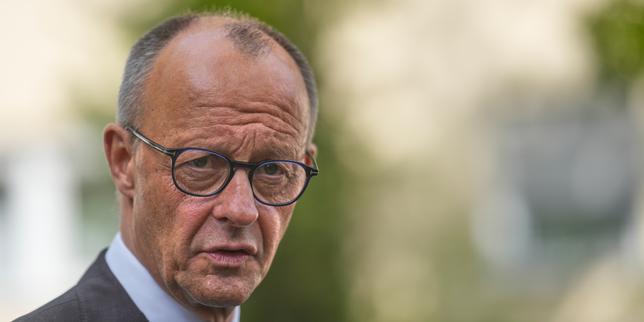
Twelve months after taking the oath of office, Chancellor Friedrich Merz finds his administration trapped in a vice of its own making. The honeymoon did not just end; it evaporated under the heat of a stagnant economy and a fractured coalition that seems more interested in internal survival than national progress. Merz promised a return to German efficiency and conservative fiscal discipline, but the reality on the ground is one of plummeting approval ratings and a public that feels the country is drifting toward irrelevance.
The fundamental crisis is not merely a matter of bad polling. It is a structural failure to reconcile a high-cost social state with a global market that no longer grants Germany its traditional "complexity premium." For decades, German engineering and industrial reliability justified higher prices. Today, those margins are gone, and the Merz government’s attempt to cut its way to growth has instead triggered a crisis of confidence among the very middle-class voters who carried him to the Chancellery in May 2025.
The Illusion of the Merz Miracle
When Friedrich Merz replaced the stalled government of Olaf Scholz, he was framed as the CEO the country desperately needed. The narrative was simple: clear out the bureaucratic sludge, rein in the debt brake, and restore the dominance of the German automotive and chemical sectors. However, being a corporate veteran does not always translate to the messy, pluralistic theater of the Bundestag.
His first year has been defined by a series of legislative stalemates. By insisting on a strict adherence to the Schuldenbremse (debt brake), Merz has starved essential infrastructure projects of the capital they require. You cannot run a first-world economy on third-world rail networks and internet speeds. The result is a paradox where the government claims fiscal responsibility while the national assets continue to depreciate at an alarming rate.
Industry leaders, once his most vocal supporters, are now whispering about a "lost year." The promised deregulation has been slow to arrive, tied up in the friction of a coalition that lacks a shared vision for the future. While Merz talks about the virtues of the free market, his ministers are busy firefighting the social fallout of a shrinking industrial base.
The Energy Trap and Industrial Flight
The elephant in the room remains the cost of power. Merz gambled that a pivot toward a more pragmatic energy mix—including a tentative rethink of nuclear and a heavier reliance on diversified gas imports—would bring prices down quickly. It didn't.
Large-scale manufacturers in the Rhine-Ruhr area are not waiting for the government to find its footing. They are moving. The migration of German capital to North America and China is no longer a threat; it is a documented trend. When BASF or Volkswagen shift production focus away from their home turf, it isn't just about labor costs. It is a vote of no confidence in the long-term energy security of the German state.
Merz has tried to frame this as a necessary "cleansing" of the market, a transition toward high-tech services and green innovation. That sounds good in a white paper. It feels much different in a factory town where the local tax base is drying up and the skilled workers are wondering if their children have a future in the country.
A Ghost in the Chancellery
Power in Berlin is often about the ability to project a sense of inevitability. Merz, despite his towering physical presence and sharp rhetorical style, has struggled to project authority over his own cabinet. The ideological gap between his conservative core and his junior partners has turned every cabinet meeting into a negotiation rather than a decision-making body.
This perceived weakness has emboldened the fringes. To his right, the AfD continues to harvest the resentment of those left behind by the green transition. To his left, a disorganized but angry opposition points to the rising cost of living as proof that Merz is a "Chancellor for the 1 percent."
The data reflects this alienation. A year into his term, Merz's personal approval ratings are significantly lower than those of his predecessor at the same mark. This is a staggering realization for a man who spent nearly twenty years in the political wilderness waiting for this specific moment. He finally won the prize, only to find the machinery of state broken and the tools at his disposal blunted by decades of underinvestment.
The Failure of the "Middle-Class" Tax Reform
Central to the Merz campaign was the promise of significant tax relief for the Mittelstand—the small and medium-sized enterprises that form the backbone of the economy. The reform that eventually passed was a watered-down version of the original proposal, so laden with compromises that the average worker barely noticed a difference in their take-home pay.
- Inflationary Pressure: Even as the government tried to lower taxes, rising insurance premiums and energy surcharges ate the gains.
- Bureaucratic Bloat: The "one-in, two-out" rule for regulations has been largely ignored by a civil service that has grown accustomed to micro-managing the private sector.
- Lack of Skilled Labor: Merz’s restrictive stance on certain types of migration has made it harder for companies to fill the 1.5 million job vacancies currently hindering growth.
The Global Stage and the Loss of Influence
On the international front, Germany's voice has become a stutter. Historically, the Chancellor of Germany was the de facto leader of Europe. Under Merz, that leadership has been ceded to Paris and Warsaw.
His "Germany First" approach to EU budget negotiations has alienated traditional allies in the south and east. By focusing so heavily on domestic fiscal purity, he has left a vacuum in European defense and foreign policy. While the world watches conflicts in the Middle East and Ukraine with apprehension, the Merz government appears preoccupied with its own budget deficits. This inward-looking stance is a departure from the Merkel era, where Germany was the indispensable broker of every major deal.
The Defense Spending Mismatch
The Zeitenwende—the historic shift in defense policy—remains more of a slogan than a reality. Merz promised to hit the 2% NATO spending target with ease. Instead, he has faced a revolt from his own finance ministry, which argues that defense spending cannot be exempt from the debt brake.
The military is still waiting for the equipment it was promised years ago. Orders are bogged down in procurement hell. For an investigative mind, the paper trail of these "missing billions" reveals a department that is structurally incapable of spending money efficiently, regardless of who sits in the Chancellery. Merz’s inability to fix the Ministry of Defense is perhaps his most glaring failure of management. It was supposed to be his specialty.
A Culture of Pessimism
Perhaps the most damaging aspect of the first year of Merz is the pervasive sense of "German Angst" that has returned with a vengeance. Consumer sentiment is at historic lows. People are saving because they are afraid, and that fear is a self-fulfilling prophecy for a consumer-driven economy.
The Chancellor’s communication style hasn't helped. He often comes across as lecturing the public, telling them they need to work harder and complain less. In an era of high anxiety, people don't want a headmaster; they want a leader who understands their struggles. Merz’s detached, aristocratic demeanor has created a barrier between him and the electorate that may be impossible to bridge.
The Looming Shadow of the Next Election
The political clock in Berlin is unforgiving. With regional elections on the horizon, the pressure on Merz to deliver a "win" is immense. But there are no easy wins left. The low-hanging fruit of the German economy was picked years ago. What remains are the hard, structural problems: a demographic cliff, a crumbling infrastructure, and an energy policy that is at odds with industrial reality.
If Merz cannot pivot within the next six months, he risks becoming a "lame duck" Chancellor before his second year is out. The talk in the Berlin salons is already shifting toward who might replace him, even within his own party. They are looking for someone who can combine fiscal reality with social empathy—a combination that has so far eluded the current incumbent.
The tragedy of the Friedrich Merz chancellorship is that he may be the right man for a version of Germany that no longer exists. He is a 20th-century strategist trying to navigate a 21st-century poly-crisis. He operates on the assumption that the old rules of trade and diplomacy still apply, while the rest of the world has moved on to a more aggressive, protectionist, and unpredictable model.
The German public is waking up to the realization that simply changing the man at the top does not fix a system that has been stagnating for a generation. The "Merz Era" was supposed to be a restoration. Instead, it is looking more like a final, desperate attempt to cling to a status quo that has already slipped away.
The only way forward is a radical departure from the current path. This would require Merz to abandon his dogmatic attachment to the debt brake and authorize a massive, state-led investment program in energy and digital infrastructure. It would require him to face down the vested interests in his own coalition and prioritize the survival of the industrial core over ideological purity.
But that would require a different kind of man. Friedrich Merz has spent his whole life preparing for this role, and he is unlikely to change his script now. He will continue to manage the decline with a steady hand and a sharp suit, even as the walls of the German economic powerhouse continue to crack around him.
The question is no longer whether Merz can save the German economy, but whether the German economy can survive the Merz chancellorship without suffering permanent structural damage that no successor can repair.