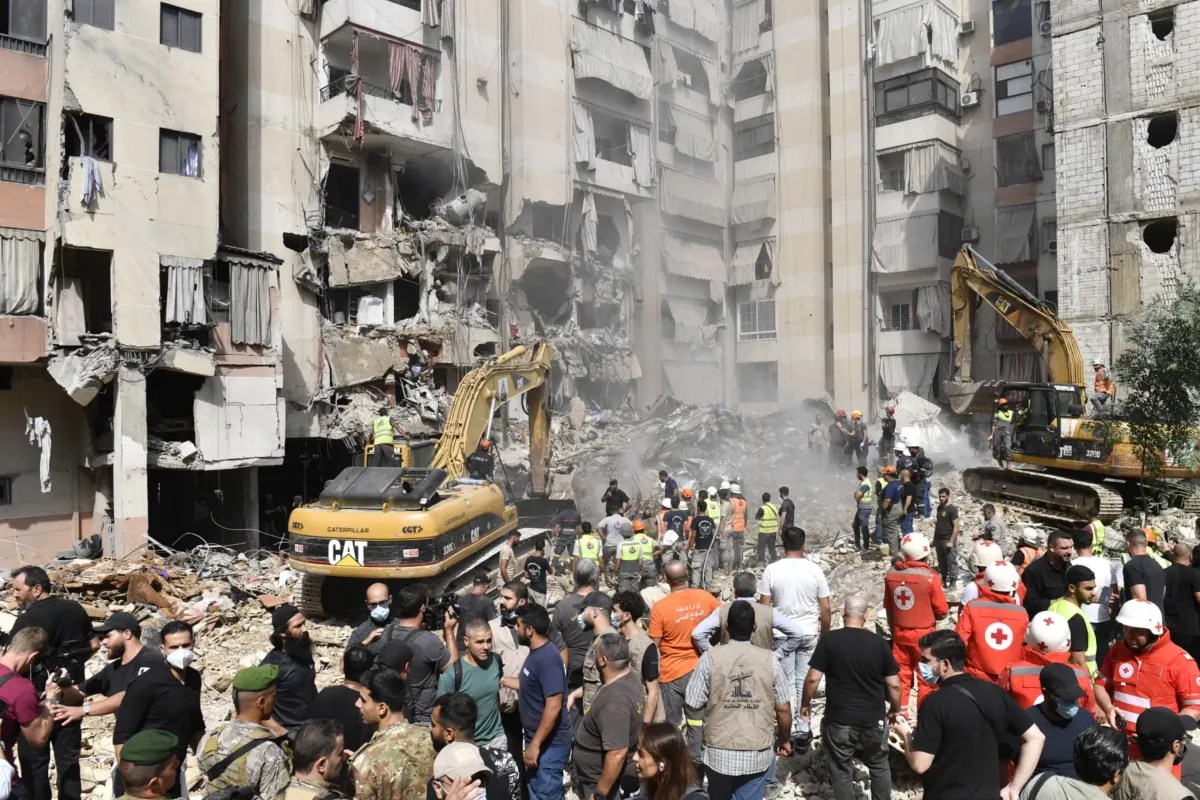
The reported death toll in Lebanon has surged past 250 with more than 1,100 individuals injured following a massive wave of aerial bombardments. This is no longer a localized skirmish or a predictable exchange of fire across a disputed border. We are witnessing the systematic dismantling of the decade-old rules of engagement that previously kept a lid on a total regional conflagration. Families in Beirut now face the terrifying reality that the "red lines" once thought to protect urban centers have effectively evaporated under the weight of high-intensity munitions.
The Failure of Calculated Restraint
For years, the standoff between Israel and Hezbollah operated on a grim but stable logic of "tit-for-tat" strikes. If one side hit a military outpost, the other responded in kind, usually within a few kilometers of the Blue Line. That logic has been incinerated. The current offensive represents a shift from tactical degradation to an attempt at strategic erasure. By striking deep into residential areas of Beirut and southern Lebanese villages, the Israeli military objective has pivoted toward forcing a total political surrender of the northern neighbor, regardless of the humanitarian cost.
The sheer volume of fire delivered in a single 24-hour window suggests a level of intelligence preparation that has been years in the making. This wasn't a reactive scramble. It was a planned execution. When over a thousand people are wounded in such a concentrated timeframe, the local medical infrastructure doesn't just bend; it breaks. Hospitals in Lebanon, already reeling from years of economic collapse and the lingering trauma of the 2020 port explosion, are now operating in a state of primitive triage.
Dissecting the Intelligence Breach
One must ask how targets were identified with such lethal precision and frequency. The recent events suggest a catastrophic compromise of communication security within the Lebanese infrastructure. The hardware once thought to be secure has been turned into a liability. This isn't just about missiles; it is about the total penetration of the digital and physical life of the Lebanese citizenry.
When an air force can strike hundreds of targets across a country in one day, it implies they are no longer guessing where the assets are hidden. They are watching them in real-time. This level of oversight creates a psychological paralysis among the population. People are not just fleeing from bombs; they are fleeing from the terrifying realization that nowhere is invisible.
The Urban Warfare Trap
Beirut is one of the most densely populated cities in the Mediterranean. Conducting "precision" strikes in such an environment is a mathematical fallacy. Even if a missile hits its intended mark, the overpressure and fragmentation in narrow streets ensure that bystanders pay the ultimate price. The screams heard in the streets of the capital are the sounds of a society realizing that its civilian status provides no shield.
- Infrastructure Collapse: Power grids and water lines are often severed as "collateral," leading to long-term displacement.
- The Refugee Surge: Thousands are moving north, creating a secondary crisis of housing and food security in areas of Lebanon not yet under direct fire.
- Psychological Operations: The use of mass messaging and intrusive warnings by the attacking force serves to create a stampede effect, clogging roads and making emergency response nearly impossible.
The Geopolitical Vacuum
The international community is currently offering nothing but recycled rhetoric about de-escalation. These statements ring hollow when the physical reality on the ground is shifting so violently. The United Nations and regional power brokers appear sidelined, unable or unwilling to exert the necessary pressure to halt the kinetic momentum.
There is a cold calculation at play here. The aggressors are betting that the world’s attention is too fragmented to sustain an outcry. They are betting that the domestic political needs of various world leaders will prevent any meaningful intervention until the "objectives" are met. This creates a dangerous window of impunity.
Weaponizing Displacement
The mass exodus from southern Lebanon is not an accidental byproduct of war. It is a tool. By forcing hundreds of thousands of people into the heart of Beirut and northern cities, the offensive creates an internal pressure cooker. The Lebanese government, already a ghost of its former self, has no capacity to manage a displaced population of this scale. This moves the conflict from a military struggle to a societal breaking point.
When you see 1,165 people injured, you are seeing a generation of young people who will live with permanent disabilities. You are seeing a workforce that is being systematically decimated. The economic ripple effects of these strikes will be felt for decades, long after the smoke clears and the diplomats return to their villas.
The Myth of Surgical Precision
Military spokespeople often use the term "surgical" to sanitize the reality of aerial warfare. There is nothing surgical about a 2,000-pound bomb dropped in a neighborhood. The kinetic energy alone can collapse buildings blocks away. The data coming out of Lebanese health ministries confirms that a significant portion of the casualties are non-combatants—women, children, and the elderly who simply could not move fast enough.
The argument that these targets are purely military ignores the reality of modern Lebanese geography, where the political, social, and military wings of local organizations are deeply intertwined with the civilian fabric. To strike one is to inevitably destroy the other. This is total war dressed in the language of a "security operation."
The Redefinition of Sovereignty
What we are witnessing is the final death of the concept of national sovereignty in the Levant. If a nation can be bombarded with 250 deaths in a single day without a declaration of war or a clear legal framework, then the very idea of borders becomes a fiction. This sets a precedent that will be studied by every other regional power. It signals that the cost of aggression has dropped, while the cost of defense has become astronomical.
The sophisticated nature of the weaponry used—ranging from glide bombs to thermobaric munitions—indicates that the offensive is also a live-fire demonstration of modern military technology. Lebanon has become a proving ground for the next generation of urban destruction.
A Cycle Without an Exit
The most harrowing aspect of the current situation is the lack of a clear endgame. If the goal is to stop rocket fire, history shows that aerial bombardment rarely achieves that end; instead, it radicalizes a new cohort of fighters. If the goal is a buffer zone, it requires a permanent occupation that will drain the resources of the invader and the blood of the invaded.
Every missile that hits a Beirut apartment block serves as a recruitment poster for the next decade. We are not just seeing the death of 254 people; we are seeing the birth of a more virulent, more desperate resistance. The cycle is self-sustaining. The "screams in Beirut" are not just an immediate reaction to pain; they are a warning of the instability that will now define the region for the foreseeable future.
The immediate priority for the surviving population is not political alignment or grand strategy. It is the basic, grueling task of finding blood for the wounded and bread for the hungry. While the world watches high-definition footage of explosions, the reality on the ground is one of dust, blood, and the smell of cordite. Lebanon is being pushed into an abyss, and there are no signs that the hands pushing it are prepared to stop.
The international community must look past the "terrorist" vs. "state" narratives and recognize the humanitarian erasure occurring in real-time. If the global order cannot protect a capital city from being turned into a killing field, then that order is functionally dead. The victims in Lebanon are not just statistics in a briefing; they are the evidence of a failed global security architecture that prizes tactical wins over human survival.
Expect the numbers to rise as the rubble is cleared. Expect the rhetoric to sharpen as the funerals begin. The time for "monitoring the situation" passed hours ago. We are now in the era of consequence, where the only thing certain is that more blood will be spilled before any meaningful silence returns to the skies over Beirut.
Stop looking for a "moderate" outcome in a conflict defined by extremes. The reality is far simpler and far more grim. This is a deliberate escalation designed to break a nation's will, and in the process, it is breaking the lives of thousands who had no say in the start of this war.
Reach for the medical supplies. Open the borders. Prepare for a long, dark winter in a country that used to be the light of the Middle East.


