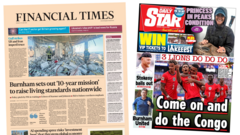
Every midnight, a strange ritual occurs across British television networks. Presenters sit in brightly lit studios, flanked by a revolving door of political commentators, former speechwriters, and think-tank directors, to sift through the front pages of the next morning’s newspapers. It is an industry reviewing itself, a feedback loop where the headlines of Fleet Street dictate the broadcast agenda for the following day.
When the papers highlight headlines like Andy Burnham’s ten-year mission to overhaul regional infrastructure alongside updates on the Princess of Wales returning to peak physical condition, they are not merely reporting the news. They are participating in a highly calculated choreography of political messaging and distraction. The traditional press review has become a mechanism that flattens complex institutional failures and celebrity obsession into a single, digestible stream of content, distorting public perception of what actually matters.
The Illusion of a Ten Year Plan
Regional devolution in the United Kingdom has long been treated as a personal crusade rather than a structural reality. When local leaders announce decadelong strategies to fix transport, housing, or healthcare, the national press tends to frame these initiatives through the lens of individual ambition. It becomes a story about a politician's personal trajectory rather than the gridlock of central government funding.
The fundamental flaw in any ten-year municipal mission in Britain is structural financial instability. Metro mayors can draw up grand blueprints for integrated bus networks or localized carbon-neutral targets, but they remain entirely dependent on a volatile treasury in Whitehall. The British state remains one of the most centralized in the Western world. Financial control rests firmly in London, meaning a local ten-year mission can be derailed by a single autumn statement or a shift in national party leadership.
Furthermore, the media’s focus on the long-term optics allows immediate governance failures to slip under the radar. It is easier to write a sweeping piece about where a city-region intends to be in the next decade than it is to audit why a current local transit authority is failing to meet its weekly scheduling targets today. This hyper-focus on the horizon line creates a comfortable buffer for public officials, transforming concrete accountability into abstract forward planning.
The Royal Health Narrative as Public Distraction
On the opposite side of the front page, the British press routinely deploys its most reliable commodity, the royal family. Coverage declaring a prominent royal to be in peak condition after a period of illness or absence serves a specific systemic purpose. It is a reliable circulation driver that simultaneously acts as a cultural sedative, shifting public attention away from grim economic indicators or legislative gridlock.
The obsession with royal health updates operates on a strict formula of crisis and restoration. First comes the panic of vulnerability, followed closely by triumphant declarations of resilience and recovery. This narrative structure is designed to project stability onto a nation that is otherwise experiencing deep institutional decay. While the public reads about an individual's personal fitness regime in their country estate, the broader collapse of the National Health Service remains relegated to the inside pages.
This juxtaposition is not accidental. The layout of a British newspaper is a daily exercise in balancing institutional anxiety with comforting tradition. A devastating report on child poverty or regional transport cancellations is routinely neutralized by a glossy, full-page photograph of a smiling royal. The presentation suggests that no matter how broken the underlying infrastructure of the state becomes, the central symbols of national identity remain intact and robust.
The Broken Machinery of Editorial Priority
The modern newsroom is no longer dictated solely by the public interest or investigative merit. Algorithmic feedback, digital subscription metrics, and the relentless speed of the 24-hour news cycle have forced editors to rely on predictable formulas. The press review simply mirrors this internal desperation, packaging the easiest narratives for a television audience that has largely stopped buying physical print.
+------------------------------------+------------------------------------+
| Narrative Type                     | Systemic Function                  |
+------------------------------------+------------------------------------+
| The Institutional Long-Term Plan   | Deflects immediate criticism by    |
| (e.g., Regional Devolution)        | shifting accountability to a vague |
|                                    | future date.                       |
+------------------------------------+------------------------------------+
| The Royal Restoration Story        | Compels emotional engagement and   |
| (e.g., Royal Health Updates)       | neutralizes systemic anxiety.      |
+------------------------------------+------------------------------------+
This dynamic creates an ecosystem where complex, slow-burning crises are systematically ignored. A major infrastructure collapse or a shifts in corporate regulatory frameworks cannot be easily summarized in a two-minute television segment at midnight. Instead, the media relies on personalized battles. It chooses to cover a mayor fighting the treasury or a princess conquering an illness, leaving the public highly informed about personal dramas but completely illiterate about the mechanics of power.
The real crisis of the British media landscape is this refusal to connect the dots. The press review should be an autopsy of corporate and political messaging, not an echo chamber that amplifies it. By treating long-term political promises and celebrity health updates as equivalent components of the daily national fabric, the press fails to perform its primary democratic function. It leaves citizens navigating a world where the noise of the headlines completely drowns out the reality of the rot.