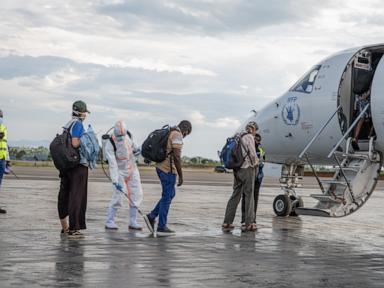
The World Health Organization recently admitted that global health forces remain behind the curve in containment efforts during the Ebola outbreak in the Democratic Republic of the Congo, even as diagnostic testing capacities improve. This acknowledgment exposes a fundamental flaw in modern crisis management. Faster lab results mean nothing when the social infrastructure required to act on them has completely broken down. The international community is treating a complex socio-political crisis as a purely medical math problem. Until the strategy shifts from deploying high-tech tools to rebuilding local trust, the virus will continue to outrun the response.
The Illusion of Technological Victory
Global health agencies love measurable metrics. They track the number of GeneXpert diagnostic machines deployed, the thousands of vaccine doses administered, and the shrinking turnaround times for blood sample analysis. On paper, the technical response to recent Ebola outbreaks in the eastern DRC looks formidable.
The reality on the ground is starkly different.
An ultra-rapid PCR test cannot save a patient who refuses to visit a treatment center. It does not trace contacts who have fled into the forest out of fear. The obsession with technological fixes creates a dangerous blind spot. By focusing on the tools, international actors convince themselves they are making progress while the epidemic continues to expand through hidden chains of transmission.
The core breakdown is not scientific. It is institutional. When the World Health Organization notes that responders are lagging behind despite better diagnostics, they are witnessing the limits of top-down medicine. A laboratory can confirm a diagnosis in hours, but if it takes days to convince a family to isolate their sick relative, the virus wins every time.
The Ghost of Interventions Past
To understand why communities resist the Ebola response, one must look at the historical footprint of international aid in the region. For decades, North Kivu and surrounding provinces have suffered from armed conflict, systemic neglect, and mass casualties from preventable diseases like malaria and measles.
Suddenly, when Ebola appears, hundreds of millions of dollars pour in. Fleets of white SUVs fill the roads. Exotic field hospitals spring up overnight.
To a local population that has been buried in grief and insecurity for a generation, this sudden influx of resources looks suspicious. They ask a logical question: Why does the world only care about our deaths when the disease threatens to cross international borders?
+------------------------------------------------------------+
|            THE TRUST GAP IN CRISIS ZONES                   |
+------------------------------------------------------------+
|  Local Reality:              |  International Response:    |
|  • Decades of conflict       |  • Single-disease focus     |
|  • High malaria mortality    |  • Sudden resource influx   |
|  • Deep political distrust   |  • Top-down directives      |
+------------------------------------------------------------+
This structural disconnect breeds deep conspiracy theories. Armed groups exploit these anxieties, painting foreign medical workers as opportunists or political actors. When response teams arrive accompanied by state military escorts, the medical mission becomes indistinguishable from the ongoing civil conflict. The clinical space becomes a combat zone.
The Failure of the Outbreak Complex
The international emergency response apparatus operates on a military model. Command structures are centralized, decisions flow from Geneva or Kinshasa, and field teams execute orders. This template works well for logistical deployments, but it fails miserably in communities defined by shifting local allegiances and deep-seated trauma.
Consider the standard protocol for a safe and dignified burial. Ebola remains highly contagious after death, making traditional washing and funeral practices lethal events. When early response teams forcibly took bodies away from grieving families, they broke a sacred social contract.
"A medical intervention that violates the dignity of the dead will never secure the cooperation of the living."
💡 You might also like: The Last Room on the Left
The backlash was immediate. Families began hiding their sick, burying bodies secretly at night, and avoiding medical checkpoints. The sophisticated testing equipment sat idle because the inputs—the patients—had vanished from the official registry.
Reversing the Flow of Authority
Fixing the broken response requires stripping away the bureaucratic hierarchy. The local community cannot be treated as a passive recipient of aid or a variable to be managed. They must hold the design authority.
- Redefining the Frontline: Instead of flying in international experts to lead teams, local nurses, traditional healers, and community leaders must be the primary operators. They possess the social capital that no foreign degree can buy.
- Integrating Healthcare Services: Ebola treatment units should not exist as isolated, heavily guarded citadels. Emergency funding must be diverted to fortify existing community clinics so they can treat malaria, pneumonia, and childbirth complications alongside Ebola screening.
- Decentralizing Resources: Direct cash transfers and logistical control must be handed to local health zones, bypassing the slow, leaky pipelines of national capitals and international agencies.
When community members see that the health response addresses their daily survival needs, the resistance to Ebola surveillance disappears.
The High Cost of the Current Path
The financial burn rate of a prolonged, top-down Ebola intervention is staggering. Millions are spent on security details, international airlifts, and temporary infrastructure that vanishes once the outbreak is declared over. This approach leaves the underlying health system just as fragile as it was before the virus arrived.
Imagine a hypothetical scenario where an outbreak occurs in a district with functional basic sanitation, reliable primary care, and a well-paid medical workforce. The virus would be detected early by trusted local doctors, contacts would isolate willingly because they trust the advice, and transmission would stop before a massive international mobilization becomes necessary.
Instead, the global health community prefers to spend ten times the amount on emergency firefighting rather than investing in fire prevention.
The Blind Spot in Security Analysis
Many analysts blame the persistence of the virus solely on the presence of rebel militias like the Allied Democratic Forces (ADF). While active conflict certainly hampers movement, it is a convenient excuse for institutional failure.
Insecurity does not just mean gunfire. It means the economic vulnerability of a father who must choose between isolating for 21 days or working to feed his children. The current response framework offers isolation but fails to adequately compensate for the economic ruin that accompanies it. When compliance equals starvation, non-compliance becomes a rational survival strategy.
The World Health Organization will continue to report that it is behind until it stops measuring success by the sophistication of its lab equipment and starts measuring it by the willingness of a community to open its doors. The virus is a biological reality, but the epidemic is entirely social.