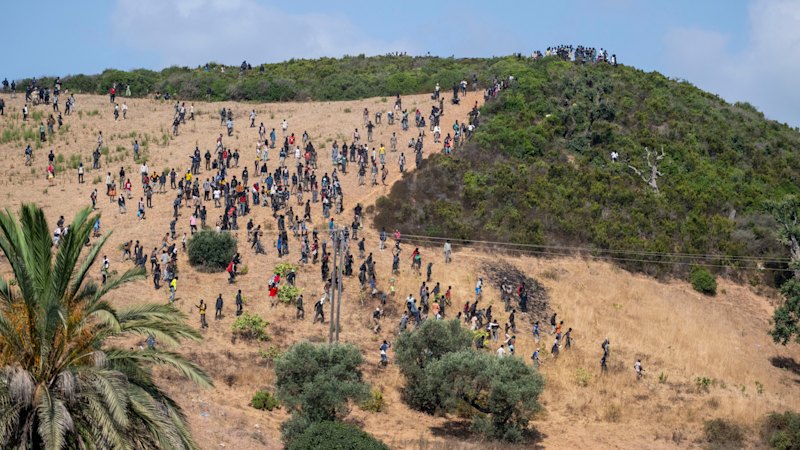
Every time a few hundred people sprint toward the double fences separating Morocco from the Spanish enclave of Ceuta, the media apparatus runs the exact same script. Sirens blare on television screens. Pious anchors lament humanitarian tragedies. Politicians posture about national sovereignty and border fortification. The lazy consensus is as predictable as it is lazy: thousands of desperate individuals are crashing against an immovable fortress, and the only debate is whether to reinforce the walls or open the gates.
Both sides of that mainstream argument are wrong.
They are wrong because they treat Ceuta and Melilla as simple geographic anomalies or immigration flashpoints. They treat them as humanitarian theater rather than what they actually are: economic valves on a continent-sized pressure cooker, maintained by cynical statecraft on both sides of the Mediterranean.
I have spent years watching policymakers debate migration metrics while ignoring the structural mechanics of border management. I have seen governments pour millions into razor wire while quietly negotiating backroom bilateral trade agreements that make border rushes inevitable. When you look past the breathless reporting of the latest border surge, a far more uncomfortable truth emerges. The system is not failing. The system is operating precisely as designed, and every frantic rush at the fence is just noise drowning out the machinery underneath.
The Geography of Convenience
Let us start by dismantling the geographic myth. Ceuta is not just a border town; it is a geopolitical pressure valve. Spain maintains sovereignty over two small North African territories that have belonged to the Spanish crown for centuries. Morocco claims them. Because of this historical friction, migration control is never just about policing a perimeter. It is about leverage.
When European capitals panic about migrant flows, they do not just talk to border guards. They write checks to Rabat. They offer development aid, trade concessions, and diplomatic backing. In exchange, Moroccan authorities act as Europe's externalized border police.
This creates a perverse incentive structure. If migration stops entirely, Rabat loses its primary diplomatic bargaining chip against Madrid and Brussels. If migration surges too violently, Europe threatens to withhold funds. Therefore, border rushes are carefully calibrated events. They are violent enough to remind Europe of its vulnerability, but contained enough to prevent total systemic collapse.
When hundreds of migrants attempt a coordinated rush at the Tarajal or Benzú perimeter fences, the media frames it as an organic uprising of the desperate. It is rarely that simple. These movements are organized, timed, and heavily influenced by the shifting tides of diplomatic tension between Morocco and Spain. When diplomatic relations sour, the surveillance relaxes. When Brussels needs a PR win, cooperation tightens.
To look at a Ceuta migrant rush and see only desperate people running from poverty is to miss the statecraft entirely. It is a macro-level negotiation conducted with human bodies on the asphalt.
Dismantling the Open Borders Fantasy
On the other side of the aisle, activists and human rights advocates offer an equally detached view of reality. The emotional argument insists that walls are immoral, that borders are arbitrary lines on a map, and that anyone should have the right to walk into European territory simply by virtue of reaching it.
This sounds noble in an opinion column. On the ground, it is an administrative impossibility.
Imagine a scenario where Spain unilaterally dismantles the Ceuta fences and processes every single arrival on the spot. Within weeks, the migratory traffic through North Africa would multiply by a factor of ten. The infrastructure of any municipality with a population of eighty thousand people—which Ceuta has—would collapse under the weight of tens of thousands of unmanaged arrivals. Local social services, housing markets, and municipal budgets would evaporate overnight.
Borders are not moral statements; they are administrative limits. Pretending that a nation-state can absorb infinite arrivals without institutional destruction is not compassion. It is fantasy. The progressive stance often ignores the friction of reality, assuming that goodwill can substitute for sewage systems, healthcare capacity, and legal processing frameworks.
When you tell people that borders are inherently evil without offering a functioning alternative for resource allocation, you invite populist backlash. You hand political power to demagogues who promise iron fists because the alternative sounds like administrative suicide.
The Economics of the Bypass
Why do people keep running at the fences when the odds of success are vanishingly slim? Because the alternative is worse, and because the underground economy of migration depends on the existence of these bottlenecks.
Human smuggling networks do not lose money when borders get harder to cross; they make more money. Scarcity drives up the price of passage. Every time Europe finances a higher fence or purchases thermal cameras, the smugglers simply pivot to more dangerous maritime routes or more sophisticated coordination tactics for mass rushes.
The security apparatus feeds the smuggling industry, and the smuggling industry feeds the security apparatus. It is a symbiotic loop.
Furthermore, Europe's domestic labor markets quietly crave the very labor force that these borders claim to keep out. Walk through agricultural Andalucia, construction sites in Madrid, or the delivery networks of major European cities, and you will find undocumented workers keeping entire sectors afloat. European economies have structured their low-wage service and agricultural models around a permanent underclass of workers who lack legal recourse, making them cheap, compliant, and easy to exploit.
We build walls to satisfy domestic political theater while maintaining porous economic realities that draw people toward those exact walls. Until policymakers confront this glaring hypocrisy—that Europe wants the labor but hates the logistics—every migrant rush at Ceuta will remain an inevitable recurring tragedy.
The Real Question We Refuse to Ask
People love to ask: How do we stop the rushes? Or conversely: How do we open the borders safely?
Both questions are trap doors. They accept the premise that Ceuta is an immigration problem waiting for a technical fix.
The real question is: Why do we continue to externalize our geopolitical borders to authoritarian transit states while refusing to build legal, predictable labor migration channels that match economic reality?
If European nations need labor, they should create transparent, regulated visa frameworks that allow workers to enter legally, work, pay taxes, and return home or transition to residency. If European nations refuse to do that, they must own the reality that their current system relies on violence, deterrence theater, and human suffering to manage supply and demand.
Right now, Europe gets the worst of all possible worlds. It incurs the moral cost of razor wire and brutal border clashes, the economic cost of massive security expenditures, and the political cost of endless anti-immigrant populism—all while failing to stop the flow of people who have nothing left to lose.
Stop looking at the fence. Look at the balance sheets, the bilateral treaties, and the labor markets that built it. Until we fix those, the people will keep running, and the cameras will keep rolling on the exact same tragedy.