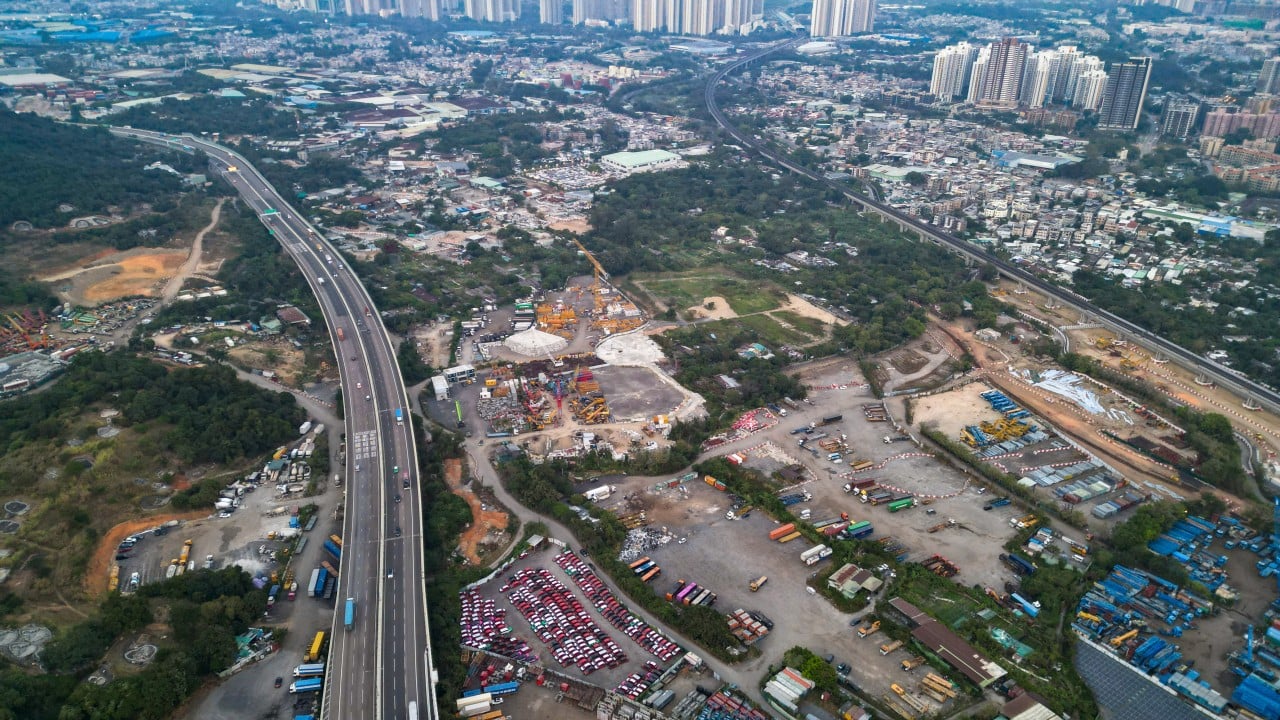
A stack of official papers sitting on a government desk rarely contains the power to shift the geography of a global financial capital. Yet, when the clock struck noon on a humid Friday in Hong Kong, the closing of a tender box at the Development Bureau marked exactly that.
For decades, the city has grown according to a predictable script. Capital flooded into the glittering, vertical corridors of Hong Kong Island and Kowloon, while the vast stretches of land bordering mainland Shenzhen remained a quiet expanse of brownfield sites, old villages, and container yards. To the casual observer, the north was an afterthought. To the city’s planners, it was the final frontier.
Now, that frontier is being claimed under an entirely new philosophy of urban survival.
The official announcement was wrapped in the standard vocabulary of bureaucracy: the closing of the tender for the 11-hectare Hung Shui Kiu/Ha Tsuen pilot area. It is the first major test of Hong Kong’s large-scale land disposal model, a strategy designed to build the ambitious Northern Metropolis faster than traditional bureaucratic machinery allows.
But stripped of the administrative jargon, this is a story about a radical shift in power, risk, and responsibility. The government is attempting to act as a matchmaker, forcing traditional property tycoons into arranged marriages with industrial operators.
The stakes are higher than the balance sheets suggest. If this gamble succeeds, it creates a self-sustaining engine of technology, housing, and commerce right on China's doorstep. If it fails, it risks leaving a massive, half-baked scar on the territory's northern landscape.
Breaking the Concrete Monopoly
To understand why this tender matters, you have to look at how Hong Kong was built. Historically, land sales were straightforward, almost clinical affairs. The government carved out a plot of land, put it up for auction, and a single mega-developer wrote a massive check. That developer built residential towers, sold them for astronomical sums, and walked away with a handsome profit.
It was an efficient system for generating government revenue and building high-rises. But it was entirely unsuited for building a modern, integrated tech economy.
Consider the fundamental conflict of interest between a real estate developer and a technology company. A developer wants the highest possible rent per square foot today. A biotechnology startup or an advanced logistics firm needs specialized infrastructure, long-term stability, and affordable space to experiment, fail, and scale. Left to the open market, concrete almost always wins over innovation.
The Hung Shui Kiu pilot site forces a truce between these competing forces. Out of the 11 hectares up for grabs, only 2.6 hectares are earmarked for profitable residential development. A much larger slice—5.5 hectares—is strictly reserved for industrial and technology use, alongside public walkways and community spaces.
The catch? The winning bidder can’t just build the lucrative apartments and ignore the rest. They are legally bound to build the entire ecosystem. They must flatten the earth, lay the pipes, build the roads, construct the public facilities, and develop the industrial hubs.
The financial logic is an exercise in cross-subsidization. The government is essentially telling the private sector to use the quick, guaranteed cash flow from selling luxury flats to fund the slow, high-risk, long-term construction of the technology park next door.
The Weight of the Envelopes
When Secretary for Development Bernadette Linn stepped forward to announce that two major bids had been received, the collective sigh of relief in government offices was palpable. In a cautious economic environment, getting corporate titans to commit to an experimental, multi-year mega-project was never a guarantee.
The names behind the bids reveal a shifting tide. One bid came from Henderson Land Development. The other was a massive joint venture led by China Overseas Land & Investment and Sino Land, flanked by four other corporate players.
The real victory for the administration, however, wasn't just the names on the paper. It was the structure of the entities themselves. Every single bid received was a consortium. Property developers did not show up alone; they brought industrial operators, logistics experts, and technology managers to the table.
This is where the government’s unusual tendering rules altered the game.
In a standard land auction, the highest price wins. Period. It is a raw contest of financial muscle. But for Hung Shui Kiu, the Development Bureau deployed a strict two-envelope tendering system.
The first envelope contains the premium proposal—the cold, hard cash the bidder is willing to pay the city. This financial offer accounts for a meager 30 percent of the total score.
The second envelope contains the non-premium elements—the actual vision for the site. This envelope carries a massive 70 percent weighting. A dedicated Tender Assessment Panel, packed with directorate officers and chaired by the Permanent Secretary for Development, is currently dissecting these plans.
They aren't looking at who can write the biggest check. They are evaluating who can actually attract strategic global industries. They are assessing who can guarantee the fastest construction timeline, who has a credible plan to bring in substantial corporate investment, and who will create real, sustainable jobs for the thousands of people expected to move north.
The Invisible Footsteps on the Ground
It is easy to get lost in the macro-economics of a multi-billion-dollar tender, but the reality of Hung Shui Kiu is written on the ground.
Imagine a long-time resident of the western New Territories. For a generation, living here meant a grueling, ninety-minute commute on congested trains or highways just to reach an office in Central or Tsim Sha Tsui. The north was where you slept; the south was where you lived, worked, and spent your money.
The Northern Metropolis is an attempt to smash that daily asymmetry. The site at Hung Shui Kiu is strategically positioned close to the future Hung Shui Kiu Station on the Tuen Ma Line, scheduled for commissioning in 2030. It is designed to sit at the convergence of three separate rail networks, including the planned Hong Kong-Shenzhen Western Rail Link, which will bridge the gap between Hong Kong and the economic powerhouse of Qianhai just across the border.
But a railway station is just cold steel and concrete without a destination. By embedding an enterprise and technology park directly into the residential fabric, the project aims to create a community where a software engineer, a logistics manager, or a data analyst can walk to work, buy groceries, and raise a family without ever needing to cross the mountains into the old urban core.
To make this space available, the government has to undertake the messy, deeply human work of land resumption. Before a single excavator turns over the soil, the administration must clear private plots, negotiate compensation, and arrange rehousing for local households and small business operators. It is a logistical jigsaw puzzle where human lives, livelihoods, and histories must be carefully relocated to make way for the future.
A Capitalist Experiment with Civic Strings
There is a distinct vulnerability in this entire enterprise. The government is trying to play the role of a master strategist while relying entirely on the animal spirits of private capital.
By forcing developers to handle site formation and infrastructure, the state is offloading immense financial risk. The private sector is notoriously efficient at keeping construction projects on time and under budget when their own profit margins are on the line. The land premium bids submitted on Friday have already factored in these massive, hidden engineering costs.
Yet, this model requires a delicate balance. If the government ties too much red tape around the industrial sites, developers will balk at the risk and walk away. If the government is too lenient, the city risks getting substandard public facilities and industrial buildings that sit empty while the residential towers are sold off for a quick buck.
The evaluation process is moving at an uncharacteristic sprint, with officials targeting an award date by the end of August. What happens over the next few weeks inside those closed assessment rooms will dictate the blueprint for the remaining two pilot areas in Fanling North and the San Tin Technopole.
The old Hong Kong grew by looking inward, clinging to the deep-water harbor that made its fortune. The new Hong Kong is being forced to look outward, stretching toward a northern horizon where the borders between two distinct economic systems are blurring into a shared digital future.
The envelopes are on the table. The alliances have been forged. The true test of whether a city can mandate innovation through real estate is about to begin.