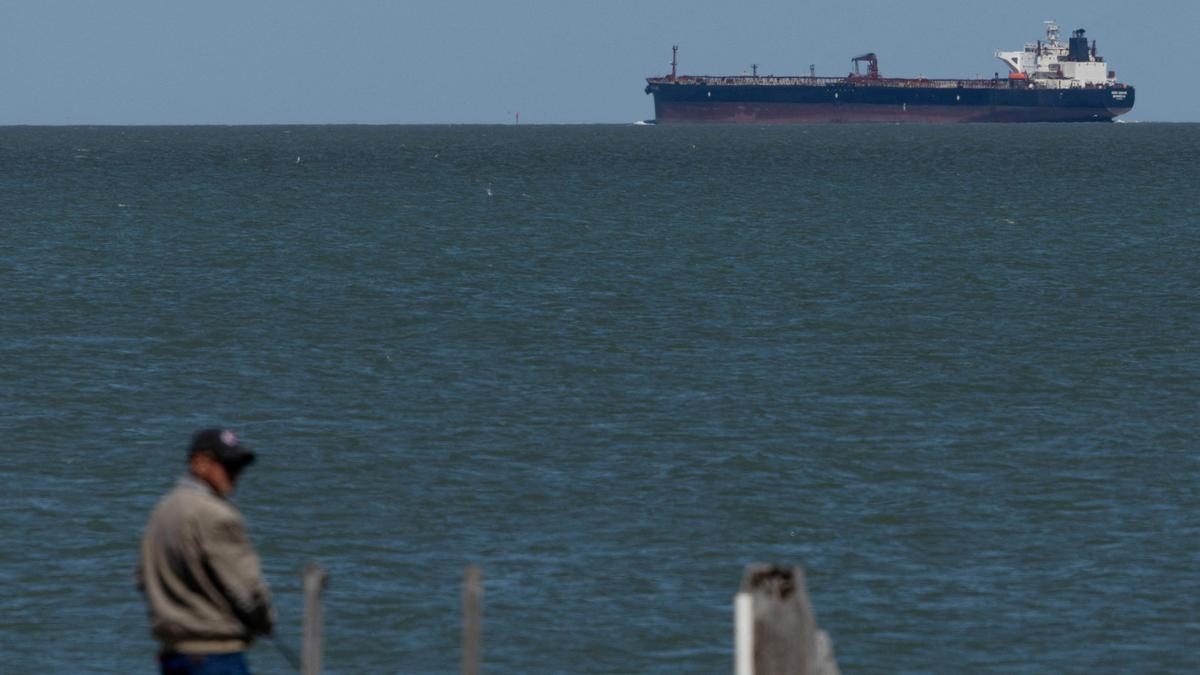
The headlines are screaming about a "breach" in the Persian Gulf. They want you to believe that a few U.S.-sanctioned supertankers slipping through a maritime blockade is a failure of intelligence or a lapse in enforcement.
They are wrong.
The arrival of these vessels isn't a crack in the system. It is the system functioning exactly as intended. The "blockade" as described by mainstream analysts is a convenient fiction—a geopolitical security blanket that makes Western observers feel like they still control the global flow of molecules.
I have spent two decades tracking commodity flows and the dark fleet's evolution. I have seen the same "shocked" reports every time a VLCC (Very Large Crude Carrier) pops its AIS transponder back on near the Strait of Hormuz. The shock is performative.
The Paper Tiger of Maritime Sanctions
Mainstream media treats sanctions like an impenetrable wall. In reality, sanctions are a tax.
When the U.S. Treasury’s Office of Foreign Assets Control (OFAC) blacklists a vessel, they aren't making it vanish. They are simply increasing the cost of doing business. The "sanctioned" label creates a price floor for risk. It drives the ship into the "dark fleet," a sophisticated, multi-layered infrastructure of shell companies, flags of convenience, and ship-to-ship (STS) transfer hubs that operate with more efficiency than most legitimate logistics firms.
The "blockade" is a ghost. There is no physical line of warships preventing movement. There is only a digital registry of "bad actors" that a significant portion of the world’s energy-hungry nations has decided to ignore.
The AIS Deception Gap
The biggest misconception is that turning off an Automatic Identification System (AIS) is a "sneaky" tactic. It's not. It's standard operating procedure.
Current satellite monitoring and Synthetic Aperture Radar (SAR) can track a 300-meter steel beast from space regardless of whether its transponder is screaming "I'm here." The U.S. and its allies know exactly where these ships are. They aren't "slipping through." They are being allowed to pass because the alternative—physically seizing every vessel—would trigger a global energy shock that would incinerate the political capital of any administration in power.
Why We Need the Dark Fleet
Here is the truth nobody wants to admit: The global economy requires these sanctioned tankers to succeed.
Imagine a world where every sanction was 100% effective. Crude oil from Iran, Russia, and Venezuela would be completely removed from the daily supply. We are talking about millions of barrels per day.
If the "blockade" actually worked:
- Brent crude would instantly spike to $150 or $200 a barrel.
- The inflationary pressure would collapse European manufacturing.
- Logistics costs for every physical good on earth would double.
The sanctioned tankers are the safety valve of the global economy. They provide the "discounted" barrels that keep China’s refineries running and India’s transport sector fueled. By maintaining the pretense of a blockade while allowing the reality of the trade, the West gets to look tough on paper while avoiding the bread lines at home.
The Sophistication of "Dark" Logistics
Critics call these ships "rust buckets." That is a dangerous underestimation.
While some older hulls are indeed a maritime hazard, the tier-one operators of the dark fleet are running a tech-stack that rivals major carriers. They use sophisticated "spoofing" technology to broadcast false coordinates, making a ship appear to be in the South China Sea while it's actually loading in the Gulf.
The Chemistry of Evasion
The most misunderstood aspect is the "identity wash." A sanctioned tanker doesn't just deliver oil; it delivers a chemical transformation. Through STS transfers in places like the Sohar anchorage or the waters off Malaysia, sanctioned crude is blended with "legitimate" grades.
The resulting cocktail is sold with new paperwork. It isn't "Iranian Heavy" anymore; it's a "Middle Eastern Blend" or "Malaysian Grade." The banks look at the certificates of origin, see a clean paper trail, and process the payments. This isn't a failure of the blockade—it’s the market’s way of routing around a damaged node.
The Expertise of the Shadow Shipowner
I’ve sat across the table from the men who finance these "ghost" ships. They aren't pirates in eye patches. They are sophisticated maritime lawyers and former commodity traders from Geneva and Dubai.
They understand the $\text{Risk/Reward Ratio}$ better than any bureaucrat in D.C.
Consider the math of a single voyage. A VLCC carrying 2 million barrels of crude bought at a $20 discount per barrel creates a $40 million margin. Even if the ship is seized or the insurance is voided, a single successful run can pay for the entire hull and the next three voyages.
When the profit margin exceeds the cost of the asset in a single transaction, your "blockade" is nothing more than a minor business expense.
The Myth of the "Environmental Time Bomb"
The "lazy consensus" says these tankers are an environmental disaster waiting to happen. While it’s true that they lack standard P&I (Protection and Indemnity) insurance, the dark fleet has a vested interest in not spilling oil.
A spill brings the one thing a shadow operator cannot survive: massive, direct, physical scrutiny from every navy and coast guard in the region. They maintain their vessels better than the media suggests because the cost of a spill isn't just a fine—it’s the total destruction of their multi-billion dollar trade route. They operate under a "Private Law" system where reputations and successful deliveries are the only currency that matters.
Stop Asking "How Did They Get Through?"
The question itself is flawed. It assumes they weren't supposed to be there.
The presence of sanctioned tankers in the Gulf isn't a sign of weakness; it's a sign of a new, multipolar reality. The era where a U.S. Treasury memo could stop a ship in its tracks is over.
We are moving toward a bifurcated global economy:
- The Transparent Market: High overhead, high regulation, low margin.
- The Shadow Market: High risk, zero regulation, massive margin.
These two markets are not separate. They are connected by a thousand invisible threads of blending, re-flagging, and re-invoicing.
The next time you see a report about a sanctioned tanker "entering the Gulf despite the blockade," don't look for the hole in the fence. Look at the people who are quietly buying the oil once the cameras are turned off.
The blockade isn't being broken. It is being ignored by anyone who actually matters in the global energy trade.
The tankers aren't the problem. They are the market's response to the delusion that you can control the world's most vital commodity with a PDF and a press release.
Get used to the sight of them. They are the only ones playing the game honestly.