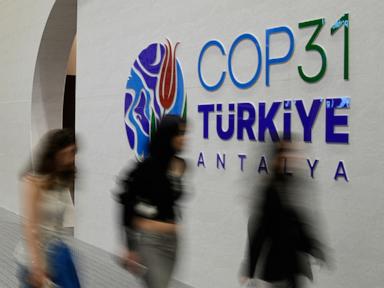
The coffee in the plastic cup turned cold two hours ago, but nobody in the plenary hall has touched it anyway.
It is 3:15 AM in a cavernous venue built for air-conditioned order, yet the air smells of stale sweat, wool suits, and synthetic carpets. Delegates from nearly two hundred nations are slouched in ergonomic chairs designed for ninety-minute speeches, not forty-eight-hour marathons. On the main dais, a exhausted diplomat runs his hand across his face, his wedding ring catching the harsh fluorescent light. Behind him, the digital clock ticks silently into overtime.
Outside these doors, the global climate is not waiting for a quorum. Glaciers melt according to the unyielding laws of thermodynamics, not the schedule of international diplomacy. But inside, the entire world is trapped in a war of verbs.
Whether the final text will say phase out or phase down. Whether the commitment is urged or mandated. Whether relief money is framed as reparations or voluntary assistance.
To the casual observer scanning a headline on a morning commute, these linguistic battles look like bureaucratic theater—the ultimate expression of geopolitical navel-gazing. But stand in that hallway at dawn, watch a delegate from a sinking Pacific island nation break down into silent tears outside a closed-door consultation, and the illusion of dry policy evaporates.
The jargon isn't fluff. It is a calculated, desperate proxy war for human survival.
The Room Where Time Stretches
Imagine a negotiation table where two completely different realities collide.
On one side sits a representative from a low-lying archipelagic state. Let's call her Amina—a hypothetical composite of the very real envoys who walk these halls. In Amina’s home village, high tide is no longer a tidal event; it is an intrusion into the kitchen. Her country’s total gross domestic product is a fraction of what a single multinational energy firm spends on deep-water exploration in a single quarter. For Amina, every hour this conference lingers without a firm financial commitment is not an abstract political setback. It is a direct line drawn through the schoolyard where her daughter plays, marking where the ocean will reach by 2035.
On the other side sits a lead negotiator for a major industrial economy. He is not a cartoon villain. He is a career public servant chained to a domestic legislature back home that is balance-sheet obsessed and politically fractured. He knows that agreeing to an un-capped financial liability clause means his government will face a brutal backlash at the polls next autumn, potentially ushering in leadership that will tear up the treaty entirely.
So they sit. They posture. They trade commas for capital investments.
When climate summits push past their official deadlines, it isn't because people are slow workers. It happens because the international system was constructed to preserve national sovereignty above all else. Under the governing framework of these talks, decisions require consensus. Not a majority. Not a two-thirds vote. Consensus.
That means a single nation dependent on heavy crude exports can hold the same legal veto power as an entire coalition of vulnerable island nations. It is a design flaw that makes progress excruciatingly slow, yet it remains the only legal architecture we have to bring everyone to the same table.
The Math of Human Suffering
It is easy to get lost in the financial figures tossed around the negotiation halls. One hundred billion dollars here. Four hundred billion for loss and damage there. The numbers become so vast they lose all texture, sounding like monopoly money drawn from an infinite planetary ledger.
To ground this abstract math, we have to look at what happens when the money fails to arrive.
Consider a smallholder farmer in the Horn of Africa. After four consecutive failed rainy seasons, the soil on his three-acre plot has dried into a hard, pale crust that rejects the plow. He doesn't read the draft texts coming out of the summit. He doesn't know what article 6.4 means. He only knows that his livestock are dead, his well is empty, and his family must walk thirty miles to an overcrowded displacement camp.
When delegates debate the creation of a global loss and damage fund, they are effectively debating his grocery bill. They are asking: who pays when a country suffers damage it did not cause and cannot adapt to?
Historically, the industrial powers produced the vast majority of atmospheric carbon accumulated since the dawn of the steam engine. Yet the countries bearing the immediate, devastating costs of global warming are overwhelmingly those that contributed less than one percent of global emissions.
That is the moral rift underneath every overtime session. It isn't just about environmental policy; it is an unresolved argument about global justice. When rich nations hesitate to sign binding financial commitments, vulnerable nations view it as a betrayal of fundamental equity. When developed nations demand immediate emission cuts from emerging economies without offering capital for clean infrastructure, those emerging economies see a ladder being pulled up just as they try to climb out of poverty.
The Mirage of the Breakthrough
Every few years, a climate conference yields a moment of high drama. The gavel strikes at 4:00 AM. Exhausted ministers embrace. The press releases proclaim a historic breakthrough.
Then comes Monday morning.
The fundamental tension of international climate agreements is that they carry immense moral authority but almost no hard enforcement mechanisms. There is no international environmental police force tasked with fining a nation that misses its emission targets. The entire apparatus relies on a mechanism colloquially known as name and shame—the belief that public scrutiny and economic peer pressure will force sovereign states to honor their pledges.
Sometimes it works. Investments in renewable energy have surged globally at rates that were unthinkable two decades ago. Solar and wind power are now cheaper than fossil fuels in most major markets, driven in part by the policy signals sent by these very summits. The trajectory of global warming has shifted downward from catastrophic projections of four or five degrees Celsius toward something closer to two and a half degrees.
That is real, measurable progress. It has saved millions of lives.
Yet two and a half degrees is still a world of unmanageable fires, flooded coastal cities, and destabilized food systems. The gap between what has been promised and what the physics of the atmosphere requires remains a chasm.
That gap is why these negotiations feel so suffocatingly intense. Everyone in that room knows the math. Scientists publish updated reports almost daily, reinforcing the same relentless truth: greenhouse gas emissions must drop precipitously within this decade to avoid crossing irreversible tipping points.
Every year spent arguing over phrasing is a year consumed by the clock.
The Weight of the Morning After
As the sun begins to rise over the venue, illuminating the glass facade of the convention center, the cafeteria workers arrive to set up breakfast for a crowd that hasn't slept.
Negotiators emerge from small side rooms in clusters, their ties loosened, holding papers covered in redline edits and handwritten scrawls. The final draft is coming. It will contain compromises that satisfy almost no one entirely. Environmental advocates will call it a spineless surrender to fossil fuel interests. Heavy industry will quietly complain that it sets unrealistic burdens. Developing nations will accept it with heavy hearts, knowing it falls far short of what their people actually need to survive the coming decades.
Yet, they will sign it.
They will sign it because the alternative—a collapse of the multilateral system into pure economic and ecological nationalism—is far worse. In a world where every country acts solely in its short-term self-interest, the weak are devoured first, and the strong eventually succumb to the systemic collapse of the global biosphere.
The overtime hours of a climate summit are not a sign that the system is broken; they are proof of how impossibly hard it is to repair a world in real time. Rebuilding the energy infrastructure of human civilization while keeping the lights on for eight billion people is the most complex task humanity has ever attempted.
As the final plenary session is called to order, Amina takes her seat near the front of the hall. She adjusts her headphones to catch the simultaneous translation, takes a breath, and lifts her country's nameplate into the air to speak one more time.
Beyond the glass walls, the sky turns grey with the coming day. The ocean rolls quietly against distant shores, completely indifferent to the words written on the paper, waiting to see what we do next.