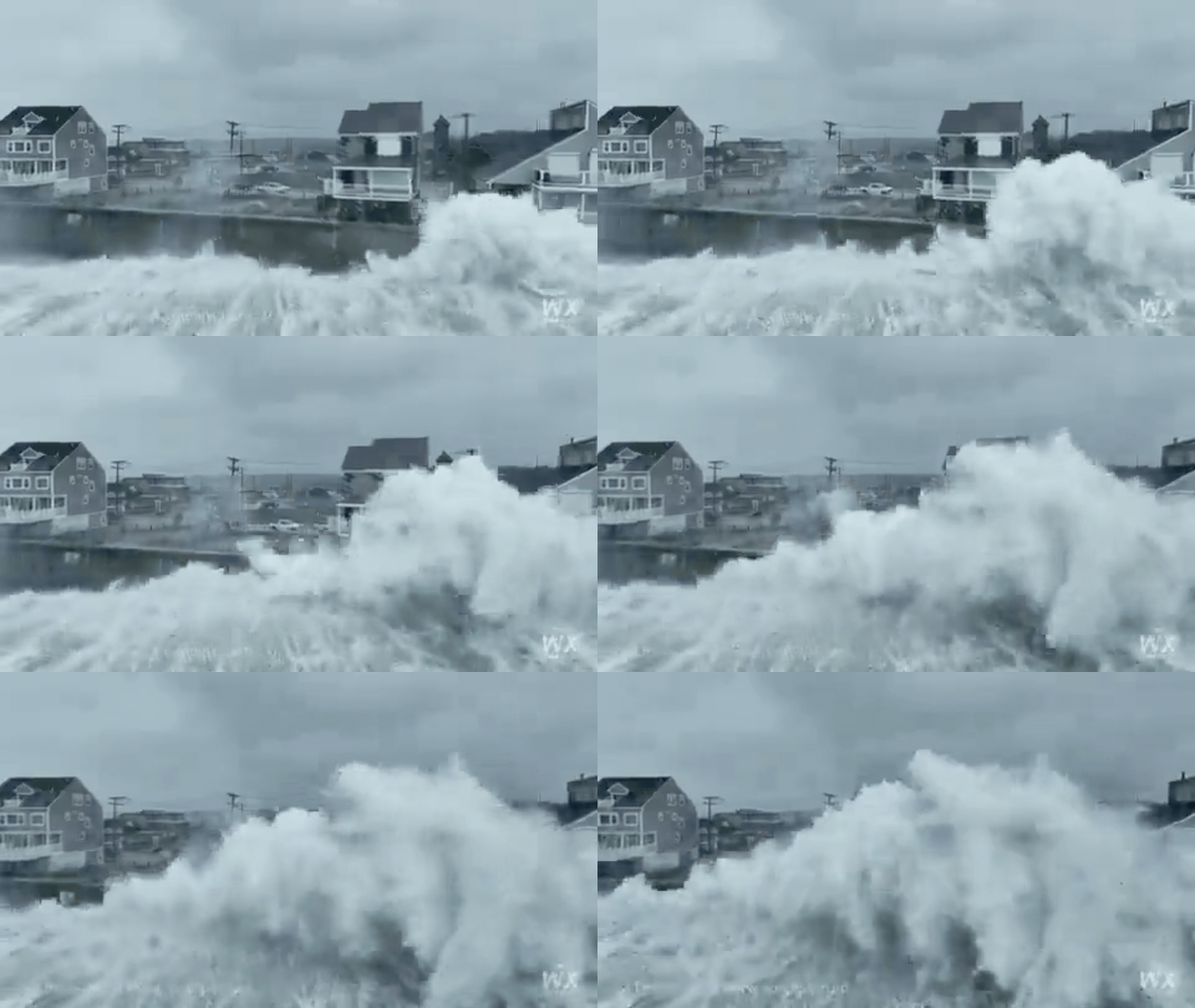
Every time a cold front drops down from Canada and meets warm Atlantic moisture, the media turns into a panic machine. You get the standard drone footage of twenty-foot waves chewing up boardwalks, breathless meteorologists clinging to lampposts, and politicians warning residents to stay off the roads. The narrative is always the same. Mother Nature is angry, the storm is an unprecedented beast, and coastal communities are helpless victims of atmospheric wrath.
It is lazy, theatrical nonsense.
The storm itself is not the crisis. The crisis is a multi-billion-dollar cocktail of poor municipal planning, outdated building codes, and federal insurance subsidies that literally pay people to rebuild in the exact same path of destruction year after year. We treat nor'easters like random acts of God when they are actually entirely predictable financial and engineering failures.
Let us look at the mechanics of what actually happens when a powerful low-pressure system parks itself off the mid-Atlantic coast. A standard nor'easter generates sustained winds from the northeast because counterclockwise circulation pulls arctic air down from the interior while drawing maritime moisture off the Gulf Stream. When that fetch of wind blows consistently over a long expanse of open ocean for forty-eight hours, it piles water against the shoreline. Combine that setup with a high astronomical spring tide, and you get coastal flooding.
None of this is a secret. Oceanographers and coastal engineers have mapped these dynamics for decades. Yet, every single autumn and winter, headlines shriek about twenty-foot waves as if rogue walls of water materialized out of nowhere to punish New England.
The lazy consensus says we need better evacuation routes and higher seawalls. Both ideas are economic dead ends.
The Seawall Fallacy
Building taller concrete barriers against the Atlantic Ocean feels proactive. It gives mayors something to cut ribbons in front of. It makes homeowners feel secure behind their gray slabs of poured aggregate.
It also accelerates erosion and guarantees catastrophic failure down the road.
When you armor a coastline with a seawall, you interrupt the natural sediment budget. Beaches rely on the dynamic exchange of sand between dunes and the surf zone to absorb wave energy. Put up a rigid concrete wall, and the backwash from breaking waves scours the sand right out from underneath it. Within a decade, the beach in front of the seawall disappears entirely, leaving the structure exposed to deeper water and even more violent hydraulic forces.
I have watched municipalities spend tens of millions of dollars on rock revetments and bulkheads that get ripped apart by the next moderate gale. It is an exercise in throwing hard currency into the surf. You cannot out-engineer a rising sea and a permanent storm track with concrete. Every dollar spent maintaining a doomed beachfront property is a subsidy
Stop Blaming Climate Change For Every Nor Easter That Wrecks The Coast
news
Every time a weather map turns violently purple and a 20-foot wall of water pounds the US East Coast, the media script is painfully predictable. Pundits line up to point at rising temperatures, rising seas, and a broken atmospheric machine. They want you to believe that a vicious nor'easter battering Boston or the Outer Banks is an unprecedented, apocalyptic visitor sent exclusively by our carbon-heavy sins.
It is a lazy narrative. And it is completely wrong.
Nor'easters are not modern anomalies invented by industrialization. They are the original architects of the Atlantic seaboard. They built the barrier islands, shaped the estuaries, and carved the marshlands long before a single coal-fired plant existed. Treating every severe low-pressure system as a shocking climate anomaly prevents us from confronting the real culprit behind the billions of dollars in structural damage.
We are not losing the coast to the ocean. We are losing it to bad real estate choices.
The Engineering Fallacy Of Fighting Ocean Physics
For decades, coastal management relied on a fundamentally arrogant assumption: we can build hard barriers to keep the Atlantic in check. Millions of tons of granite rip-rap, massive concrete seawalls, and billion-dollar beach replenishment projects litter the coastline from Maine to Florida.
I have watched local municipalities burn through municipal reserves year after year, pumping sand onto eroding beaches only for the next autumn gale to drag it back out to sea within a single tidal cycle. It is an economic shell game.
Imagine a scenario where a beachfront community stops spending tax revenue on temporary sand hauling and instead redirects every dollar toward aggressive, managed retreat. The pushback is always immediate. Property owners scream about real estate values. Local politicians panic over lost tax bases. Yet, doubling down on static zoning in a dynamic, high-energy environment defies every basic principle of fluid dynamics and coastal geology.
The nor'easter is not malicious. It is simply behaving like a nor'easter. When cold air plunging down from Canada collides with warm moisture evaporating off the Gulf Stream, a thermodynamic engine fires up. High winds whip the surface water into massive kinetic waves, driving storm surges onto the continental shelf. The geography of the East Coast, with its shallow bays and heavily populated barrier spits, acts as a funnel.
Blaming the wind and the waves misses the structural engineering failure happening on dry land. We built million-dollar homes on shifting sand dunes and expected nature to RSVP to our property tax assessments.
The Real Numbers Behind The Surge
Let us look at the actual mechanics of what happens during a severe coastal storm. When wind speeds sustain gale-force levels for 48 hours over a fetch of open ocean, the sheer friction moves colossal volumes of water. A standard nor'easter can push water levels three to five feet above normal astronomical tide charts. Add heavy astronomical spring tides, and you get coastal flooding that breaches bulkheads built in the 1970s.
Those bulkheads were engineered for historical baselines that no longer apply, not because the physics changed, but because the margin for error dropped to zero. When developers packed high-density housing into low-lying salt marshes, they eliminated the natural sponge effect of wetlands. A marsh can absorb millions of gallons of storm surge energy before it ever reaches dry ground. Pave that marsh over with asphalt and luxury condominiums, and the water has only one place to go: your living room.
We treat every flooded intersection in Norfolk or Charleston as a sudden crisis, yet we continue to issue building permits for ground-level retail spaces in flood zones. The institutional inertia is staggering. Insurance subsidies underwrite risk in ways that defy market logic, keeping high-risk properties artificially viable on the taxpayer's dime.
Dismantling The Panic
The common media coverage focuses heavily on wind gusts and wave heights, terrifying viewers with dramatic footage of piers splintering. While visually arresting, focusing exclusively on the violence of the storm distracts from the institutional failure of our zoning laws.
Why do we keep rebuilding in the exact same footprint after every major storm cycle?
The answer lies in subsidized federal flood insurance and local tax incentives that reward short-term municipal revenue over long-term structural resilience. As long as the federal government acts as an unlimited backstop for repeated rebuilding in high-hazard velocity zones, local governments have zero financial incentive to zone sensibly.
We need to redefine what resilience means. It does not mean building a higher seawall. Hard structures accelerate erosion on adjacent properties by deflecting wave energy downward, scouring the base of the wall until it collapses. True resilience means accepting that the shoreline moves. It means buying out repetitive loss properties, restoring natural dune buffers, and moving critical infrastructure out of the reach of the next low-pressure system rolling up Cape Hatteras.
Stop asking how we can stop the storms. They have been spinning up off our coast for millennia, and they will be here long after every concrete seawall currently standing has crumbled into aggregate.
Start asking why we keep inviting them in.