You can't just press a button, let go of the steering wheel, and expect the law to shield you when things go horribly wrong. For years, drivers have tried to use the "the car was driving itself" excuse to escape responsibility after devastating accidents. A recent criminal case out of Texas shows exactly why that defense is completely dead.
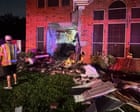
In Harris County, Texas, prosecutors officially charged 44-year-old Michael David Butler with manslaughter following a fatal crash on June 19. Butler was driving his Tesla Model 3 in Katy, a suburb of Houston, while making deliveries for DoorDash. His car veered off the road and plowed straight through the front wall of a suburban home, pinning and killing 76-year-old grandmother Martha Avila inside.
When paramedics arrived at the horrific scene, Butler immediately claimed that the vehicle was operating on Autopilot. He told police he was simply changing the music on his touchscreen right before he "passed out." But when investigators pulled the car's data recorder, the story crumbled completely. The digital footprints left behind by his own vehicle turned a tragic accident into a felony criminal prosecution.
What the Black Box Really Revealed
Cars don't lie, and they don't forget. The criminal complaint filed in Harris County's 208th District Court proves that modern vehicle telemetry tracks every millisecond of driver input. While Butler claimed his vehicle took over or that he lost consciousness, Tesla’s black box data painting a very different picture.
According to investigators, Butler had been using Full Self-Driving software during his delivery routes. The automated system was performing as intended until Butler decided to step in. The logs show that as the car approached a stop sign, Butler pressed down on the accelerator pedal to force the car through the intersection faster than the automated software preferred. This is a common habit for drivers who get impatient with the slow, deliberate stops required by the National Highway Traffic Safety Administration.
Seconds later, the software turned on a blinker and prepared to steer left toward the next delivery drop-off. Instead of letting the car turn, Butler hit the accelerator again. This time, he didn't just nudge it. The telemetry logs indicate the accelerator pedal was pushed down to 100% capacity. He went pedal to the metal in a quiet, residential cul-de-sac.
The vehicle shot straight ahead instead of turning, hitting a staggering 73 miles per hour. That is more than double the legal speed limit for a residential neighborhood. The car's data also proved that Butler did not touch the brake pedal once during the final minute leading up to the impact.
The Search History That Sealed the Case
The physical actions inside the cabin were bad enough, but prosecutors uncovered something even more damning. Investigators obtained a search warrant for Butler’s digital records and cell phone. They found that in the weeks leading up to the fatal incident, Butler had been running specific Google searches expressing frustration with Tesla's software.
His search history showed queries complaining that Full Self-Driving was too timid or too slow. He was actively looking for ways to make the car drive more aggressively. When you pair those searches with the black box data, the prosecution's narrative writes itself. Butler wasn't a passive passenger riding in a rogue vehicle. He was an impatient driver overriding a cautious system, forcing the car to move faster than it wanted to go.
Tesla executives quickly moved to distance the company from the incident. Ashok Elluswamy, the vice president of artificial intelligence software at the company, stated publicly that the driver manually overrode the system by flooring the pedal. Elon Musk chimed in too, pointing out that the high-speed nature of the crash contradicts how the software operates in quiet neighborhoods.
The Myth of the Driverless Tesla
The biggest issue here is a massive misunderstanding of what these vehicle systems actually do. Tesla markets its features under names like Autopilot and Full Self-Driving. These terms imply that the car can handle trips entirely on its own. The reality is much more mundane.
According to the Society of Automotive Engineers, driving systems are graded on a scale from Level 0 to Level 5. A Level 0 vehicle has no automation at all. A Level 5 vehicle is entirely autonomous, requiring no steering wheel, pedals, or human intervention.
No passenger car available for public purchase sits at Level 5. Tesla's systems are firmly categorized as Level 2 automation.
A Level 2 system can manage steering, acceleration, and braking under specific conditions, but it requires a fully attentive human driver at all times. The driver is legally responsible for monitoring the road, keeping their hands on the wheel, and taking control the instant something unexpected happens.
When you activate these features, a warning pops up on the screen reminding you to stay alert. The vehicle monitors your attention using cabin cameras and steering wheel torque sensors. If you ignore those warnings or actively stomp on the gas pedal, you are the one flying the plane.
Civil Lawsuits and Federal Inquiries
The criminal manslaughter charge is just one layer of the legal fallout from this crash. The family of Martha Avila has already launched a massive wrongful death lawsuit targeting both Butler and Tesla.
The lawsuit alleges gross negligence on Butler's part for his reckless operation of the vehicle. It also takes aim at Tesla for a failure to warn consumers properly about the limitations of its technology. The family's attorneys argue that marketing software as Full Self-Driving creates a false sense of security that leads to preventable tragedies.
The federal government is stepping in as well. The National Highway Traffic Safety Administration and the National Transportation Safety Board both launched independent investigations into the Katy crash. These agencies have opened nearly 50 special investigations into crashes involving advanced driver-assistance systems since 2016. Those incidents have resulted in roughly two dozen reported fatalities.
Regulators are looking closely at whether these systems give drivers too much room to misbehave. If a car detects that a driver is traveling at 73 mph in a 30 mph zone while heading straight for a house, should the vehicle intervene and ignore the human's input? It is a complex ethical question that automakers and government officials are still wrestling with.
How to Protect Yourself and Others on the Road
If you drive a vehicle equipped with advanced lane-keeping or automated acceleration features, you need to change how you look at the technology. It is a tool to reduce highway fatigue, not a license to check out.
First, never override the system to force a high-speed maneuver. If the software is driving too slow for your taste in a residential area, disengage the system entirely and drive manually. Stomping on the gas while the car trying to steer creates a dangerous conflict between human input and machine logic.
Second, understand that your car is recording you. Every tap of the brake, every push of the accelerator, and every steering adjustment gets written to a storage module. If you cause an accident, investigators will know exactly what you did with your feet and hands in the seconds before impact. You cannot blame a software glitch when the physical logs show you floored the pedal.
Keep your eyes on the road, keep your foot ready to hit the actual brake, and treat the software like a student driver you are supervising. If you don't, you could easily find yourself sitting in a jail cell facing a second-degree felony conviction.