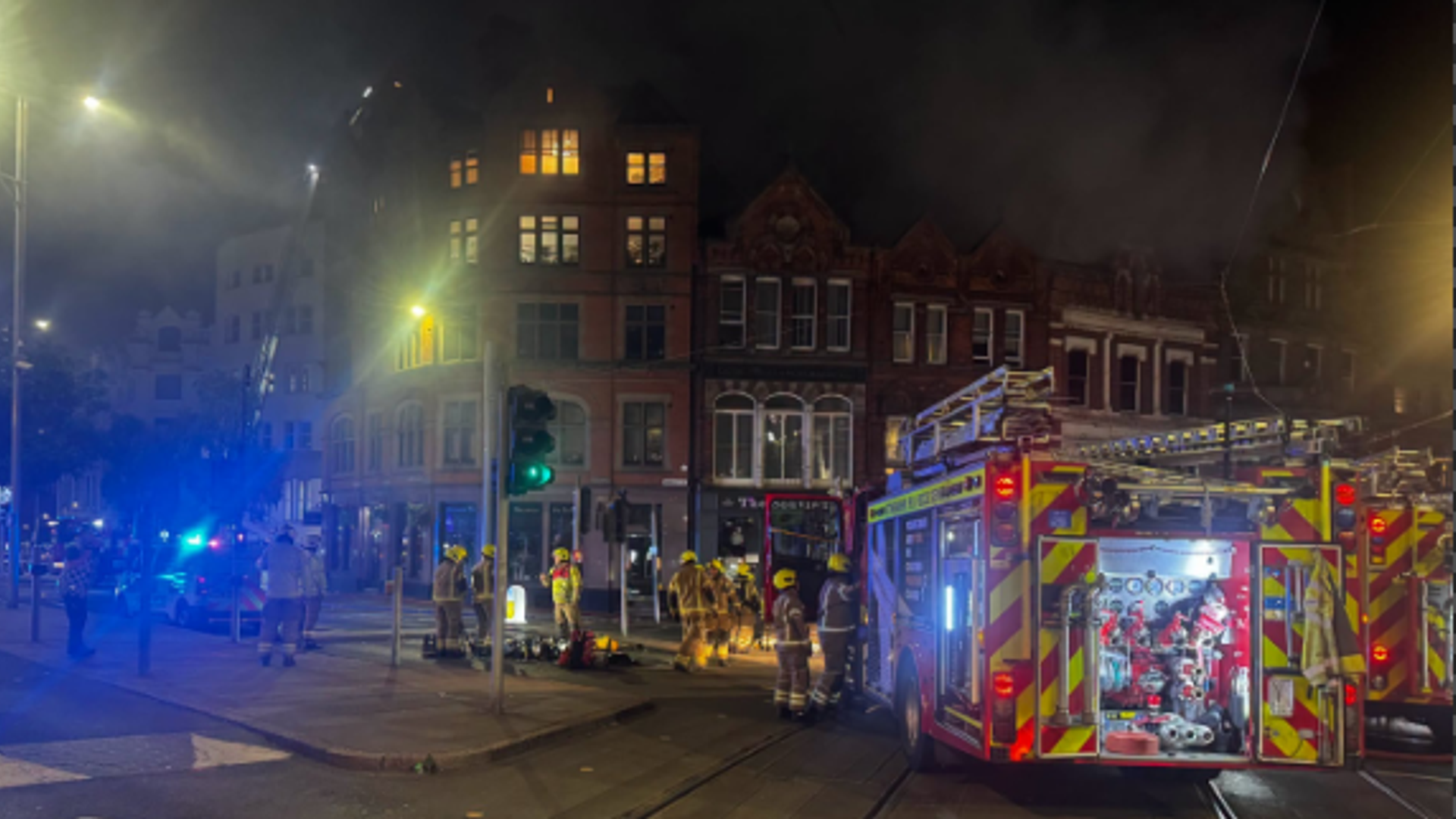
Every time smoke billows over an urban center and a major artery gets cordoned off, the reflex narrative writes itself. Local outlets rush to publish breathless timelines, citizens complain about transit misery, and fingers point instantly toward emergency response times or structural failures. When a severe fire shuts down Nottingham city centre, the default public outcry follows a predictable script. People scream about municipal incompetence, outdated infrastructure, or delayed response logistics.
It is a comfortable narrative. It is also entirely wrong.
When you peel back the dramatic photographs of charred masonry and billowing grey smoke, the shutdown of a core commercial district is not a random act of God or a failure of the hoses. It is a calculated, brutal exercise in urban risk management. Yet, lazy commentators treat every city centre closure as a logistical catastrophe rather than what it actually is: a necessary circuit breaker for a fragile commercial ecosystem.
I have spent years watching municipal authorities panic over urban safety margins, and the truth is that Nottingham's temporary paralysis reveals a deeper rot in how we design, insure, and protect modern commercial hubs.
The Myth of the Bulletproof High Street
The standard narrative surrounding urban fires assumes that city centres should be indestructible zones of uninterrupted commerce. If a building goes up in flames, the expectation is that traffic should divert by magic, pedestrians should flow seamlessly around the hazard, and retail sales should not dip for a single second.
This expectation ignores the baseline reality of how commercial real estate actually functions. Most British city centres rely on a delicate density of heritage buildings, tight corridors, and legacy utility networks that were never engineered for twenty-first-century fire loads. When a major blaze takes hold of a central property, the threat is not just the immediate combustion. It is the cascading structural instability of neighboring walls built during the Victorian era.
When authorities slap a cordon around half the city centre, they are not overreacting. They are preventing a localized disaster from turning into a structural collapse. The emergency services do not shut down an entire district because they enjoy causing traffic chaos. They do it because the alternative is gambling with human lives inside a stone-and-mortar canyon where falling masonry can crush a double-decker bus.
Stop treating emergency cordons as an administrative failure. They are a physical symptom of an under-invested built environment.
Why Retailers Panic Over the Wrong Things
Whenever Nottingham city centre faces a major disruption, local business associations flood the media with lamentations about lost revenue. They count every hour of closed foot traffic as pure financial bleeding.
They are looking at the ledger through the wrong end of a telescope.
The financial threat to a modern urban core is not a twenty-four-hour road closure due to a fire. The real threat is the systemic vulnerability of landlords who refuse to modernize fire suppression infrastructure because sprinklers eat into their profit margins. For decades, property owners in historic districts have treated fire safety regulations as a compliance checklist rather than an operational insurance policy.
Imagine a scenario where every commercial landlord in Nottingham was legally mandated to install cutting-edge mist suppression systems. The cost would be steep upfront. But the frequency of total city-centre shutdowns would plummet by eighty percent. Instead, we allow property owners to run century-old retail spaces on the absolute legal minimum of safety investment, and then we act shocked when a single electrical fault brings the entire tram network and retail strip to a grinding halt.
The business owners whining about lost foot traffic during a fire should be directing their anger toward the landlords renting them ticking time bombs.
The Logistics of Chaos
Let us address the transit meltdown. When Nottingham city centre locks down, the ring roads choke, the trams stall, and commuters lose their minds. The public response is invariably to demand better traffic management or more alternative routes.
You cannot route around a bottleneck that is the bottleneck.
Urban planning in historical cities is a zero-sum game. You have a fixed amount of asphalt feeding into a medieval footprint. When a major fire neutralizes a primary junction, there is no secret alternative highway waiting to absorb fifty thousand displaced vehicles. Traffic engineering cannot defy geometry.
The obsession with keeping cars flowing through the heart of a burning or unstable district is a psychological addiction. Cities should be resilient enough to absorb a transit blackout without collapsing into total paralysis. If a single building fire can completely sever the economic life of a region, your regional infrastructure is dangerously brittle.
Other European cities understood this decades ago. They built true pedestrianized cores backed by decentralized transport loops that can isolate a crisis zone without turning the entire metropolitan area into a parking lot. Nottingham’s vulnerability during a major incident is a direct consequence of decades of piecemeal urban patch-work—adding bike lanes here, repaving a square there, without ever rethinking the underlying arterial spine.
The Insurance Conundrum Nobody Mentions
There is another player in every city centre fire shutdown that escapes public scrutiny: the insurance industry.
When a building burns down in a prime commercial zone, the cordon does not lift when the last spark is extinguished. It stays locked down because forensic loss adjusters and structural engineers refuse to sign off on public safety until every square foot of the surrounding facade has been scanned for micro-fractures.
Insurance mandates dictate caution. If an adjuster clears a street too early and a parapet falls on a pedestrian, the liability payout can bankrupt a municipality. Therefore, closures are extended not for safety, but for legal self-preservation.
This creates a perverse incentive. Property owners have little financial motivation to clean up or stabilize sites rapidly because their business interruption insurance covers the downtime. The taxpayer absorbs the cost of police overtime, transit re-routing, and emergency services deployment, while private insurers manage the balance sheets.
Until we tie municipal recovery speed directly to the financial penalties imposed on negligent property owners, city centres will continue to sit paralyzed for days after the flames are gone.
The Real Lesson
Every time Nottingham—or any other city—faces a major downtown fire, we treat it as a freak accident. It is not. It is a stress test of our urban resilience, and we fail it every single time because we refuse to confront the structural flaws in our real estate and transit models.
The fire brigade did not shut down Nottingham city centre. Decades of deferred maintenance, complacent property ownership, and brittle infrastructure did that.
Fix the buildings, hold the landlords accountable, and stop blaming the people holding the hoses.


