The air in the private luxury suite smelled of expensive leather, polished glass, and the distinct, sharp scent of unvarnished ambition. Outside the tinted windows, a stadium hummed with the vibration of eighty thousand screaming souls. But inside, the noise was reduced to a faint, rhythmic heartbeat. Two men stood near the center of the room, looking less like sports executives and more like heads of state plotting the partition of a new continent.
Gianni Infantino adjusted his tie, his face fixed in a practiced, cosmopolitan smile. Opposite him stood Donald Trump.
To the casual observer, it is an odd pairing. One is a Swiss-Italian lawyer who climbed the greasy pole of European football bureaucracy with quiet, calculating precision. The other is a brash New York real estate mogul turned political disrupter who views the entire world through the lens of leverage and television ratings. Yet, watch them together for more than five minutes, and the optical illusion fades. They are cut from the exact same cloth. They speak the same language. It is a dialect composed entirely of numbers, spectacle, and power.
Football—or soccer, depending on which side of the Atlantic you occupy—used to pretend it was above the muck of partisan politics. The governing body of the sport, FIFA, routinely cloaked itself in the language of international diplomacy, acting as a secular United Nations with better branding.
That illusion is dead.
The reality is far more mercenary. As the world’s biggest sporting event descends upon North American soil, a fundamental truth has become glaringly obvious to anyone paying attention.
FIFA cannot say no to Donald Trump.
The Gravity of the American Goldmine
To understand why a Swiss bureaucrat bows to an American politician, you have to look past the jerseys and the flags. You have to look at the balance sheets.
For decades, soccer viewed America the way an eighteenth-century explorer viewed the Northwest Passage. It was a mythic, dangerous territory filled with immense riches that always seemed just out of reach. The old guard of European football looked down on the American market, mocking its lack of history and its stubborn insistence on calling the game by the wrong name.
But modern FIFA does not care about history. It cares about growth.
Consider the sheer scale of the financial engine driving the current tournament. The North American market is not just a participant in the global sports economy; it is the sun around which every other market orbits. The broadcasting rights alone represent a financial ocean. Corporate sponsorships from American conglomerates fund the youth programs in small European villages and build the stadiums in South America.
Imagine a hypothetical mid-level executive at a major television network. Let's call her Sarah. Sarah does not care about the tactical beauty of a false-nine formation or the historical rivalry between Argentina and Brazil. She cares about eyeballs. She cares about the fact that a single prime-time commercial slot during a World Cup match on US soil can command more revenue than an entire season of programming in a smaller European domestic market.
When Trump put his weight behind the United Bid years ago, he changed the math. He did not just offer stadiums; he offered the backing of the world's largest economy. He turned a sporting bid into a matter of state compliance. Infantino recognized immediately that to unlocked this treasury, he needed more than just a stadium agreement. He needed a political guarantor.
The Theater of Absolute Control
Power recognizes power. More importantly, authoritarian egos recognize each other.
Infantino’s rise to the top of FIFA was defined by a steady consolidation of control. He systematically dismantled the old committee structures, replaced independent oversight with loyalists, and shifted the center of gravity within Zurich to his own office. He reshaped FIFA in his own image: centralized, unaccountable, and deeply transactional.
When he looks at Trump, he sees a kindred spirit who achieved the same result on a vastly grander stage.
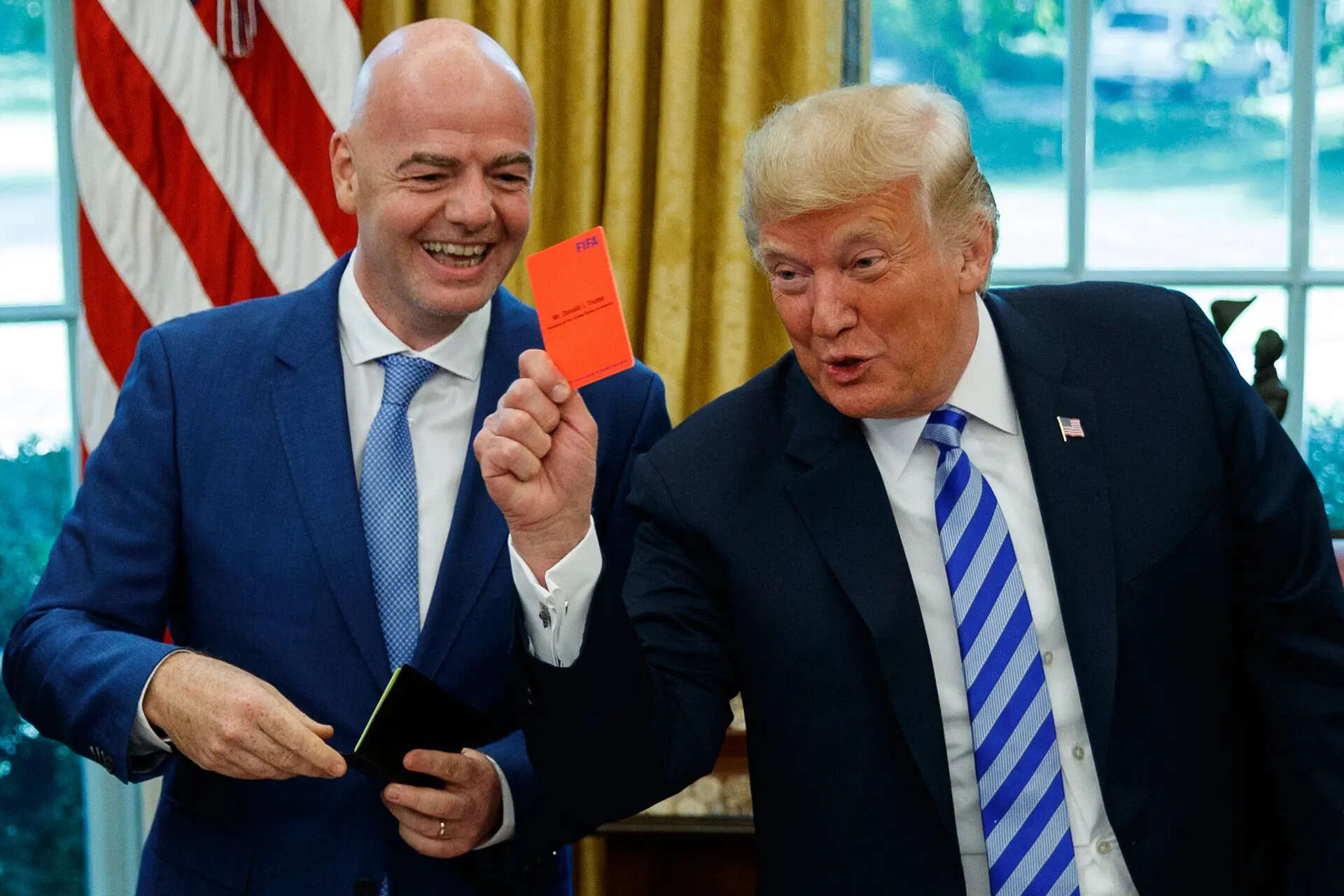
There is a specific choreography to their interactions. Look back at the footage of their meetings in the Oval Office. Infantino handles Trump a yellow card, jokingly suggesting it could be used to penalize the press corps. Trump laughs, mimicking the gesture, throwing his shoulders back. It looks like a lighthearted moment. It is actually a public contract.
By engaging in this public theater, Infantino signals to his internal rivals and his global partners that he has access to the most powerful office on earth. It provides him with an armor of invincibility. If the President of the United States treats the FIFA boss like an equal, who within the football world dares to challenge him?
But this access comes with a steep price tag. Trump does not grant his presence or his blessing for free. The currency he demands is deference, spotlight, and validation.
When the tournament logistics required complex agreements regarding tax exemptions, visa fast-tracking for hundreds of thousands of foreign visitors, and massive federal security guarantees, standard diplomatic channels would have taken years to navigate. Bureaucracy is a slow, grinding machine.
Trump bypassed the machine. With a stroke of a pen and a series of public declarations, the administrative hurdles melted away. For FIFA, a corporate entity that despises sovereign interference unless that interference works in its favor, this was intoxicating. They realized that working with Trump was vastly more efficient than dealing with a traditional, predictable administration that insisted on following standard protocols.
The Invisible Stakes of the Turf War
But the real problem lies elsewhere, buried beneath the superficial glitz of VIP boxes and photo opportunities. The alliance between Zurich and Washington has fundamentally altered the power balance of global sports governance.
For decades, European football—centered around UEFA and the ultra-wealthy clubs of England, Spain, and Italy—held a functional veto over FIFA's ambitions. The best players played in Europe. The most lucrative club competitions happened in Europe. Infantino was constantly checking his rearview mirror, worried that the European giants would break away and form their own global empire, leaving FIFA with nothing but an empty shell.
By anchoring FIFA’s future to the American continent, and specifically to the political machinery controlled by Trump, Infantino executed a brilliant flanking maneuver.
Consider what happens next: The financial windfall from the current cycle will give FIFA an unprecedented cash reserve. This money will not be redistributed evenly. It will be used to fund a new, expanded Club World Cup, an initiative designed specifically to challenge the dominance of the European Champions League.
To make this new tournament work, FIFA needs American corporate cash, American tech infrastructure, and American stadiums. They need the very ecosystem that Trump helped secure.
If Europe decides to boycott or resist Infantino’s global expansion, FIFA can now simply shrug its shoulders. They have a new backyard. A larger backyard. One that possesses a seemingly bottomless appetite for sports entertainment and the capital to back it up.
This leaves the traditional football world in a terrifying position. They are watching the soul of the sport being digitized, monetized, and exported to a country that views the game primarily as an advertising delivery system. Yet, they cannot stop it. The gravity of the American market is too strong. The political shield provided by the White House is too thick.
The Human Cost of the Transactional Age
It is easy to get lost in the macro-economics of sports diplomacy. It is easy to view this as a game of chess played by billionaires in tailored suits.
But the consequences of this unholy alliance are felt far down the food chain.
Think of a fan named Miguel. He lives in a working-class neighborhood in Los Angeles. He grew up playing the game on asphalt lots, saving his dollars to buy cheap jerseys, watching his heroes on grainy television screens. For Miguel, the World Cup coming to his home city should be the culmination of a lifelong dream. It should be a celebration of community.
Instead, Miguel is priced out before the first ball is even kicked. The ticket pricing structures, designed to maximize revenue and satisfy corporate hospitality packages, treat real fans as an afterthought. The security perimeters around the stadiums, dictated by federal mandates and high-level political panic, turn neighborhoods into militarized zones. The local street vendors, who have sold food outside these venues for twenty years, are swept away by corporate exclusion zones enforced by private security and local police.
The game is no longer his. It belongs to the suite holders. It belongs to the politicians who use the opening ceremonies as a backdrop for their reelection campaigns. It belongs to the television executives who demand kickoff times that disrupt local communities just so viewers in London or Tokyo can watch during prime time.
This is the true cost of FIFA's inability to say no. When you tether your sport to the highest echelons of political power, you must adopt the values of that power. You must prioritize efficiency over equity. You must prioritize profit over preservation.
The Final Unchecked Box
The sun begins to set over the stadium, casting long, dark shadows across the immaculate green grass. Down on the field, workers are setting up the staging for another corporate event.
In the executive suites, the glasses are empty, but the documents are signed.
Gianni Infantino understands the gamble he has taken. He knows that by aligning himself so closely with a figure as polarizing as Donald Trump, he has alienated a massive segment of the traditional football world. He knows that he has compromised the old, sacred principle of sporting neutrality.
But as he looks out over the vast, glittering expanse of the American stadium, it is highly unlikely that he feels any regret.
FIFA did not say no because saying no would require a moral conviction that does not exist within the corporate DNA of modern sports governance. Saying no would mean turning away from the greatest accumulation of wealth and power the sporting world has ever seen.
The beautiful game has transitioned into its final form. It is no longer a sport, nor is it merely a business. It is a sovereign currency, traded between men who view the passions of billions as nothing more than chips on a global roulette table. And as long as the wheel keeps turning, the man in Zurich will always answer the call from Washington. Every single time.