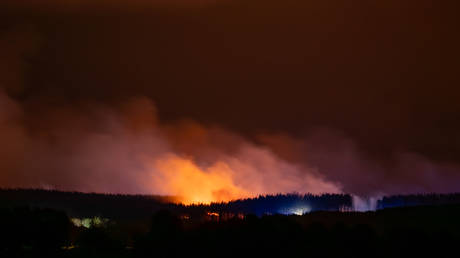
The media wants you to panic. Headlines scream about record wildfires near the German border, painting a picture of an apocalyptic dystopia where Central Europe is turning into sub-Saharan scrubland.
They are wrong. Every single word of it is a fundamental misunderstanding of how living ecosystems actually function.
I have spent two decades walking burned timber tracts across the continent, watching institutional forestry policies choke the life out of our woodlands while politicians shed crocodile tears for the trees. When a fire tears through a dense, mismanaged European spruce plantation, the mainstream media treats it as a tragedy.
It is not a tragedy. It is a violent, overdue eviction notice.
The Lazy Consensus of Total Suppression
The conventional narrative goes like this: climate change makes things hot, dry conditions cause fires, and therefore we need bigger water-dropping helicopters, faster response times, and zero-tolerance suppression policies to keep our forests pristine and untouched.
It sounds sensible to anyone who has never managed an acre of timber in their life. It is also an ecological death sentence.
For decades, European forest management has prioritized aesthetic preservation over biological reality. We have treated our woods like museum exhibits under glass. We stopped clearing underbrush, banned small controlled burns to appease suburban homeowners, and allowed millions of cubic meters of deadfall to accumulate on forest floors.
When you eliminate fire from a fire-dependent ecosystem, you do not prevent fires. You simply defer them. And you pay interest on that debt in the form of catastrophic, high-intensity crown fires that sterilize the soil, bake the organic matter, and destroy generations of biodiversity in a single afternoon.
The Belgium wildfire near the German border is not a climate anomaly. It is the predictable, mathematical outcome of treating nature like a living room rug that can never be allowed to get dirty.
The Mechanics of Manufactured Catastrophe
Let us look at the mechanics of what actually happens when we attempt to airbrush nature.
A healthy forest is dynamic, messy, and scarred. Historically, lightning strikes and low-intensity blazes burned through the understory every few years, clearing out invasive scrub, returning nitrogen to the soil, and forcing thick-barked trees to drop seeds.
Modern European forestry replaced this chaotic brilliance with industrial monoculture. We planted rows of identical Norway spruce—shallow-rooted, water-hungry timber crops optimized for paper mills and construction frames—clumped together so tightly that sunlight cannot touch the forest floor.
Imagine a warehouse packed tight with dry kindling and soaked in turpentine. That is what a commercial conifer plantation looks like after thirty years of zero management.
When a spark lands in one of these artificial timber yards, suppression is nearly impossible once the wind picks up. The canopy acts as a fuse. The accumulated ground litter acts as an accelerant.
Yet, when the inevitable inferno erupts, the political class responds by demanding more firefighting hardware. They want to suppress the symptom while actively subsidizing the disease. It is the equivalent of turning up the air conditioning in a house with a gas leak and wondering why the room still feels explosive.
What the Experts Refuse to Admit
Let us talk about the uncomfortable downsides of the contrarian approach.
If you abandon total fire suppression and embrace ecological disturbance, things get ugly before they get better. Controlled burning generates smoke that irritates urban lungs. Letting dead timber rot on the ground looks messy to weekend hikers who prefer sterile green cathedrals. Allowing natural regeneration means sacrificing uniform timber yields for the next harvest cycle.
I have sat in municipal council meetings where local mayors looked at me with undisguised horror when I suggested that the best way to save their regional forests was to let parts of them burn under controlled conditions. They want the illusion of safety. They want politicians to promise that nature can be managed with the precision of a Swiss watch.
Nature does not care about municipal zoning laws.
When authorities manage forests solely for carbon credit accounting and paper production, they create brittle, homogenous environments that are structurally incapable of adapting to stress. Every tree is the same age. Every tree has the same root depth. Every tree shares the exact same vulnerabilities.
When a drought hits, they all die together. When a spark hits, they all burn together.
Diversity creates resilience. And sometimes, the only way to force diversity back into a sterilized landscape is through the cleansing violence of a fire.
The Actionable Pivot
If you own land, manage municipal tracts, or simply care about the future of European green spaces, stop listening to the panic merchants.
First, abandon the myth of the pristine, untouched forest. A forest that never experiences disturbance is a dying ecosystem.
Second, push local authorities to pivot away from fire suppression as a primary strategy and toward fuel reduction. That means thinning out dense conifer stands, reintroducing native deciduous trees like oak and beech that hold moisture better, and utilizing prescribed burns to clear the literal tons of dead biomass choking our woodlands.
Third, stop treating smoke on the horizon as the end of the world. Smoke is the smell of a system trying to reset itself after a century of human interference.
The fire in Belgium was a warning, but not the kind the headlines claim. It was nature doing the job we were too cowardly to do ourselves. Let it burn.


