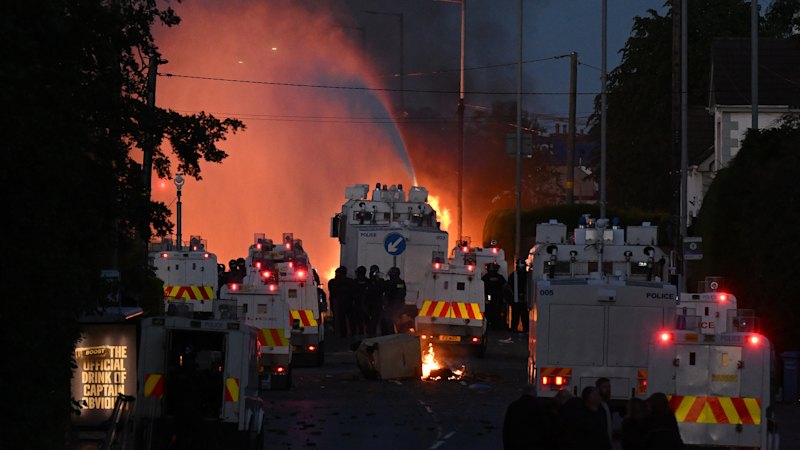
Street violence erupts in Belfast, a stabbing occurs, and the media immediately deploys its favorite copy-paste script. The narrative is always identical: a singular tragic event takes place, community leaders call for calm, and commentators wring their hands over "senseless behavior" that supposedly appeared out of a vacuum.
This diagnosis is completely wrong.
Calling these recurring flashes of civil disorder "senseless" or treating them as isolated reactions to a specific criminal act is a lazy consensus. It shields decision-makers from looking at the structural mechanics of urban unrest. I have spent years analyzing regional security data and working within areas affected by post-conflict stagnation. The reality is predictable, measurable, and entirely systemic.
The stabbing was not the cause of the riot. It was merely the atmospheric spark that drifted into a room already filled with gas.
The Flawed Logic of "Spontaneous" Unrest
Media outlets frame these nights of disorder as sudden deviations from normalcy. They ask the wrong question entirely: What triggered this specific night of violence? When you focus exclusively on the trigger, you ignore the ammunition.
Urban riots do not happen because a community collectively loses its mind over a single incident. They happen because specific neighborhoods are trapped in a cycle of economic exclusion, educational underachievement, and territorial policing.
Consider the data on regional deprivation. The areas in Belfast that experience recurrent street violence consistently rank in the highest percentiles of the Multiple Deprivation Measure (MDM). We are talking about deep-seated economic paralysis, high rates of youth unemployment, and zero social mobility.
When a high-profile incident occurs, it does not create anger; it provides a low-risk theater for pre-existing anger to manifest. For a disconnected teenager in a neglected estate, a riot is not a political statement. It is a rare moment of high-stakes visibility, adrenaline, and communal solidarity. Pretending it is about the "stabbing victim" is a fundamental misreading of street psychology.
The Ineffectiveness of Peace Language
Every time the bricks start flying, a predictable chorus of politicians, church leaders, and NGOs steps to the microphone to "appeal for calm."
These statements are entirely useless. In fact, they might be making things worse.
Appeals for calm are designed to comfort the comfortable. They reassure the middle-class suburbs that the establishment is doing something, while completely missing the target audience on the ground. The individuals throwing petrol bombs do not read press releases from community coalitions. They do not respect the authority of the figures issuing these statements.
"Demanding peace without addressing the underlying mechanics of deprivation is just a demand for quiet compliance."
📖 Related: The Tehran Bluff And The Tuesday Deadline
When the establishment focuses entirely on restoring calm, they are prioritizing the absence of tension over the presence of justice. They want the symptoms to disappear so they can go back to ignoring the disease.
Dismantling the De-escalation Industry
A massive, self-perpetuating industry has built up around post-conflict community management. Millions of pounds flow into local organizations tasked with "cross-community engagement" and "de-escalation."
If these strategies worked, the same streets wouldn't be burning every few years.
The bitter truth is that the current framework incentivizes the preservation of tension. Funding flows to areas that are perceived as volatile. When an area becomes genuinely stable, the resources dry up. This creates a perverse ecosystem where localized gatekeepers rely on their ability to manage friction rather than eliminate it.
Furthermore, the traditional "two traditions" model of managing Belfast completely ignores how the city has changed. The old green-and-orange framework cannot handle the complexities of modern urban pressure, immigration, and class warfare. The violence we see today is driven far more by socioeconomic alienation than by pure ideological alignment.
How to Actually Stop the Burning
Stop asking how to calm the streets. Start asking how to make the destruction of those streets unprofitable for the people living on them.
If a young person feels they have a genuine stake in their economy, a path to a high-paying job, and a future worth protecting, they do not throw a petrol bomb at a police Land Rover. The risk becomes too high. Right now, for a significant cohort of youth in deprived wards, the risk-reward calculation favors chaos because their baseline reality offers nothing to lose.
We must shift from a model of reactive policing and soft community funding to hard economic intervention.
- Dismantle the gatekeeper economy: Bypass the traditional community middlemen who rely on managing tension for funding. Direct resources into tangible infrastructure and direct youth employment schemes.
- Targeted educational investment: Flood the schools in these specific hot spots with resources, vocational training pipelines, and direct connections to high-growth industries.
- Enforce accountability for structural neglect: Hold regional authorities accountable for the stark spatial inequalities that define the geography of the city.
The downside to this contrarian approach is that it requires long-term, expensive structural reform that doesn't fit neatly into an election cycle or a two-minute news segment. It requires admitting that our current peace-building models are outdated and failing.
Until we stop treating these riots as unpredictable anomalies and start treating them as the direct, logical output of structural neglect, the cycle will repeat. The next time an incident occurs, the gas will ignite again, the same politicians will express shock, and the streets will burn exactly as predicted.
Stop reading the statements calling for calm. Watch the money, watch the infrastructure, and look at the conditions of the streets when they aren't burning. That is where the riot is actually created.