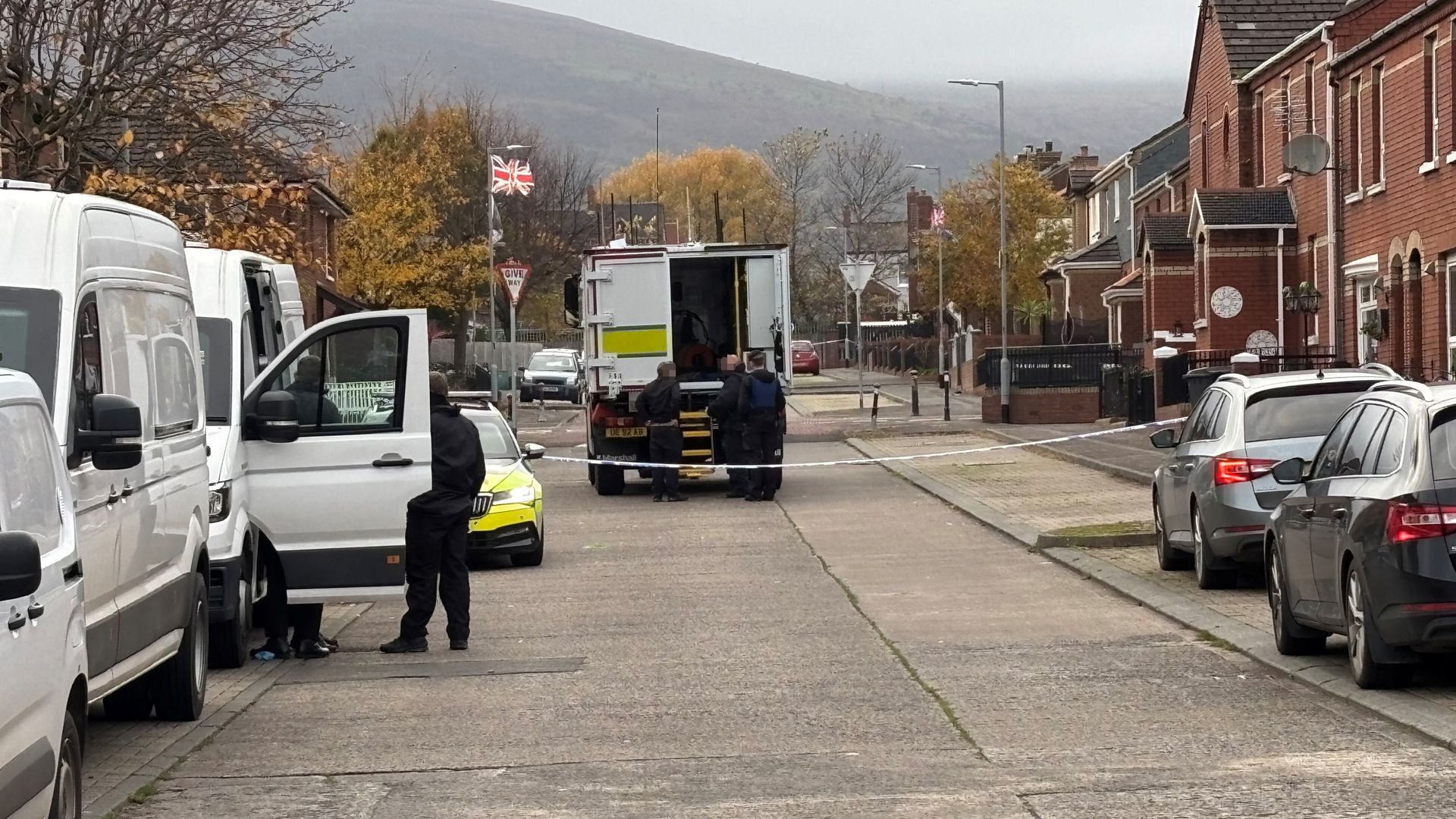
When the Police Service of Northern Ireland confirms that a man has been arrested in Belfast as part of an ongoing probe into suspected terrorism offences, the official statement is always a masterclass in institutional minimalism. A suspect is detained under the Terrorism Act 2000. He is taken to the Serious Crime Suite at Musgrave Police Station for questioning. No name is released, no specific paramilitary faction is identified, and the public is left to read between the lines of a three-sentence press release.
To understand what actually happens behind that tight-lipped routine, you have to look past the immediate headline and examine the machinery of modern counter-terrorism policing in Northern Ireland—a system built on protracted intelligence gathering, high-stakes legal thresholds, and a persistent security threat that refuses to stay in the history books.
The Anatomy of a Section 41 Detention
In Northern Ireland, the legal framework governing a terrorism arrest operates on a completely different track from standard criminal procedure. While an ordinary suspect in Belfast can generally only be held for 24 hours without charge before police must apply to a magistrate for an extension, an individual detained under Section 41 of the Terrorism Act 2000 enters a much wider window of state authority.
The initial detention period is 48 hours. From there, detectives from the PSNI’s Terrorism Investigation Unit can apply to a judicial authority for warrants of further detention, extending the custody clock up to a maximum of 14 days. Every interview inside the Musgrave Serious Crime Suite is recorded, scrutinized by specialist legal teams, and structured around a specific evidentiary puzzle.
Why the extended timeline? Terrorism probes in Belfast are rarely reactive responses to a single street-level incident. They are almost always the culmination of months, sometimes years, of covert surveillance, financial tracking, and digital forensics. By the time officers knock on a door in West, North, or East Belfast, they are usually testing a specific hypothesis against a mountain of pre-existing intelligence.
Yet an arrest is not a conviction. In fact, in the context of Northern Ireland’s security apparatus, an arrest frequently serves an entirely different tactical purpose.
Intelligence Disruption Versus Prosecution
Spend enough time covering security operations across the North, and a clear pattern emerges. A massive proportion of individuals arrested under terrorism legislation are eventually released without charge, or released pending a report to the Public Prosecution Service. To an outside observer, that looks like a failure of policing. Inside the security establishment, it is often viewed as a successful disruption.
Consider a hypothetical example of how this plays out on the ground. Suppose intelligence indicates that a splinter group is attempting to move munitions or recruit younger members in a specific neighborhood. Detectives may not yet have the forensic evidence required to meet the high bar of criminal prosecution beyond a reasonable doubt. However, executing a coordinated arrest operation achieves several immediate operational goals:
- Seizure of digital footprints: Phones, laptops, encrypted storage drives, and burner devices are immediately taken into custody for forensic extraction. Even if the suspect exercises their right to silence, their metadata often speaks volumes.
- Sowing internal paranoia: Within clandestine groups, an unexpected arrest triggers immediate suspicion about informants. Operations freeze while leadership tries to figure out who leaked the information.
- Denying operational space: Removing a key logistical coordinator from the board for even 72 hours can derail a planned attack or disrupt a cross-border supply chain.
The trade-off is steep. When suspects are repeatedly arrested and released without charge, community skepticism grows. Critics and human rights advocates argue that broad counter-terrorism powers risk alienating the very neighborhoods police rely on for cooperation, turning routine investigative tools into political flashpoints.
The Persistent Shadow of Dissident and Loyalist Factions
Nearly three decades after the Good Friday Agreement, the phrase "suspected terrorism offences" in Belfast still carries heavy historical baggage, though the threat profile has shifted dramatically. The monolithic paramilitary structures of the late twentieth century have fractured into smaller, localized, and often criminally entangled networks.
On the republican side, dissident republican groups—most notably the New IRA and Continuity IRA—remain committed to the use of violence to destabilize the political settlement. Security assessments from MI5 and the PSNI have repeatedly noted that while these groups lack broad public support and face intense infiltration by intelligence services, they retain the lethal intent and technical capability to target police officers, prison staff, and security infrastructure. A single viable explosive device or a targeted shooting requires only a handful of committed operatives.
Simultaneously, the security landscape is complicated by entrenched loyalist paramilitary structures like the UVF and UDA. While officially on ceasefire, elements within these organizations continue to exert coercive control over working-class communities, engaging in extortion, drug distribution, and localized violence. When arrests occur in loyalist areas under terrorism or serious crime legislation, the line between political paramilitarism and organized crime is frequently blurred.
This dual reality forces investigators to maintain two distinct operational playbooks. One focuses on ideological insurgency and cross-border cells operating between Belfast, Derry, and the Irish Republic; the other targets localized territorial control and illicit financing.
The Digital Battlefield and Encrypted Tradecraft
Modern counter-terrorism probes in Belfast look far less like the street-corner checkpoints of the 1980s and far more like complex cyber-investigations. Today’s suspects rarely rely on traditional dead drops or unencrypted phone calls. They communicate through end-to-end encrypted messaging applications, use virtual private networks, and obscure financial transactions through cryptocurrency or layered cash businesses.
Consequently, when the PSNI announces a terrorism-related arrest, the physical search of a property is often secondary to the technical exploitation of the devices found inside. Forensic specialists spend weeks bypassing passcodes, recovering deleted chat logs, and cross-referencing cell-site location data with CCTV networks across Belfast.
The legal battles that follow are equally technical. Defense solicitors routinely challenge the admissibility of surveillance evidence, arguing over the boundaries of privacy rights and the legality of covert listening devices or intercepted communications. Under the Investigatory Powers Act, intelligence gathered by security agencies like MI5 often cannot be presented directly in open court without risking the exposure of sensitive sources and methods.
This creates the classic intelligence-to-evidence dilemma. Security services may know with near-certainty who is orchestrating a plot, yet find themselves unable to translate that knowledge into admissible courtroom proof without burning an informant or revealing a technical capability.
What the Public Never Sees
When a brief news report notes that a man has been arrested in Belfast on suspicion of terrorism offences, it captures a single, frozen frame of a much longer film. It does not show the months of quiet surveillance preceding the dawn raid. It does not show the intense legal negotiations inside Musgrave Police Station, nor the months of forensic lab work that follow after a suspect walks out the door on bail or unconditional release.
The real story is rarely contained in the initial police press release. It lies in the slow, grinding tension between state intelligence and clandestine networks, played out in courtrooms, forensic labs, and quiet residential streets across Belfast—where the past is never entirely past, and every arrest is merely one move in a much longer game.