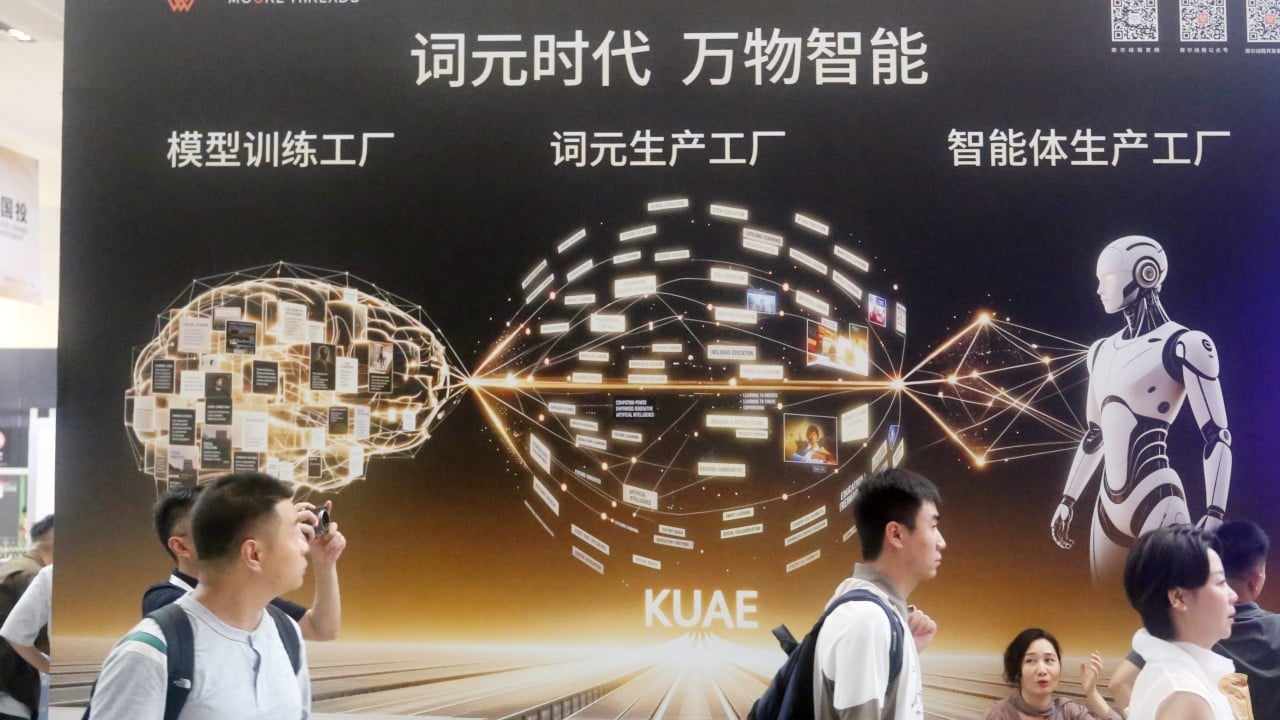
Language shapes how we think. If you spend your day using English jargon to describe local innovations, you’re not just borrowing words. You’re adopting a worldview. That’s exactly what Chinese state media is worried about as the artificial intelligence race heats up.
You might have heard murmurs about Beijing pushing back against English AI terminology. It isn’t just linguistic pedantry. It’s a strategic move to secure intellectual independence. When technical standards are defined in English, the conceptual framework for building, regulating, and thinking about these tools follows suit. If China wants to lead the next generation of computing, it needs a vocabulary that feels like its own.
The Power of Defining the Terms
Think about how you describe a new software feature. You use terms like "large language model," "reinforcement learning," or "agentic workflow." These aren't neutral labels. They carry baggage from Western research labs and Silicon Valley boardrooms. When a Chinese researcher uses these terms, they are essentially acknowledging a hierarchy. The English term becomes the gold standard, while the Chinese translation feels like a secondary approximation.
State media outlets are pushing to standardize native Mandarin equivalents for these concepts. They want to shift the focus. It’s about building a digital ecosystem where the logic and the labels originate from within. By mandating or encouraging local phrasing, they’re trying to prevent the "English-first" mental trap where foreign ideas are always perceived as inherently superior or more advanced.
Why This Matters for Innovation
You’re probably wondering if this hurts their competitiveness. It’s a valid question. English is the global lingua franca of science and engineering. Roughly 90% of scientific papers appear in English. This creates a structural advantage for English-speaking researchers. They don't have to translate their thoughts; they just write them down.
When you force a shift to local terminology, you create friction. Researchers might find it harder to reference international research papers. But here is the flip side: efficiency. Mandarin is incredibly dense. A single character can represent a concept that requires three or four English words. This makes processing tokens—the building blocks of AI—faster and more efficient in Chinese.
If you are building an AI model from scratch, thinking in a language that tokenizes concepts more compactly is a technical benefit. If Beijing successfully shifts the standard to Chinese-based terminology, they aren't just protecting their culture. They are potentially optimizing their technical stack for better reasoning and lower computational overhead.
Moving Beyond Translation
The goal isn't just to replace "prompt engineering" with a Chinese phrase. It’s about creating a unique conceptual architecture. Western AI often struggles with cultural nuances in languages like Arabic or Chinese because it was trained predominantly on English datasets. The result is often vague or poor-quality content in non-English languages.
By forcing the development of a native terminology, China is forcing the development of a native AI identity. They are signaling to their tech giants—companies like Baidu, Alibaba, and DeepSeek—that the priority should be domestic robustness.
If you're operating in this space, you should expect more "China-first" technical papers and documentation. These won't just be translations. They will be original research rooted in a different set of linguistic and cultural assumptions.
Practical Reality for Developers
If you work in tech, don't ignore these shifts. The era of "everything in English" is fracturing.
- Watch the standards. Expect China to issue updated glossaries for AI development. If you want to collaborate with Chinese research institutions, you’ll need to know these equivalents.
- Understand the tokenization advantage. Pay attention to how Chinese models handle complex reasoning. Their ability to "think" in Chinese might soon outperform Western models in specific regional tasks.
- Anticipate bifurcated ecosystems. We are moving toward a world where the AI stack is not universal. Different regions will have different standards, different vocabularies, and different performance benchmarks.
Beijing isn't just playing with words. They are trying to redraw the map of artificial intelligence. By decoupling their technical language from the English-dominated status quo, they are preparing for a future where their tools don't depend on Western concepts to function.
Whether this strategy works remains to be seen. But the days of assuming everyone is reading from the same English-language manual are gone. The linguistic wall is already under construction.
AI content labeling laws in China
This video explains the recent regulatory environment in China regarding mandatory AI content labeling, which is part of the broader effort to control and define the domestic AI ecosystem.
http://googleusercontent.com/youtube_content/1