Beijing will not write a blank check for Southeast Asia's railway dreams anymore. The era of massive, state-backed mega-loans under the Belt and Road Initiative has quietly shifted toward smaller, strictly commercial joint ventures, blended finance, and tough risk-sharing demands. While high-speed and standard-gauge rail links promise to bind ASEAN economies closer to southern China's manufacturing hubs, Beijing's policy banks are increasingly hesitant to absorb sovereign default risks on multi-billion-dollar transit corridors.
For decades, the idea of a continuous iron silk road running from Kunming down to Singapore captivated planners across the region. On paper, the logic is undeniable. Southeast Asia is China's largest trading partner, and moving cargo by rail slashes transit times compared to ocean freight while bypassing maritime chokepoints like the Strait of Malacca. Yet steel tracks do not lay themselves, and tunnel boring machines do not run on diplomatic goodwill. Learn more on a connected topic: this related article.
Look closely at the projects currently inching forward across the Mekong subregion and the Malay Peninsula. A stark financial reality emerges. China wants the geopolitical and commercial connectivity, certainly, but its domestic lenders are nursing bruised balance sheets from overseas debt restructurings and a prolonged property slump at home.
The Shift from Sovereign Debt to Commercial Realism
During the first decade of the Belt and Road Initiative, the financing playbook was straightforward. Chinese policy banks—primarily the Export-Import Bank of China and the China Development Bank—extended massive, sovereign-guaranteed loans to host governments. Chinese state-owned enterprises built the tracks, supplied the rolling stock, and collected the engineering fees. More journalism by The Motley Fool highlights similar views on the subject.
That model hit a wall.
Laos offers the clearest case study of both the triumph and the financial strain of this approach. The Boten-Vientiane railway, which opened in late 2021, transformed a landlocked nation into a land-linked transit hub. Freight volumes have surged, carrying everything from Thai durians to Chinese electronics. However, the roughly $6 billion price tag required Vientiane to take on heavy debt obligations, sparking years of sovereign credit downgrades and difficult debt-service negotiations with Beijing.
Surrounding nations watched that balance-sheet stress unfold in real time. Governments in Bangkok, Kuala Lumpur, and Hanoi grew wary of signing sovereign guarantees for ten-figure infrastructure loans. Simultaneously, regulators in Beijing tightened oversight on overseas lending, ordering policy banks to prioritize bankability over geopolitical vanity.
Today, when officials from ASEAN capitals sit across the table from Chinese financiers, the conversation revolves around equity stakes, public-private partnerships, and land-value capture. Beijing still brings unmatched construction speed and technical dominance in high-speed rail engineering, but host nations are now expected to put significantly more skin in the game.
The Missing Links of the Kunming-Singapore Network
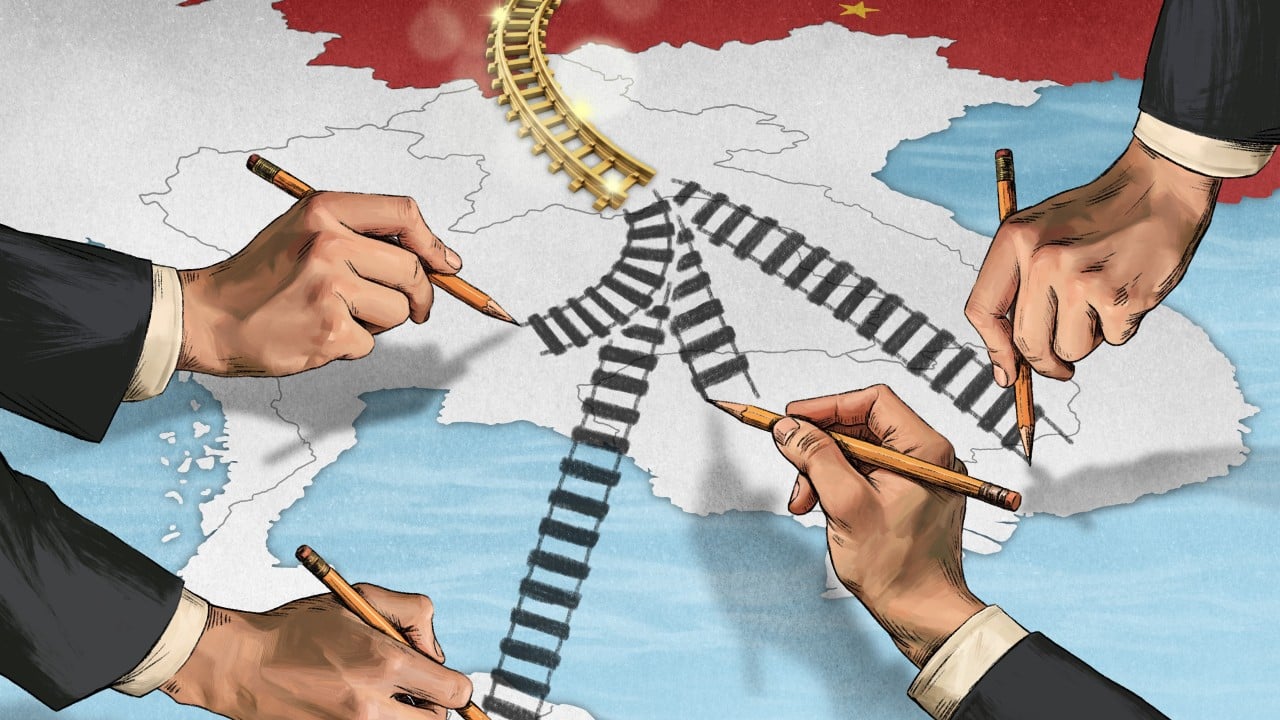
To understand where the money is stuck, you have to look at the physical gaps on the map. The Pan-Asia Railway Network relies on three main routes radiating southward from Kunming, the capital of China's Yunnan province.
The Central Route runs through Laos, Thailand, and Malaysia down to Singapore. The Eastern Route traverses Vietnam. The Western Route cuts through Myanmar. Each corridor faces distinct financial and political roadblocks that make Beijing think twice before opening its vault.
Thailand's Deliberate Pace
Thailand sits at the geographic heart of mainland Southeast Asia, making its rail network the linchpin for regional integration. Yet Bangkok has consistently refused to follow the Laotian financing model.
For the Thai-Chinese high-speed rail project connecting Bangkok to Nong Khai on the Lao border, the Thai government insisted on funding the civil engineering works itself. China is supplying the track systems, signaling technology, and trains, while Thai contractors handle the viaducts and stations.
This arrangement protects Thailand from foreign debt traps, though it has dragged out construction timelines. Land acquisition disputes, environmental assessments, and local budget allocations have slowed progress to a crawl. Even when the first phase between Bangkok and Nakhon Ratchasima finishes, the crucial second phase reaching the Mekong River—and the bridge connecting to the Lao railhead—remains years away from completion. Without that physical link across the river, containers still have to be offloaded onto trucks, erasing much of the efficiency gained by rail.
Vietnam's Dual-Track Dilemma
For years, Hanoi resisted Chinese rail financing altogether, haunted by historical distrust and the painful delays of the Chinese-built Cat Linh-Ha Dong metro line in Hanoi. Instead, Vietnam poured its energy into studying a massive $60 billion-plus North-South high-speed railway, courting Japanese expertise and domestic funding.
Realpolitik is forcing a subtle recalibration. China is Vietnam's largest trading partner, and northern Vietnamese factories rely heavily on components trucked across the border from Guangxi and Yunnan. Upgrading the colonial-era, meter-gauge tracks between Lao Cai, Hanoi, and the port city of Haiphong to standard gauge (1,435 millimeters) has become an urgent economic necessity.
Vietnam is now actively discussing cross-border standard-gauge links with Beijing. Still, Hanoi wants concessional terms, technology transfer, and strict limits on Chinese labor—conditions that compress profit margins for Chinese state contractors and complicate loan approvals in Beijing.
Malaysia's Renegotiated Megaproject
Further south, Malaysia's East Coast Rail Link (ECRL) demonstrates what happens when political upheaval collides with Belt and Road financing. Originally conceived as a $20 billion project backed by China Exim Bank, the ECRL was suspended in 2018 after a change in government in Kuala Lumpur sparked outrage over inflated costs and opaque terms.
Beijing eventually agreed to slash the construction cost by roughly a third, reroute sections of the track, and form a 50-50 joint venture with Malaysia Rail Link to operate and maintain the line once completed. That compromise saved the project, proving that Beijing will bend on financial terms when strategic maritime bypasses are at stake. Connecting the South China Sea port of Kuantan directly to Port Klang on the Strait of Malacca gives Chinese cargo a land bridge across the Malay Peninsula. Even so, the painful renegotiation left deep scars on both sides, setting a precedent that future deals will face intense public and parliamentary scrutiny.
Myanmar's Stalled Corridor
The Western Route through Myanmar exists largely on paper. Ongoing civil conflict, collapsing state capacity, and severe security risks along the Shan State border have frozen major infrastructure investments. Chinese state firms will not deploy thousands of engineers into active conflict zones, nor will Chinese banks underwrite multibillion-dollar loans to a military administration struggling with basic currency stability. Until political stability returns, the western rail corridor remains a dead letter.
Why Freight Economics Matter More Than Passenger Glamour
Media coverage of Asian railways tends to obsess over sleek bullet trains whisking tourists between capital cities. In the boardrooms of Beijing and Bangkok, nobody is betting billions on passenger ticket sales.
High-speed passenger rail rarely turns an operational profit outside densely populated corridors like Beijing-Shanghai or Tokyo-Osaka. In Southeast Asia, air travel is cheap, dominant, and fiercely competitive. Budget carriers like AirAsia and VietJet connect regional hubs for less than the cost of a high-speed train ticket, and in a fraction of the time.
The real financial engine behind China's rail push is intermodal freight.
Consider a hypothetical electronics manufacturer operating an assembly plant in northern Vietnam or eastern Thailand. That factory imports display panels, microchips, and specialty plastics from Shenzhen or Chongqing, assembles the final product, and ships it to consumers in Europe or North America.
A seamless standard-gauge rail network turns mainland Southeast Asia into an extension of China's domestic supply chain. Containers can move from factories in Chengdu directly to deep-water ports in Thailand's Eastern Economic Corridor or Malaysia's West Coast, avoiding congested South China Sea shipping lanes. Better yet, cargo from ASEAN can plug straight into the China-Europe Railway Express, traveling overland across Kazakhstan and Russia to reach European distribution centers in under three weeks—roughly half the time of maritime shipping.
Cold-chain logistics provide another powerful incentive. Southeast Asian agricultural exports—mangosteens, durians, palm oil, and rubber—command high prices in Chinese tier-one cities, provided they arrive fresh. Rail cuts spoilage rates dramatically compared to multi-stage trucking and port handling.
Because freight drives the revenue, Chinese planners care deeply about gauge standardization and customs integration. Most legacy railways in Thailand, Malaysia, and Vietnam run on narrow meter-gauge tracks, whereas China uses standard gauge. Every time a train hits a break-of-gauge at a border, cranes must lift containers off one set of bogies and place them onto another. Beijing is willing to subsidize feasibility studies, signaling upgrades, and dry-port logistics hubs specifically to eliminate these bottlenecks, even if it refuses to fund the entire mainline track network outright.
The Geopolitical Counterweight and Alternative Lenders
Beijing is no longer the only game in town, though its rivals operate on a vastly different scale.
Japan remains a formidable player in Southeast Asian rail, particularly in urban mass transit and high-capacity commuter lines in Jakarta, Manila, and Ho Chi Minh City. Through the Japan International Cooperation Agency (JICA), Tokyo offers ultra-low interest rates and long repayment horizons, coupled with a strong reputation for engineering durability. Yet Japanese projects are notoriously slow to clear bureaucratic hurdles and carry strict procurement rules that drive up upfront capital costs.
Western-backed initiatives, such as the G7's Partnership for Global Infrastructure and Investment (PGII) and the European Union's Global Gateway, have pledged hundreds of billions of dollars globally to counter Chinese influence. On the ground in ASEAN, however, Western capital rarely materializes for heavy rail civil works. Western development banks prefer funding regulatory capacity building, green energy grids, or digital infrastructure rather than underwriting risky, capital-intensive railway construction across rugged tropical terrain.
This leaves ASEAN governments in a delicate balancing act. They leverage Western and Japanese interest to extract better terms from Beijing, knowing full well that only Chinese state-owned conglomerates possess the sheer industrial capacity to lay thousands of kilometers of track through karst mountains and monsoon floodplains within a single political cycle.
Hidden Costs That Stall the Trains
Even when Beijing and an ASEAN capital agree on a financing split, hidden operational hurdles frequently derail projected returns.
Land acquisition is the single biggest schedule killer in democratic or semi-democratic Southeast Asian states. Unlike in China, where the state can clear rights-of-way rapidly, governments in Thailand, Malaysia, and Indonesia must negotiate with thousands of private landowners, navigate complex environmental litigation, and compensate displaced communities at market rates. Cost overruns from delayed land clearance routinely wipe out early financial projections.
Customs and border friction pose an equally stubborn barrier. Laying physical steel across a border means nothing if trains sit idle for 48 hours while customs officers manually inspect manifests, reconcile differing phytosanitary standards, and collect overlapping transit tariffs. The Laos-China railway initially suffered from severe bottlenecks at the Mohan-Boten border crossing until authorities introduced pre-clearance customs protocols and integrated digital cargo tracking. Replicating that regulatory alignment across Thailand, Malaysia, and Singapore requires years of diplomatic grinding inside ASEAN's notoriously consensus-bound bureaucracy.
Currency mismatch quietly erodes project viability over time. Railway tickets and domestic freight fees are collected in Thai baht, Lao kip, or Malaysian ringgit. Meanwhile, foreign loans, imported rolling stock, and specialized maintenance parts are priced in US dollars or Chinese renminbi. When local currencies depreciate—as the Lao kip did catastrophically in recent years—the cost of servicing foreign rail debt balloons overnight, forcing host governments back to the negotiating table for emergency debt relief.
What the New Financing Playbook Looks Like
Beijing has not abandoned its ambition to wire Southeast Asia into its rail grid. Instead, Chinese policymakers and state banks have rewritten the rules of engagement to protect their own balance sheets while keeping the tracks moving forward.
First, expect a surge in blended finance and multilateral co-financing. Rather than carrying 100 percent of the credit risk, Chinese policy banks are increasingly partnering with the Asian Infrastructure Investment Bank (AIIB), the Asian Development Bank (ADB), and sovereign wealth funds from the Middle East. Spreading the debt across multiple institutional lenders lowers the political temperature in host countries and enforces stricter, internationally recognized environmental and financial auditing.
Second, Beijing is pushing Build-Operate-Transfer (BOT) and joint-venture equity models. Under this structure, a consortium of Chinese rail operators and local conglomerates puts up the equity, builds the line, and operates it for 30 to 50 years to recoup their investment through freight tariffs and commercial real estate development around stations. Transit-oriented development—building shopping malls, logistics parks, and residential towers directly above rail hubs—often generates far higher profit margins than running the trains themselves.
Third, China is targeting surgical, high-impact upgrades rather than massive greenfield megaprojects. Financing a $300 million cross-border rail bridge, a standardized container transshipment yard, or an automated signaling overhaul yields immediate trade benefits at a fraction of the cost and political risk of building a brand-new 1,000-kilometer high-speed corridor.
Southeast Asia's rail network will eventually connect Kunming to Singapore, not through a single grand imperial decree, but piece by negotiated piece. ASEAN nations will end up owning most of the concrete and steel within their borders, paying for it through a messy patchwork of domestic budgets, multilateral loans, and commercial joint ventures—while Beijing quietly collects the dividends on the freight flowing north and south.