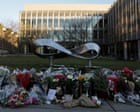
The transition from ideological fervor to kinetic violence is rarely a sudden rupture; it is a measurable trajectory defined by the compounding interest of perceived injustice. In the case of the shooting at Brown University, the FBI’s identification of an "accumulation of grievances" provides a specific behavioral framework that supersedes the simplistic narrative of a "lone wolf" snapping under pressure. Targeted violence of this nature functions as the terminal output of a multi-stage escalation process where the actor systematically devalues institutional alternatives while inflating the perceived utility of a terminal strike.
The Triad of Radicalization Mechanics
Understanding the escalation at Brown University requires a structural analysis of how individual grievances transform into an actionable mandate. This process relies on three distinct psychological and operational pillars.
1. The Perceived Injustice Loop
The foundation of targeted violence is not the objective reality of a situation, but the subjective internalizing of a grievance. When an individual perceives a loss of status, a career setback, or a social rejection, they enter a feedback loop. Every subsequent negative interaction is filtered through this lens, reinforcing the belief that the system—in this case, the university structure—is inherently predatory or corrupt. This creates a "sunk cost" in the grievance itself; the individual has invested so much emotional energy into being the victim that they cannot accept any outcome other than a radical reset.
2. Cognitive Rigidity and Alternative Exhaustion
As grievances accumulate, the actor’s ability to conceptualize non-violent conflict resolution atrophies. This cognitive narrowing results in "alternative exhaustion." In a standard organizational conflict, a student or employee might seek mediation, legal counsel, or transfer. For a suspect driven by a grievance stack, these options are discarded as "tainted" by the same system they seek to punish. The logic becomes binary: total submission to their will or total destruction of the perceived source of pain.
3. The Validation Gap
Violent actors often seek external validation for their internal narrative. If the surrounding social environment (online forums, radicalized peer groups, or echo chambers) reinforces the grievance, the gap between "thought" and "action" closes. The FBI’s assessment suggests that the Brown University suspect reached a threshold where the internal pressure of these accumulated slights outweighed the external deterrents of law and social ruin.
Quantifying the Threshold of Escalation
The term "accumulation" implies a quantitative build-up. We can categorize the variables that contribute to this threshold through an informal cost-benefit analysis conducted by the actor.
- Trigger Events: High-impact incidents (expulsion, firing, public shaming) that accelerate the timeline.
- Leakage: The communication of intent to third parties, often dismissed as venting but functionally serving as a "dry run" for the logic of the attack.
- Resource Acquisition: The shift from conceptual grievance to tactical preparation, involving the procurement of hardware and site reconnaissance.
The bottleneck in preventing these events is not a lack of data, but the "signal-to-noise" ratio in behavioral monitoring. Universities are high-density environments of stress and dissent. Distinguishing between a student experiencing a standard mental health crisis and an actor following a pathway to violence requires identifying the specific transition from despair (internalized) to directed entitlement (externalized).
The Institutional Failure of Threat Assessment
The Brown University incident exposes a critical vulnerability in how elite academic institutions manage internal security. Traditional security models are reactive, designed to mitigate an active shooter after the first round is fired. A data-driven strategy requires a shift toward "threat management," which operates on the assumption that violence is a process, not an event.
The first limitation of current institutional responses is the siloed nature of information. The registrar may know about academic failure; the campus police may know about a minor altercation; the health center may know about psychological distress. Without a centralized "fusion" of these data points, the accumulation remain invisible. The suspect’s grievances were likely visible in fragments across multiple departments, yet the pattern only became legible in the forensic aftermath.
This creates a structural blind spot. Universities prioritize privacy and student autonomy—values that are essential to the academic mission but diametrically opposed to the intrusive monitoring required to catch a grievance-driven actor in the "pre-attack" phase. The failure is not necessarily one of individual negligence, but of a systemic inability to aggregate behavioral red flags into a singular risk profile.
The Calculus of the "Grievance Stack"
To deconstruct the FBI's findings, we must look at the specific taxonomy of grievances that lead to university-based violence. These typically fall into three buckets:
Socio-Political Alignment
In the current polarized climate, institutional policies regarding global conflicts or domestic social issues provide a "heroic" veneer for personal instability. An individual can frame their personal failures as a form of resistance against an oppressive administration. This externalization makes the suspect feel like a martyr rather than a criminal.
Academic and Professional Rejection
In high-stakes environments like Brown, the perceived cost of failure is catastrophic. If an individual ties their entire identity to academic prestige, a setback is not a hurdle; it is an existential threat. When the university issues a disciplinary action or an academic dismissal, it is viewed by the suspect as an act of "institutional violence" that justifies a violent response.
Interpersonal Displacement
The suspect often targets individuals who represent the institution. They are not just shooting at people; they are shooting at symbols of the grievance. This displacement allows the actor to bypass the natural human inhibition against killing by dehumanizing the targets as "cogs" in the machine that wronged them.
Behavioral Indicators vs. Profile Archetypes
A common mistake in analyzing these events is the reliance on "profiling"—searching for a specific type of person (the quiet loner, the disgruntled outcast). Modern behavioral science has moved away from this, focusing instead on behaviors.
The "pathway to violence" is marked by observable milestones:
- Research and Planning: Searching for floor plans, security rotations, or "soft" entry points.
- Boundary Probing: Testing security or making increasingly bold "veiled" threats to see if there is a consequence.
- Final Preparations: Making "end of life" arrangements, such as giving away possessions or writing manifestos.
The Brown University suspect likely exhibited several of these behaviors. The "accumulation" mentioned by the FBI refers to the chronological layering of these actions. Each layer represents a decision point where the individual chose to move closer to the target rather than de-escalate.
The Fallacy of the "Sudden" Act
The media often portrays these shootings as "senseless" or "unpredictable." From a strategic standpoint, this is an error of analysis. These acts are highly logical within the distorted framework of the actor. The shooter has spent weeks, months, or years building a rationalization for their actions.
The "accumulation of grievances" acts as a fuel source. The "ideology" or "political cause" is often just the spark. If security professionals focus only on the spark (the politics), they miss the fuel (the long-term behavioral decay). To effectively mitigate the risk of targeted violence, the intervention must happen during the accumulation phase, before the actor reaches the "point of no return" where the perceived benefits of the attack—fame, revenge, or "justice"—outweigh the cost of their own life or freedom.
The primary tactical recommendation for institutional leadership is the implementation of a Multi-Disciplinary Threat Assessment Team (MTAT). This body must have the authority to bypass departmental silos and aggregate behavioral data. Intervention should not be limited to law enforcement; it must involve "off-ramping" strategies—legal, psychological, and administrative—that provide the individual with a face-saving exit from their grievance loop before it reaches a kinetic stage. The objective is to disrupt the accumulation by resolving the underlying "debts" of the grievance stack before the actor decides to settle the account through violence.