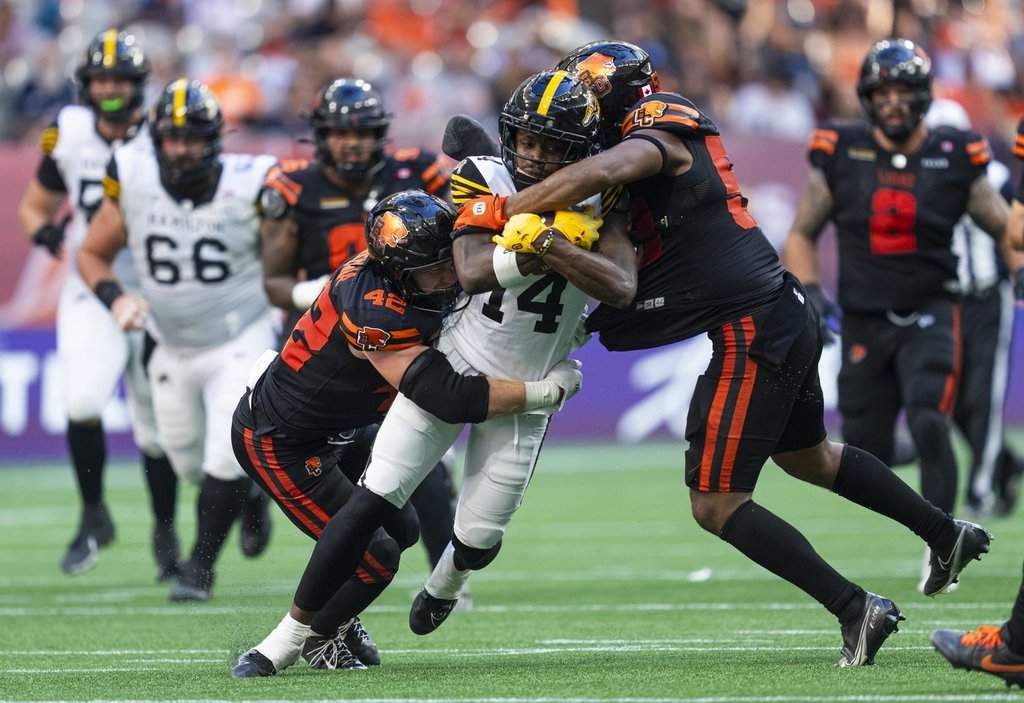
The BC Lions did not just sign a football player when they made Darnell Sankey the highest-paid middle linebacker in the Canadian Football League. They made a calculated, high-stakes bet on defensive architecture in a league where the salary cap punishes every miscalculation. By handing Sankey top-of-the-market money, Vancouver's front office signaled that the path to a Grey Cup runs straight through the teeth of opposing offenses, and they are willing to sacrifice roster flexibility at other positions to secure the best run-stopper and tackle machine available.
To understand why this move matters, you have to look beyond the standard press release applause. CFL general managers operate under one of the strictest hard caps in professional sports. Every dollar allocated to an American middle linebacker is a dollar stripped away from the offensive line, the defensive backfield, or the rotational depth required to survive an eighteen-game grind. When a franchise resets the market for an off-ball defender, it is rarely about rewarding past statistics alone. It is an admission of structural need. Building on this theme, you can find more in: Why Usman Nurmagomedov’s UAE Arrest Actually Proves MMA Has a Sponsorship Problem.
The Economics of the CFL Middle Linebacker
In three-down football, the middle linebacker occupies a unique, punishing patch of turf. With a wider field, an extra receiver in motion before the snap, and only three downs to gain ten yards, defensive coordinators ask their middle linebackers to cover more ground laterally than their counterparts in the NFL. They must diagnose run-pass options in fractions of a second, shed offensive linemen climbing to the second level, and still drop deep enough into zone coverage to deter quick slants over the middle.
Historically, CFL front offices treated the position as replaceable. Teams would cycle through young, athletic American imports on rookie minimum contracts, squeeze two productive seasons out of them, and let them walk in free agency once their price tag climbed. Paying top dollar for a middle linebacker was widely viewed as an inefficiency—a luxury reserved for teams with a quarterback on a cheap deal. Analysts at ESPN have also weighed in on this situation.
BC flipped that script with Sankey.
Sankey is not a flashy, blitz-heavy edge rusher who racks up highlight-reel strip sacks. His value lies in volume, durability, and angles. Over his CFL career, notably during his dominant stretches in Calgary, Saskatchewan, and Montreal, he has consistently sat near the top of the league in defensive tackles. More importantly, he eliminates second-level leakage. When a defense employs a middle linebacker who reliably turns a six-yard gain into a two-yard gain, it forces offenses into second-and-eight situations. In the Canadian game, second-and-long is a death sentence for offensive drives.
By making him the league's top-paid middle linebacker, the Lions are paying for down-and-distance control. They are buying predictability in a chaotic sport.
What the Lions Defense Was Actually Missing
Look at the tape from BC's recent campaigns, and a clear vulnerability emerges. For years, the Lions built their identity around explosive passing attacks and athletic, swarming defensive backs. When they played with a lead, their pass rushers pinned their ears back and overwhelmed opposing tackles.
When they fell behind, or when opponents committed to physical, downhill rushing attacks in October and November, the Lions bent—and often broke.
Playoff football in Canada is rarely won in pristine weather conditions. By the time the West Division Final rolls around, temperatures drop, winds swirl, and passing windows shrink. Teams that cannot stop the run between the tackles get bullied out of the postseason. BC's front office watched physical, balanced rosters dictate the tempo against them when it mattered most.
Sankey serves as the direct counterweight to that weakness. At roughly 250 pounds with low center-of-gravity leverage, he is built to absorb contact in the A and B gaps without losing ground. His presence allows the Lions' defensive line to play more aggressively upfield, knowing that if a ball carrier slips past the initial surge, Sankey is waiting cleanly in the alley.
The Hidden Value of Defensive Communication
There is another layer to this contract that does not show up in tackle totals. The middle linebacker is the quarterback of the defense.
In the CFL, where pre-snap waggle motion allows receivers to hit the line of scrimmage at full sprint, defensive communication must be instantaneous. One missed check between the defensive tackles and the halfbacks results in a sixty-yard touchdown. Sankey has spent years functioning as the primary communicator for championship-caliber units, including Montreal's Grey Cup-winning defense. Bringing a veteran voice into the huddle reduces mental errors for younger secondary players and allows the defensive coordinator to disguise coverages later into the play clock.
The Salary Cap Squeeze and Roster Trade-Offs
Praise for the signing has been loud, yet seasoned cap analysts know there is no free lunch in the CFL. Elevating Sankey to the top of the linebacker pay scale creates immediate financial pressure elsewhere on the Lions' roster.
Consider the ripple effects of dedicating a premium slice of the cap to one defensive spot:
- Receiver Room Compression: BC has historically spent heavily to surround its quarterback with elite pass-catchers. Locking in a top-market linebacker contract forces the front office to rely more heavily on younger, cheaper Canadian receivers or unproven American rookies to fill out the depth chart.
- Secondary Turnover: When the front seven consumes a larger percentage of the defensive budget, cornerbacks and halfbacks often become the casualties. The Lions will likely need low-cost starters in the defensive backfield to outperform their contracts.
- Special Teams Depth: Veteran backups who anchor punt and kick coverage units are usually the first to be trimmed when top-heavy contracts hit the books. Injuries later in the season will test the bottom of BC's roster far more severely than in previous years.
Front offices make these trade-offs willingly when they believe a single player elevates the floor of an entire unit. If Sankey stays healthy and plays 18 games, the gamble looks brilliant. If a soft-tissue injury or the cumulative toll of hundreds of collisions sidelines him for six weeks, the Lions are left paying top-tier money for zero production while lacking the cap space to sign a quality replacement mid-season.
Durability vs. Mileage
This brings up the most uncomfortable question surrounding any major investment in an off-ball linebacker: how much tread is left on the tires?
Middle linebacker is arguably the most physically punishing position in football outside of the trenches. Unlike wide receivers or cornerbacks, who absorb high-speed impacts sporadically, a starting middle linebacker is involved in heavy collisions on nearly every defensive snap. Sankey has logged hundreds of tackles across multiple seasons, in addition to brief stints in the NFL and the XFL.
Football history is littered with cautionary tales of teams paying top dollar for a linebacker's age-30 seasons based on what he did at 26. A fraction of a second lost in lateral burst is the difference between meeting a running back at the line of scrimmage and grabbing his ankles four yards downfield. Once a middle linebacker loses that sideline-to-sideline recovery speed, offenses ruthlessly target him in space with quick-twitch slotbacks and athletic running backs.
The Lions are betting that Sankey's instincts and film study will compensate for any natural athletic regression. Great veterans diagnose plays before the ball is even handed off, beating blockers to spots rather than trying to outrun them. It is a calculated risk, grounded in Sankey's meticulous preparation habits, yet it remains a risk nonetheless.
How This Resets the Market Across the League
BC's decision does not happen in a vacuum. Agents across the CFL immediately took notice.
Whenever a franchise sets a new financial benchmark at a specific position, every pending free agent at that spot uses the contract as their baseline in negotiations. Teams in Winnipeg, Toronto, and Hamilton—franchises that also rely heavily on veteran defensive leadership—now face steeper asking prices when trying to retain or sign starting middle linebackers.
For years, agents struggled to push middle linebacker salaries past a relatively rigid ceiling because general managers maintained an unspoken consensus on positional value. By breaking that ceiling, the Lions handed leverage back to the players. Expect the next wave of free-agent linebackers to point directly to Vancouver's ledger when demanding guaranteed money and higher base salaries.
The Ripple Effect on Canadian Ratios
There is also a subtle ratio component at play. The CFL requires teams to start a specific number of National (Canadian) players. Many franchises use one of their National starter spots at linebacker—often on the weak side or occasionally in the middle—to free up American spots at offensive tackle, defensive back, or receiver.
By committing top American money to Sankey in the middle, BC locks an American into that defensive anchor role. Consequently, the Lions must maintain strong Canadian talent along their offensive line, at safety, or in their receiving corps to stay compliant with the ratio without sacrificing talent. It forces a specific roster build that leaves very little room for error in the CFL Draft.
The Verdict on Vancouver's Gamble
Great front offices do not wait for weaknesses to expose them twice. They identify the exact flaw that kept them from a championship and pay whatever the market demands to erase it.
The BC Lions looked at the landscape of the West Division, saw the physicality required to win in November, and decided that controlling the middle of the field was worth every penny of a record-setting contract. Sankey brings proven tackle production, defensive alignment mastery, and a physical presence that immediately changes how opponents prepare for Vancouver's defense.
Whether the move ultimately delivers a championship parade comes down to the brutal math of football attrition—how well a 30-something tackler holds up over eighteen weeks, and whether the cheaper players filling out the rest of the roster can carry their weight when injuries inevitably strike.