Drone-assisted casualty evacuation is not a triumph of sudden technological invention; it is a desperate optimization problem forced by near-total aerial observation and loitering munitions across the forward line of troops. Conventional casualty evacuation relies on wheeled or tracked vehicles moving along predictable corridors. When first-person-view (FPV) strike drones, artillery, and mines saturate those corridors, a standard medical extraction turns into a multi-casualty ambush. Unmanned ground vehicles (UGVs) and heavy lift unmanned aerial vehicles (UAVs) emerge to strip human crews out of the highest-risk segment of the route while preserving the "golden hour" window for hemorrhage control and trauma care.
A superficial report on a "world's first battlefield drone rescue" typically treats the event as a single-point breakthrough—a dramatic aircraft or robot pulling a wounded soldier out of danger. That framing misses the underlying operational logic. A single extraction is an end-to-end logistics chain involving reconnaissance, route deconfliction, electronic warfare (EW) resilience, payload engineering, and ground handoff. Evaluating these operations rigorously requires separating verified operational mechanics from aspirational claims, mapping where ground and air platforms succeed or fail, and identifying the bottlenecks that determine whether one-off rescues scale into repeatable medical doctrine.
Deconstructing the Standard Rescue Narrative
Coverage of novel military robotics often compresses months of iteration and multi-unit coordination into a neat story of a machine saving a person. In reality, battlefield evacuation is a compound system rather than a standalone vehicle. Even when a heavy multirotor or tracked robot carries a casualty out of a contested zone, the mission depends on human spotters, supply drops, communications relays, and adjacent units managing threats along the corridor.
A clear-eyed breakdown of such reporting exposes four recurring analytical gaps:
- Platform fetishism: Focusing on the rescue airframe or UGV while ignoring the preceding failures—such as destroyed ground robots, blocked roads, or weather and EW holds—that forced the specific method used.
- Time compression: Treating a flight or drive lasting tens of minutes or a single hour as the full duration of the incident, when wounded personnel may wait days under cover before extraction becomes viable.
- Survivability omission: Mentioning a successful extraction without examining signature management, acoustic and thermal detectability, or vulnerability to interceptor drones and jamming.
- Scalability leapfrogging: Assuming that because one unit completed a complex extraction, thousands of front-line squads can immediately replicate it under heavy fire.
Distinguishing established facts from educated hypotheses keeps the analysis grounded. Known facts include the operational roles assigned to UGVs and heavy lift drones, the physical constraints of terrain versus airspace, and the documented use of multi-unit support during complex evacuations. Educated hypotheses include projections about long-term casualty survival rates across varied weather regimes, autonomous navigation reliability under severe spectrum congestion, and how quickly production lines can sustain replacement airframes against attrition.
The Two-Tier Evacuation Architecture
Front-line casualty movement in high-drone-density environments is splitting into a two-tier architecture: ground robotics for high-frequency, higher-payload hauling, and heavy aerial drones for high-speed or terrain-blocked extractions. Neither tier replaces the other because each optimizes for different variables in the mission equation.
Unmanned Ground Vehicles: The Workhorse Tier
UGVs handle the bulk of unmanned logistics and evacuation runs because ground contact provides higher payload capacity and lower vertical exposure under cloud cover. A tracked or wheeled platform can carry heavier equipment or multiple loads over moderate distances without expending constant rotor thrust to stay aloft. Furthermore, ground vehicles can use terrain folds, tree lines, and ruins to break line-of-sight with overhead observers.
The second limitation of UGVs is speed and obstacle sensitivity. Craters, felled timber, soft mud, water obstacles, and anti-personnel or anti-tank mines slow ground movement to a crawl. Slow transit increases exposure time inside contested zones. A wounded soldier with severe bleeding or hypothermia faces compounding physiological risk if a ground run takes hours instead of minutes.
Heavy Lift Aerial Drones: The Bypass Tier
Heavy aerial drones—such as large multirotors adapted from cargo or bomber platforms or purpose-built evacuation airframes—solve the terrain and speed problem by flying over obstacles at higher cruise speeds. Bypassing a mined road, canal, or rubble field can cut transit time dramatically when airspace conditions permit.
This creates a different vulnerability profile. A large lift drone carrying a human-scale payload requires substantial motor power, battery or fuel mass, and structural rigidity. That makes the aircraft larger, louder, and more visible on radar, thermal, and visual sensors than a small quadcopter. Hovering or flying low to pick up or drop off a casualty creates a high-value target window for enemy air defense, interceptor drones, and EW systems.
The Cost and Risk Function of Unmanned Rescue
Every unmanned evacuation operates inside a tight trade-off curve governed by four variables: exposure time, signature, link integrity, and payload mass. Improving one variable frequently degrades another.
- Exposure time: Shorter transit reduces the probability of being tracked and struck along the route, favoring speed over heavy armor.
- Signature: Larger lift capacity requires bigger airframes or heavier chassis, increasing acoustic, visual, and thermal detection range.
- Link integrity: Radio control and satellite links enable precision routing and operator intervention, yet heavy EW jamming or terrain masking can sever or degrade command channels.
- Payload mass: A wounded adult plus stabilization gear, litter or capsule hardware, and reserve power pushes weight limits, which in turn restricts flight endurance, climb rate, or ground mobility.
Consider a conceptual example of a soldier pinned down past a cratered, mined approach. Sending a light UGV may fail on obstacles or take too long; sending a heavy UGV may draw artillery and anti-armor fire due to its size and slow pace; sending a heavy aerial drone offers rapid point-to-point transit over ground hazards, but exposes a large aircraft to detection and interception if enemy air defenses or EW coverage in that sector are dense.
Cause-and-effect chains in these missions are rarely linear. For instance, shifting from manual radio control to automated or AI-assisted waypoint navigation reduces susceptibility to spot jamming on a link, yet it can reduce dynamic obstacle avoidance if unexpected threats or weather shifts occur mid-flight. Similarly, launching decoy or support drones to draw enemy attention can protect the rescue platform while simultaneously consuming scarce operator bandwidth and batteries across adjacent teams.
Operational Bottlenecks That Break Single-Point Successes
A single successful drone rescue proves technical feasibility under specific conditions; scaling that capability across an entire front requires overcoming systemic bottlenecks that have nothing to do with lifting weight.
1. Loading and Handoff Friction
Getting a wounded person onto a drone or UGV under fire is often harder than moving the vehicle between points. A severely injured soldier may be unable to climb, secure harnesses, or board a capsule independently. If no uninjured comrade is present—or if a medic or operator must approach the vehicle—human exposure spikes at the exact moment of transfer. Automated winches, quick-latch litters, or low-profile ramps help, but mechanical complexity adds weight and failure points in mud, dust, or darkness.
2. Contested Spectrum and Navigation Drift
Modern battlefields feature dense electronic warfare that degrades satellite positioning and command links. Inertial navigation, terrain-matching, or visual/AI route-following modules help vehicles hold course when GPS is jammed, yet drift accumulates over distance and time. A few meters of positional error on landing or pickup can mean missing a small clearing, hitting wires or trees, or setting down inside an active hazard zone.
3. Sustainment, Maintenance, and Attrition
Front-line robotics suffer high attrition from combat damage, rough terrain, and wear. A rescue platform is useless if batteries are depleted, motors or servos are uncalibrated, or spare parts are stuck in rear depots. High-tempo units need standardized modular components, rapid field diagnostics, and trained operators who can fly or drive under stress—not just test pilots in calm conditions.
4. Medical Stabilization Limits
Speed alone does not save every casualty. If a soldier suffers catastrophic hemorrhage, airway compromise, or severe shock and cannot receive tourniquet application, hemostatic packing, or basic airway management prior to transit, even a fast unmanned extraction may arrive too late. Conversely, a long delay before extraction—whether due to weather, EW, or waiting for darkness—can turn a survivable wound into a critical one.
Limitations and Counterarguments
Unmanned evacuation is not a universal replacement for human medics or armored medical vehicles. In severe weather—heavy crosswinds, icing, dense fog, or torrential rain—aerial lift platforms face strict aerodynamic and sensor limits, while muddy ground turns wheeled UGVs into liabilities. In urban rubble or dense forests, overhead canopies and multi-story structures complicate both line-of-sight links and vertical clearances.
Critics also rightly point out cost-exchange ratios and ethical-operational boundaries. A heavy lift drone or specialized UGV represents a significant capital and manufacturing investment compared to a cheap expendable FPV drone. Losing an expensive evacuation asset mid-mission without recovering the wounded soldier compounds the setback. Furthermore, unmanned evacuation does not eliminate human risk along the entire chain: forward troops still conduct initial stabilization and security, and rear crews still receive, triage, and transfer patients.
Strategic Recommendation for Force Designers and Operators
Treat unmanned casualty evacuation as a scheduled, multi-domain corridor operation rather than an ad-hoc hero mission. Commanders and capability planners should standardize pre-mission go/no-go thresholds tied to real-time EW intensity, weather ceilings, and counter-UAS coverage, pairing every high-value aerial or ground extraction run with pre-positioned suppression, decoy, or reconnaissance assets and clear ground-handoff protocols. Simultaneously, invest R&D and procurement priority in three high-leverage bottlenecks rather than chasing ever-larger payloads: jamming-resilient low-altitude navigation, rapid one-person or self-assisted loading mechanisms, and modular field-swappable power and drive components.
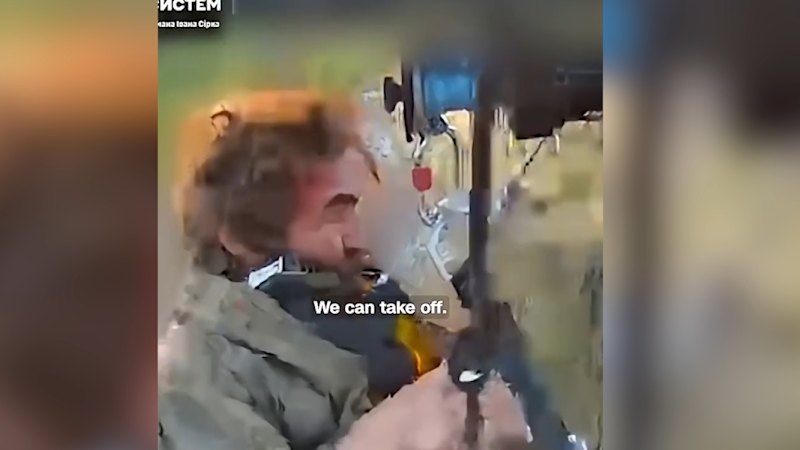
Ukrainian military evacuates wounded soldier with aerial drone for the first time
This video provides visual context on how Ukrainian forces executed a first-of-its-kind heavy aerial drone evacuation when ground rescue was impossible.