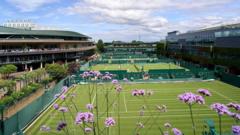
The grass at Wimbledon is not just grass. It is a specific, obsessive blend of 100% Perennial Ryegrass, shorn to exactly eight millimeters. To the groundskeepers, it is a living, breathing canvas. To the neighbors across the street, it is the boundary of an empire.
For decades, the All England Lawn Tennis Club (AELTC) has existed in a delicate, often strained, symbiosis with the London boroughs of Merton and Wandsworth. On one side of the fence lies the most prestigious tennis tournament on earth, an event that smells of Pimm’s and strawberries. On the other side lies the quiet, leafy reality of suburban London—a place where people walk their dogs, fret over traffic, and value the sanctity of their local parkland.
That fence is about to move.
A recent High Court ruling has cleared the way for a transformation so massive it effectively triples the size of the hallowed grounds. The AELTC plans to build 39 new courts, including an 8,000-seat show court with a retractable roof, on the site of the former Wimbledon Park Golf Club. It is a victory for the giants of the sport. It is a heartbreak for those who see the project as an industrial-scale encroachment on protected metropolitan open land.
The Weight of a Shadow
Think of a resident named Sarah. She isn’t real, but her concerns are shared by thousands who signed petitions against the expansion. Sarah has lived in Southfields for twenty years. To her, Wimbledon isn't a two-week televised spectacle; it is the rhythm of her life. She knows the shortcut through the park where the oaks turn gold in October. She knows the specific silence of the golf course in mid-winter.
Now, Sarah looks at the blueprints and sees 261 trees slated for removal. She sees years of construction dust, heavy machinery clogging the narrow veins of Church Road, and the permanent loss of a vista that felt, for a century, like it belonged to everyone.
The AELTC argues that this is about survival. In the hyper-competitive world of Grand Slams, standing still is the same as falling behind. Roland Garros expanded. The Australian Open modernized its entire precinct. Without more courts, Wimbledon cannot host the qualifying rounds on-site. Currently, those matches happen a few miles away in Roehampton, on a site that lacks the magic—and the infrastructure—of the main stage.
The High Court's decision to dismiss a legal challenge against the development wasn't just a win for a sports club. It was a judicial affirmation that "public benefit" can sometimes be defined by the prestige of an institution rather than the quietude of a neighborhood.
A Masterpiece of Infrastructure or an Architectural Intrusion
The scale of the "Wimbledon Park Project" is staggering. We are talking about 73 acres of land.
To visualize this, don't think of a few extra tennis nets. Imagine a small city rising where a rolling green landscape used to be. The club promises to create a new 23-acre public park as part of the deal—a "gift" to the community to offset the construction. But there is a catch. This new park would only be accessible outside of the tournament season.
This is where the friction lives.
The opponents, led by groups like Save Wimbledon Park, argue that the "parkland" being offered is a poor substitute for the heritage site they are losing. They point to the fact that the land is "Grade II*" listed, a designation meant to protect historic landscapes from exactly this kind of upheaval.
The legal battle centered on a technicality that sounds dry but feels visceral: whether the club’s 1993 promise never to build on the land was a binding covenant or a mere statement of intent. The High Court sided with the future over the past. It ruled that the planning permission granted by Merton Council was lawful, effectively giving the AELTC the green light to begin their transformation.
The Invisible Stakes of Professionalism
Why does a club that already makes hundreds of millions of pounds need to triple in size?
The answer lies in the locker rooms. Modern tennis is an arms race of recovery and preparation. Players today travel with entourages—physios, data analysts, nutritionists, and multiple coaches. The current Victorian-era footprint of the All England Club is bursting at the seams. During the first week of the tournament, the "player's lawn" looks less like an elite sporting venue and more like a crowded airport terminal.
By bringing the qualifying matches to the main site, Wimbledon ensures that every player who eventually lifts the trophy has trodden the same hallowed turf from day one. It creates a unified narrative for the tournament. It increases broadcast revenue. It allows for more spectators, more hospitality, and more "brand equity."
But at what cost to the soil?
The construction will involve desilting the lake and moving thousands of tons of earth. The club insists they will plant 1,500 new trees to replace those lost, creating a net gain in biodiversity. Critics remain skeptical. A sapling planted in 2026 is not the same as a century-old oak that has weathered the Blitz and seen the evolution of the modern world. You can’t manufacture age.
The Sound of the Future
If you stand on the edge of the golf course today, it is quiet. The only sound is the occasional thwack of a ball or the rustle of the wind through the lime trees.
In five years, that sound will be replaced by the roar of 8,000 fans under a closed roof. It will be the sound of progress, according to the AELTC. It will be the sound of a community losing its breath, according to the locals.
This isn't a story of "good guys" versus "bad guys." It is a story of competing versions of a legacy. The AELTC believes their legacy is the global health of tennis and the prestige of the United Kingdom’s premier sporting export. The residents believe their legacy is the dirt under their fingernails and the view from their bedroom windows.
The High Court has spoken, and the law is rarely sentimental. The hurdles that remain are now mostly administrative, a series of planning hurdles that feel like formalities after the weight of a High Court ruling. The expansion is no longer a "plan"; it is an inevitability.
When the first ball is struck on the new show court, most of the world will see a triumph of engineering and a celebration of sport. They will see the gleaming white lines and the perfect, eight-millimeter grass. They won't see the ghosts of the trees that stood there for a hundred years, or the quiet paths where a neighborhood used to find its peace.
The empire has won the right to grow.
Soon, the gates will open, the cement will dry, and the map of SW19 will be redrawn forever. The only thing left to see is whether the soul of the place can survive the scale of its own success.
The shadows on Church Road are getting longer, and for the first time in a century, they are cast by cranes rather than oaks.**