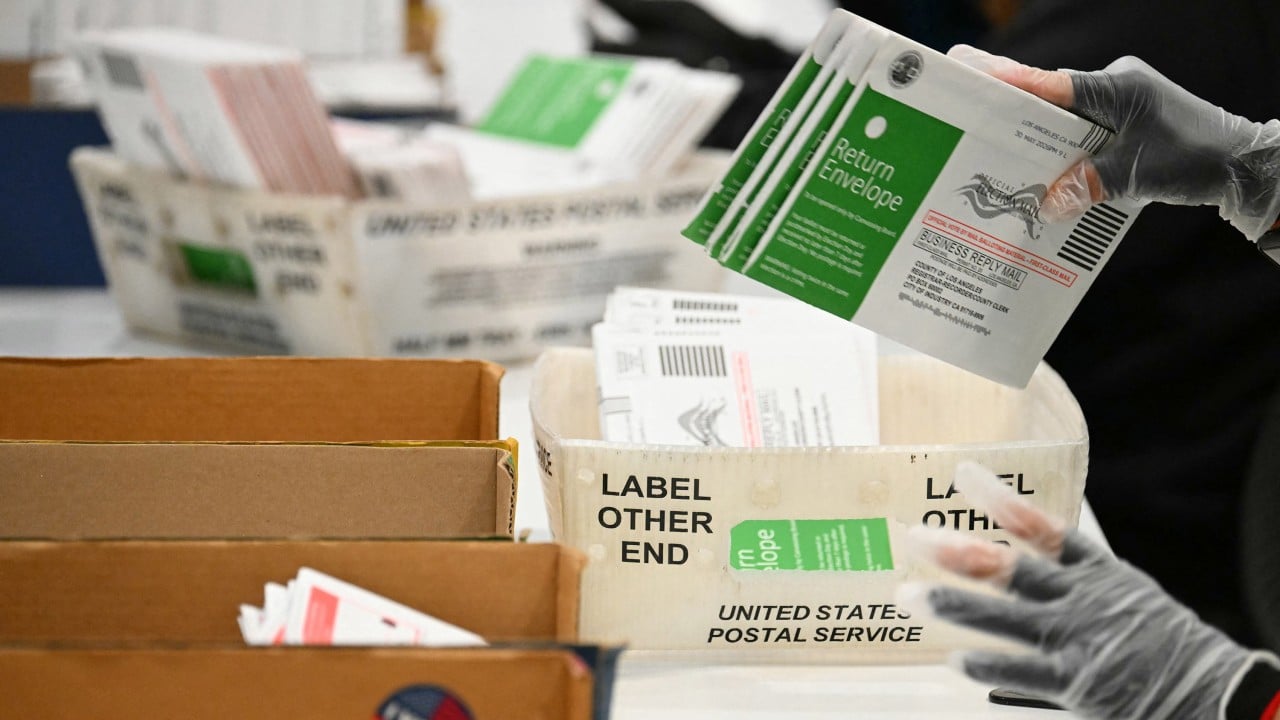
Ink dries slowly on kitchen tables across America.
For Maria, a seventy-two-year-old grandmother with a hip that throbs whenever the autumn air turns sharp, the kitchen table is where her civic duty happens. Under the glow of a single amber pendant lamp, she unscrews the cap of her favorite black gel pen. Her granddaughter sits nearby, explaining how to align the signature line with the perforated edge. This is not a casual chore. It is a ritual. For Maria, filling out a mail-in ballot means she does not have to risk the icy wind of a November morning, nor does she have to stand for forty minutes on a line that makes her lower back spasm. It means her voice survives her physical limitations.
Except, behind the scenes, paper is rarely just paper.
While millions of citizens like Maria slide their signed envelopes into outgoing mailboxes, a parallel universe of legal briefs, emergency injunctions, and federal gavels operates at a breakneck speed. Recently, that machinery collided with reality when a second federal judge stepped forward to block sweeping restrictions on mail-in voting.
To understand why this matters, you have to look past the sterile language of court transcripts. You have to look at the clock.
Consider what happens when a rule changes two weeks before an election. Imagine the logistics of a county election supervisor—let us call him David—who has spent eighteen months coordinating poll workers, ordering drop boxes, and training staff on signature-verification protocols. David’s hair is thinning, his eyes are ringed with exhaustion, and his desk is buried under stacks of provisional ballot envelopes. When a state legislature passes a new statute requiring mail-in ballots to arrive by a strict deadline, or restricting who can drop off an envelope for a neighbor, David does not experience it as an abstract political theory. He experiences it as an operational crisis.
He experiences it as a phone call from a precinct worker crying because an elderly voter was turned away.
The recent judicial intervention—the second block issued by a court scrutinizing these voting restrictions—was not merely a legal check on legislative power. It was a temporary reprieve for the machinery of democracy itself. Courts found that these new hurdles, often framed as security measures, disproportionately isolated voters who rely on postal delivery because of work schedules, geographic isolation, or failing health.
Security and access are eternal antagonists. Every lock placed on a door makes it harder for an intruder to enter, yes. But it also makes it harder for the resident to rush outside when the house is on fire.
Look closely at the arguments presented in these courtrooms. Proponents of mail-in voting restrictions argue that absentee ballots are inherently more vulnerable to fraud than in-person voting. They point to the chain of custody, the handling by postal carriers, the sorting machines, the kitchen tables where well-meaning family members might accidentally lean over a relative's shoulder and offer unwanted advice. They want absolute, pristine control over the ballot box.
And on paper, control sounds comforting. Order is comforting.
But the reality on the ground is messier. In rural districts spanning thousands of square miles, the nearest polling place might be a forty-minute drive down unpaved roads. For a single parent working two jobs—one at a diner opening at dawn, another at a warehouse closing at midnight—carving out a two-hour window to vote in person is not an inconvenience. It is an impossibility. For them, the mail-in ballot is not a convenience feature. It is the entire bridge connecting their daily survival to the halls of power.
When a second judge blocked these restrictions, pointing to the undue burden placed on ordinary citizens, the legal reasoning rested on a simple, bruising truth: laws that make voting harder do not just catch bad actors; they catch exhausted nurses, shift-working mechanics, and grandparents whose knees simply refuse to cooperate.
History is replete with these pendulum swings. We have spent centuries arguing over who gets to hold the pen. From property requirements to poll taxes, from literacy tests to signature matches, the American experiment has always been a tug-of-war between expanding the circle and guarding the perimeter.
Every time someone tries to narrow the aperture of participation, a counter-pressure builds. That pressure finds its way into federal courtrooms, where judges must weigh the speculative threat of fraud against the immediate, guaranteed disenfranchisement of legitimate voters.
When the second judge issued the injunction, the immediate effect was a collective exhale among local election offices. David, the exhausted supervisor, could finally tell his staff to stop redesigning the instructional flyers that were supposed to explain the new, tighter deadlines. The rules remained stable, at least for now. The runway stayed clear.
Yet, stability in an election cycle is always a fragile thing. Like walking across a frozen lake in early spring, you can hear the ice cracking beneath your boots even if you are moving forward.
The legal battles will wind their way through appeals courts. Briefs will be filed. Arguments will be polished by expensive lawyers who have never stood in line at a community center gymnasium waiting to cast a ballot. The politicians who drafted the restrictions will issue press releases about integrity and transparency, speaking in crisp, polished soundbites that play well on evening broadcasts.
Meanwhile, Maria will seal her envelope.
She will walk out to her porch, past the pots of withered chrysanthemums, and lift the small red flag on her mailbox. She will push the metal door shut with a satisfying click. Inside that envelope is her voice on property taxes, school funding, and the direction of a country she has watched change across eight decades. She does not know what a federal injunction is. She does not care about the jurisdictional nuances cited in page forty-two of the judicial opinion.
She only knows that she trusted the process, and she hopes the process trusts her back.
The struggle over how we cast our votes is ultimately a struggle over who we trust. Do we trust our neighbors to participate responsibly, or do we assume the worst of them? The courts, for a fleeting moment, chose trust. They drew a line in the sand and said that making it harder for a citizen to vote simply because of where they live, how old they are, or how busy their life is, violates the core promise of the republic.
The ink on Maria’s ballot dries. The mail carrier comes down the street, tires crunching on the autumn leaves, stopping box by box. The envelope slides into the canvas bag alongside utility bills and grocery flyers, carrying a tiny piece of the American future with it, protected—for today—by the quiet intervention of a judge who believed that the easiest way to protect democracy is to let people use it.