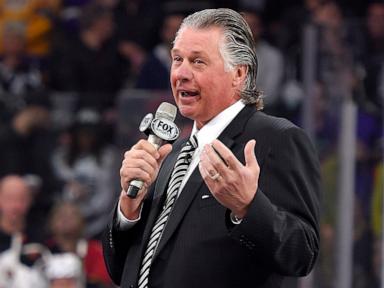
Barry Melrose died at age 70, taking with him an era of hockey that television executives would never dare manufacture today. The mullet was never a costume. It was a weather vane for an attitude that treated the National Hockey League as a blood sport played on ice by men who preferred grievances settled immediately.
When the news broke, the tributes followed a predictable script. Analysts remembered the slick suits, the biting commentary, and the unmistakable television presence that made him a household name long after his coaching days ended. Yet those summaries miss the real weight of his footprint. Melrose bridged the gap between the gritty, unfiltered hockey of the 1980s and the glossy, corporate entertainment product of the modern era. He did not merely survive the transition. He translated it for an audience that still wanted dirt under its fingernails.
The Manufacturing of an Icon
Most people forget that Melrose arrived on national television not as a polished broadcaster, but as a freshly fired coach carrying the scars of a Stanley Cup run. In 1993, he took the expansion Tampa Bay Lightning into the league's consciousness before steering the Los Angeles Kings to the finals against the Montreal Canadiens. That Kings team featured Wayne Gretzky, but it also featured heavy hitters who understood that intimidation was a tactical asset.
When Gretzky and company fell short, Melrose stood before the cameras wearing oversized glasses and double-breasted suits, refusing to offer the standard clichés. That authenticity caught the eye of ESPN producers who were searching for personality in a sport that had long hidden behind stoic, uncommunicative figures.
Television loves a character. Television usually destroys them by turning them into caricatures. Melrose managed to walk that razor-thin edge for decades. He played the villain to passionate fanbases, particularly in Canada where his unabashed support for American teams or specific players made him a lightning rod for criticism. He embraced the jeers. A broadcaster who everyone likes is usually telling the audience nothing worth hearing.
Behind the Microphone and the Bench
To understand why Melrose resonated, one must look at how he coached. His system relied on emotional combustion. Modern analytics departments would likely combust reviewing his methods, which prioritized momentum, physical imposition, and sheer willpower over zone entries and shot suppression metrics.
That philosophy translated directly to his television work. When he analyzed a game on ESPN, he did not talk about expected goals percentages. He talked about who wanted it more, who got hit, and who backed down. Critics called it antiquated. Viewers called it refreshing.
Hockey has spent the last twenty years trying to sanitize its image to attract a broader demographic. Concussion lawsuits, fighting reductions, and corporate arena cultures transformed the product. Melrose remained a living artifact of the old contract between the players and the fans. He understood that hockey is fundamentally a tribal conflict disguised as a sport. When he criticized a player for lacking grit, he was speaking the ancient language of the locker room, a language that modern broadcast partners increasingly try to mute.
The Final Years and the Battle With Parkinson's
In late 2022, Melrose announced he was stepping away from television after being diagnosed with Parkinson's disease. The announcement arrived with the same directness that defined his career. No self-pity. No public sympathy tour. Just an acknowledgment of a formidable opponent that could not be out-coached or out-skated.
The disease stripped him of his public platform just as the sport he covered was undergoing its most radical identity shift. Today's players are faster, more skilled, and infinitely more conditioned than the skaters Melrose coached or fought against in the minor leagues. Yet the league still lacks color. The personalities are media-trained, the post-game interviews are scripted exercises in cliché avoidance, and the television broadcasts feel increasingly like actuarial tables.
Barry Melrose left behind a vacuum. Not because he was the greatest coach in hockey history—his record proves otherwise—but because he was entirely, unapologetically himself in an industry that rewards conformity. When the red light flashed, you never wondered if you were getting a corporate talking point. You were getting Barry, flaws and all, telling you exactly what he saw through those tinted lenses.
The mullet is gone. The suits are hung up. The game keeps skating forward into a future that looks less and less like the one he fought for every single night.