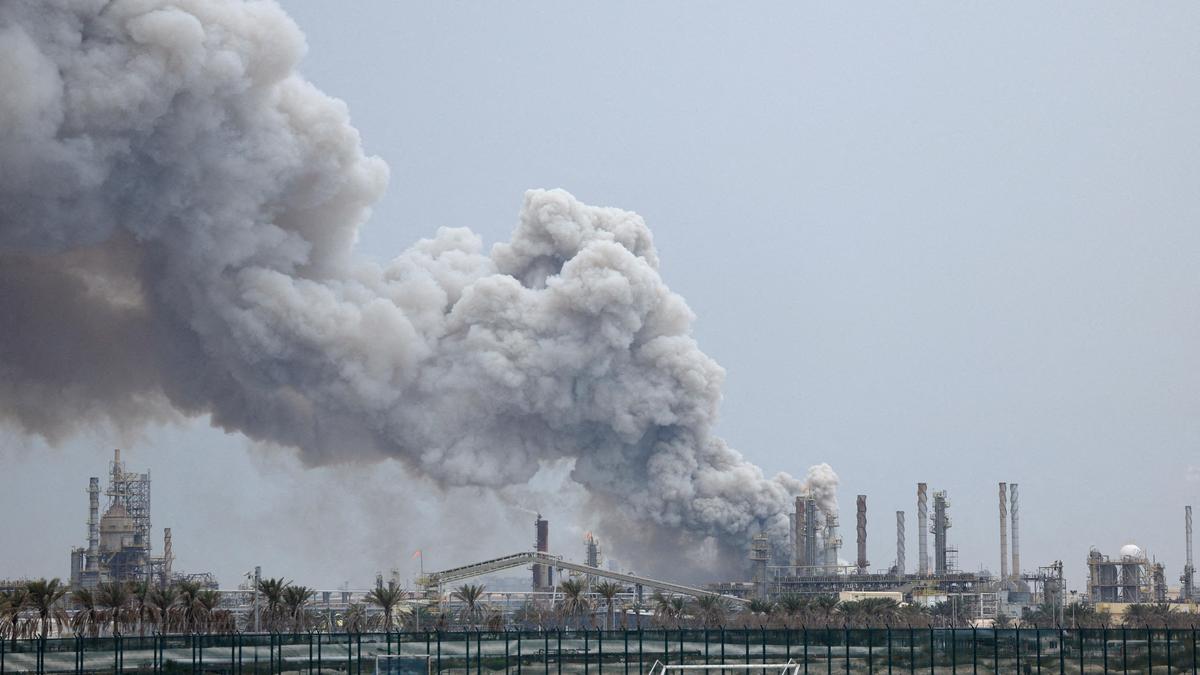
The finger-pointing started before the smoke even cleared. Analysts saw a blast in Bahrain, looked at the telemetry of a failing interceptor, and rushed to the same tired script: "It was a U.S.-operated Patriot missile." They treat the presence of American hardware like a smoking gun that proves American culpability. It is a lazy narrative that ignores how modern integrated air defense actually works.
If you want to understand why a missile goes rogue, stop looking at the flag on the uniform of the guy pushing the button. Start looking at the physics of the kill chain and the brutal reality of aging interceptor inventory.
The "analysis" circulating right now is a masterclass in surface-level observation. It assumes that because a Patriot PAC-2 or PAC-3 behaves a certain way, it must be under the direct command and control of U.S. forces stationed in the Gulf. This ignores the massive technology transfer and autonomous capability baked into these systems. We are not looking at a "whoops" from a bored operator in a trailer. We are looking at the inherent failure rate of complex kinetic systems that the industry refuses to discuss in polite company.
The Software is the Operator
In the old days, a human looked at a radar scope, identified a blip, and manually guided a missile. That world is dead. Today, the Patriot system—specifically the AN/MPQ-65 radar set and its associated Engagement Control Station—operates on a level of automation that renders the "U.S.-operated" label almost meaningless.
When a threat enters the engagement envelope, the system makes a thousand calculations per second. It decides the intercept point. It manages the uplink. If the missile loses its track or the seeker head fails to lock onto the target's RCS (Radar Cross Section), the interceptor enters a self-destruct or "fail-safe" mode.
When these missiles tumble and explode over civilian areas or industrial sites, it isn't usually a "user error." It is a mechanical or logic failure. To blame the U.S. military specifically for a malfunctioning rocket motor or a corrupted guidance loop is like blaming a driver because their car’s fuel injector exploded.
I’ve seen how these contracts work. We sell the hardware, we provide the "train-the-trainer" sessions, and then we pretend the systems are foolproof. They aren't. Every time a Patriot is fired in a high-stress, multi-target environment like the Persian Gulf, you are rolling the dice on thirty-year-old solid-state fuel.
The False Security of the Intercept
The media loves a "hit." They want to see the fireball in the sky that proves the shield works. But the "hit" is often the most dangerous part of the process.
Consider the mechanics of a PAC-2 intercept. It uses a blast-fragmentation warhead. It doesn't need to hit the incoming Scud or drone directly; it just needs to get close enough to shred it with tungsten pellets.
- The Debris Problem: Even a "successful" intercept creates a rain of supersonic trash.
- The Kinetic Residual: If the intercept happens at a low altitude, the momentum of the interceptor doesn't just vanish. It carries into the ground.
- The Failed Motor: If the solid rocket motor fails to ignite properly or burns unevenly, the missile becomes a 2,000-pound unguided pipe filled with high explosives.
When an explosion happens in a place like Bahrain, the immediate jump to "U.S.-operated" serves a political agenda, not a technical one. It shifts the blame from the inherent risks of living under a "missile shield" to a specific geopolitical actor.
Stop Asking Who Pushed the Button
The "People Also Ask" sections of the internet are currently obsessed with whether the U.S. is "responsible" for the blast. You’re asking the wrong question.
The real question is: Why are we still relying on interceptors that have a documented history of "lawn-darting" in urban environments?
During the 2003 invasion of Iraq, the Patriot system had several high-profile "friendly fire" incidents and malfunctions. We were told those bugs were squashed. They weren't. You cannot "patch" the physics of a missile that has been sitting in a canister in 110-degree heat for a decade.
The "lazy consensus" says that more batteries equal more safety. I argue that more batteries in a confined, high-density area like Bahrain actually increase the statistical probability of a catastrophic "system-side" accident.
The Logic of the Rogue Missile
Imagine a scenario where a radar detects a "ghost" or a flock of birds that matches the velocity profile of a cruise missile. The system, set to a high autonomous readiness state, launches. Once the seeker realizes there is no metallic mass to track, it tries to abort.
If the abort sequence fails—perhaps due to a faulty thermal battery—the missile follows a ballistic arc straight into whatever happens to be underneath it.
Is that "U.S.-operated"?
Is it "Bahraini-operated"?
No. It’s a hardware failure. By focusing on the nationality of the crew, we ignore the terrifying reality that our "shields" are often just as dangerous as the swords they are meant to deflect.
The Illusion of Precision
We have been sold a lie about "surgical" defense. We use words like "Point Defense" and "Lower Tier Interceptor" to make it sound like a scalpel. It is a sledgehammer.
- Radar Interference: The Gulf is one of the most electronically "noisy" places on earth. Commercial air traffic, shipping radar, and electronic warfare suites are all screaming at the same frequencies.
- Clutter: Intercepting a low-slow drone is vastly different from hitting a ballistic missile. The Patriot was designed to kill Cold War jets and high-arcing Scuds. Forcing it to play "drone hunter" in a crowded coastal city is asking for a disaster.
The industry insiders won't tell you this because it hurts sales. If you admit the Patriot has a 5-10% "critical malfunction" rate in real-world urban deployments, the multi-billion dollar export market evaporates. So, instead, we blame the "operator." We say the "analysis finds" it was a specific unit's fault.
It is easier to fire a colonel than it is to admit the math of missile defense is fundamentally broken in small, high-density geographies.
The Brutal Reality of the Kill Chain
If you live in a region protected by these systems, you aren't living under an umbrella. You are living under a series of controlled explosions.
[Image showing the "Footprint" of a missile defense battery and the danger zone of falling debris]
The "Footprint" isn't just the area the missile protects; it’s the area where the missile's parts will land when things go wrong. In a place as small as Bahrain, the "protected area" and the "debris zone" are the same thing.
The competitor's article wants to find a villain. They want to point at a U.S. battery and say, "You did this."
The truth is much more uncomfortable. The system did what it was designed to do—it attempted an engagement. The fact that the engagement ended in a ground-level blast is a feature of the technology, not a bug of the operator.
Stop looking for a human to blame for a machine’s statistical inevitability.
If you want to avoid blasts in Bahrain, stop pretending that filling the sky with high-speed, self-destructing rockets is a risk-free endeavor. The next time a "shield" fails, don't check the operator's ID card. Check the manufacturing date on the rocket motor.
Burn the manual. Stop trusting the brochure. The shield is just another fire waiting to happen.