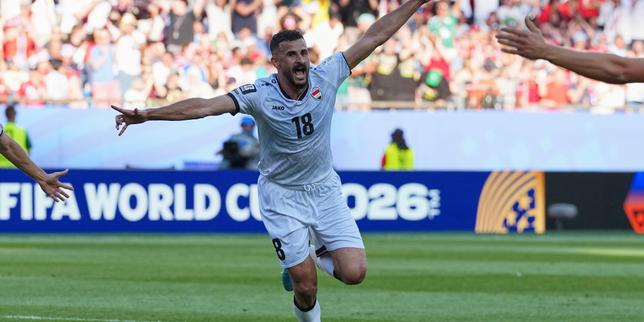
Football has a habit of laying bare the most staggering human contrasts on a single patch of grass. Tonight in Philadelphia, that contrast walks out of the tunnel. On one side, you have Didier Deschamps’ France, a well-oiled machine of footballing luxury chasing tournament immortality. On the other side stands Iraq, a nation making its first tournament appearance in 40 years, carried on the broad shoulders of its talismanic striker, Aymen Hussein.
If you’re looking for tactical nuance, you won’t find a bigger mismatch in Group I. But if you’re looking for heart, you can't look past Iraq's number 18. Hussein isn’t just a target man; he’s a symbol of survival for a country that has seen football fields turned into battlegrounds. Heading into this massive fixture at Lincoln Financial Field, the narratives surrounding both camps couldn't be further apart.
The Long Road to Philadelphia
To understand what this game means to Iraq, you have to look at where Aymen Hussein comes from. He grew up in the Al-Anbar region, a part of Iraq heavily scarred by conflict. His personal life was directly touched by the tragedies of war. His father, a military officer, was killed in an attack, and his brother was kidnapped. Most people would break under that kind of trauma. Hussein used it to fuel a relentless football career.
He’s a mountain of a striker. He doesn't play with the poetic grace of Kylian Mbappé, but he plays with a sheer physical will that forces defenders into mistakes. He proved that during the Asian qualifiers, dragging Iraq through the rounds with eight crucial goals.
Even getting to the tournament was a reminder of the geopolitical baggage he carries. Just weeks ago, after landing in Chicago, Hussein was detained at airport customs for seven hours for extra security screening. While the rest of his teammates went to the hotel, their star forward sat in a room answering questions. It’s the kind of disruption that would derail most athletes' preparation. For Hussein, it was just another day dealing with the reality of being an Iraqi public figure. He shook it off, rejoined the squad, and got straight back to work.
Surviving the Norway Reality Check
Iraq’s opening match against Norway was a brutal lesson in elite modern football. Erling Haaland did what Erling Haaland does, piercing the Iraqi defense with clinical efficiency. Yet, there was a brief moment where the script flipped.
In the 39th minute, Hussein found the back of the net, registering Iraq’s second-ever goal in their entire tournament history. For a few minutes, the dream was alive. Then, the physical toll of chasing European professionals across 90 minutes caught up with them. Iraq wilted late in the game, conceding twice in the final 25 minutes to drop the opener 4-1. Hussein even had the misfortune of scoring an own goal in stoppage time as he tried to defend a desperate set-piece.
The stats tell an honest story of that opening match:
- Shots registered: 3 by Hussein, but zero team shots after the 63rd minute.
- Defensive struggles: Iraq allowed 11 shots from inside their own penalty area.
- Late fatigue: Conceded two goals after the 75th minute.
Basically, Iraq can compete tactically for an hour. But when the legs go, the structure crumbles.
The French Problem
If Norway was a tough exam, France is a PhD defense. Les Bleus started their campaign with a 3-1 win over Senegal. They looked sluggish in the first half, but Didier Deschamps moved Michael Olise into a central playmaker role at halftime, and everything clicked.
Kylian Mbappé is currently chasing history. With his two goals against Senegal, he tied Gerd Müller for the fourth-most goals in tournament history with 14. He’s explicitly hunting the Golden Boot, which means he won’t be taking his foot off the gas against an Iraqi defense that struggled to track runners from deep.
Iraq coach Graham Arnold knows his team can’t outplay France in a possession game. If they try to build out from the back, Olise, Ousmane Dembélé, and Marcus Thuram will press them into oblivion.
Iraq’s only viable path to a historic upset relies on an old-school blueprint. They have to sit in a low defensive block, crowd the box, and use Hussein as an absolute escape valve. When the defense wins the ball, they need to launch it long. Hussein’s job is to contest aerial duels, hold up the ball against physical center-backs like William Saliba, and win fouls to buy his defenders time to breathe.
Tactical Adjustments for the Historic Clash
For Iraq to avoid another late-game collapse, Arnold has to adjust his midfield rotation. Amir Al-Ammari and former Manchester United academy product Zidane Iqbal have the technical ability to keep the ball, but they must protect the back four better than they did against Norway.
If you're tracking this game, don't just watch the ball. Watch the battle between Hussein and the French central defenders. It's going to be a physical, bruising encounter. For France, this is an exercise in professional efficiency. For Hussein, it’s a chance to show the world that Iraqi football belongs on the biggest stage, no matter how heavy the road was to get there.
The smart tactical move for Iraq is to make the game ugly early on. Disrupt the French rhythm, give away smart fouls in midfield, and hope Hussein can maximize a single set-piece opportunity. If they let France score in the opening fifteen minutes, it’s going to be a long night in Philadelphia.