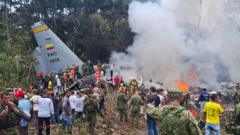
The crash of a Colombian military transport aircraft resulting in high-fatality counts is rarely a localized failure of piloting; it represents a systemic breakdown in the intersection of operational load, maintenance cycles, and high-altitude geographic stressors. Analyzing these incidents requires moving beyond the "engine failure" or "pilot error" tropes to evaluate the structural integrity of the Colombian Air Force (FAC) logistics chain. When a specialized military vessel—often a C-130 Hercules or a CASA C-295—exits the sky abruptly, the investigation must quantify three distinct variables: the airframe’s fatigue life, the tactical environment of the Andean cordilleras, and the resource allocation of the defense budget.
The Triad of Andean Aviation Risk
The Colombian theater of operations presents a unique set of variables that degrade aircraft performance more aggressively than standard NATO environments. To understand why these crashes occur, one must map the technical limitations against the physical geography.
1. High-Density Altitude and Lift Degradation
Colombian military flights frequently originate from or transit through Bogota (8,360 feet) or various mountain outposts. At these altitudes, the air is significantly less dense. The physical consequence is a reduction in the mass flow of air through the engines and over the wing surfaces.
$$L = \frac{1}{2} \rho v^2 S C_L$$
In this lift equation, $\rho$ (air density) is the critical declining variable. As altitude increases, $\rho$ drops, requiring a corresponding increase in $v$ (velocity) to maintain $L$ (lift). For a heavy transport plane near its Maximum Takeoff Weight (MTOW), the margin for error during the climb phase is razor-thin.
2. Orographic Turbulence and Macro-Scale Wind Shear
The central, eastern, and western ranges of the Colombian Andes create an atmospheric profile characterized by powerful "mountain waves" and localized wind shear. In these corridors, a transport aircraft can encounter a vertical downdraft that exceeds its maximum rate of climb (ROC). When the military mission profile demands a low-altitude transit to avoid terrain or meet logistical drop-points, the aircraft loses its most valuable asset: recovery time. The "dead man's curve" for transport aviation in this region is the altitude at which the ROC cannot overcome the atmospheric downward vector.
3. Aging Airframes and Maintenance Cycle Compression
The Colombian Air Force often operates aircraft—specifically the C-130 fleet—that have been in service for decades. These machines are subject to "pDM" (Programmed Depot Maintenance), but the frequency and intensity of tactical operations in Colombia’s internal conflict have accelerated the accumulation of flight hours.
The mechanism of failure here is metal fatigue. Each takeoff and landing cycle (a "pressurization cycle") creates micro-cracks in the fuselage and wing roots. Over thousands of cycles, these cracks can propagate to a critical length. In a high-stress environment—such as a steep turn or a heavy-payload climb—the structural integrity of the wing-box can fail catastrophically. The "dead dozens" in these crashes are often the result of this structural separation, which leaves the pilots with zero control authority.
The Operational Cost Function of Military Air Logistics
Military aviation differs from commercial aviation in its risk-to-utility ratio. In a commercial context, a flight is cancelled if a single redundant system fails. In a military context, specifically in the Colombian counter-insurgency or counter-narcotics framework, the mission often dictates a "minimum equipment list" (MEL) that is far more permissive.
The Trade-off: Payload vs. Safety Margin
When a military aircraft carries dozens of troops, it is operating at the upper limit of its weight-and-balance envelope. The center of gravity (CoG) is a calculation, not a static point. If troops or cargo are not perfectly secured or if the loadmaster miscalculates the weight of equipment, the CoG can shift during a climb.
- Aft-Shifted CoG: This induces an unrecoverable stall. The nose pitch increases, the airspeed drops below the stall speed, and the aircraft falls from the sky tail-first.
- Forward-Shifted CoG: This makes the aircraft "heavy" on the nose, requiring more elevator force to rotate. In a high-altitude takeoff (like Bogota), this can lead to a runway overrun or a failed climb.
The "cost" of the mission is the safety margin. For every additional soldier or pound of cargo, the aircraft's ability to survive a single-engine failure or a sudden gust of wind decreases. In the Colombian context, the push for logistical efficiency—moving as many troops as possible in one flight—often erodes this margin to near-zero.
Identifying the Mechanism of the Colombian Crash
The crash of a Colombian military plane is rarely a "mystery" to those who understand the physics of heavy-lift aviation. It is a predictable outcome of four intersecting failures.
The Cascade of Mechanical Attrition
The primary failure point in these incidents is frequently the propulsion system. In a four-engine C-130 or a twin-engine C-295, the loss of one engine is survivable under normal conditions. In the Colombian Andes, however, the "asymmetric thrust" created by an engine failure requires the pilot to use significant rudder input to maintain heading.
This rudder input increases drag. On a high-altitude day with a heavy load, the drag from the rudder can exceed the thrust from the remaining engine(s). This results in a "loss of control in flight" (LOC-I). This is the specific mechanism that leads to the high death tolls: the aircraft does not glide to a crash landing; it enters a spin or a dive from which recovery is mathematically impossible at low altitudes.
The Role of Tactical Avionics and Terrain Avoidance
Modern military aircraft are equipped with Terrain Awareness and Warning Systems (TAWS). However, in tactical environments where the aircraft must fly "nap-of-the-earth" to remain under the radar or to land at austere strips, these systems are often inhibited or ignored.
The "CFIT" (Controlled Flight Into Terrain) is the leading cause of fatalities in military transport. The pilot is flying a perfectly functional aircraft but lacks situational awareness due to fog, night, or technical saturation. When the aircraft impacts a mountain side, the kinetic energy ($KE = \frac{1}{2}mv^2$) of a 70,000-pound transport plane moving at 200 knots ensures a zero-percent survival rate for those on board.
The Resource Allocation Bottleneck
To analyze the tragedy, one must look at the Colombian defense budget. The Colombian Air Force must balance the acquisition of new, safer airframes with the maintenance of a legacy fleet.
The "Maintenance, Repair, and Overhaul" (MRO) sector of the FAC is sophisticated, but it faces a parts-supply bottleneck. International sanctions or simple supply-chain delays for specialized aerospace alloys can lead to "cannibalization"—the practice of taking parts from one grounded aircraft to fix another. While this keeps planes in the air, it introduces variables into the airframe’s history that can lead to unforeseen failures.
Quantifying the Human Factor: Training vs. Operational Tempo
The pilots of the Colombian Air Force are among the most experienced in the world in terms of flight hours in hostile terrain. However, experience can lead to "normalization of deviance." This is a sociological and technical phenomenon where a pilot repeatedly takes risks—such as flying over a specific ridge in bad weather—and because they survive, they begin to view the risk as a standard operating procedure.
When the normalization of deviance meets a mechanical failure, the result is the high-fatality crash reported. The "dozens dead" are the data points in a failure of safety culture that prioritizes mission completion over strict adherence to the flight envelope.
Strategic Realignment of Air Assets
The solution to preventing these mass-fatality events is not merely "better maintenance" or "new planes." It requires a restructuring of the Colombian military's logistical doctrine.
The first move must be the implementation of mandatory payload reduction for all high-altitude transits. By capping the MTOW at 85% of the airframe’s theoretical limit, the FAC can build a "performance buffer" that allows aircraft to survive sudden downdrafts or single-engine failures even in the Andes.
The second move is the immediate decommissioning of airframes that have exceeded their 20,000-cycle threshold, regardless of their current flight status. The cost of a new C-295 is significantly lower than the political, social, and logistical cost of losing thirty elite soldiers and a trained flight crew.
Finally, the FAC must integrate real-time telemetry into its transport fleet. By monitoring engine performance and airframe stress in real-time from a ground-based center, the military can ground "at-risk" aircraft before a catastrophic failure occurs during a tactical mission. The data exists; the failure is the lack of an integrated system to act upon it before the aircraft impacts a mountainside.