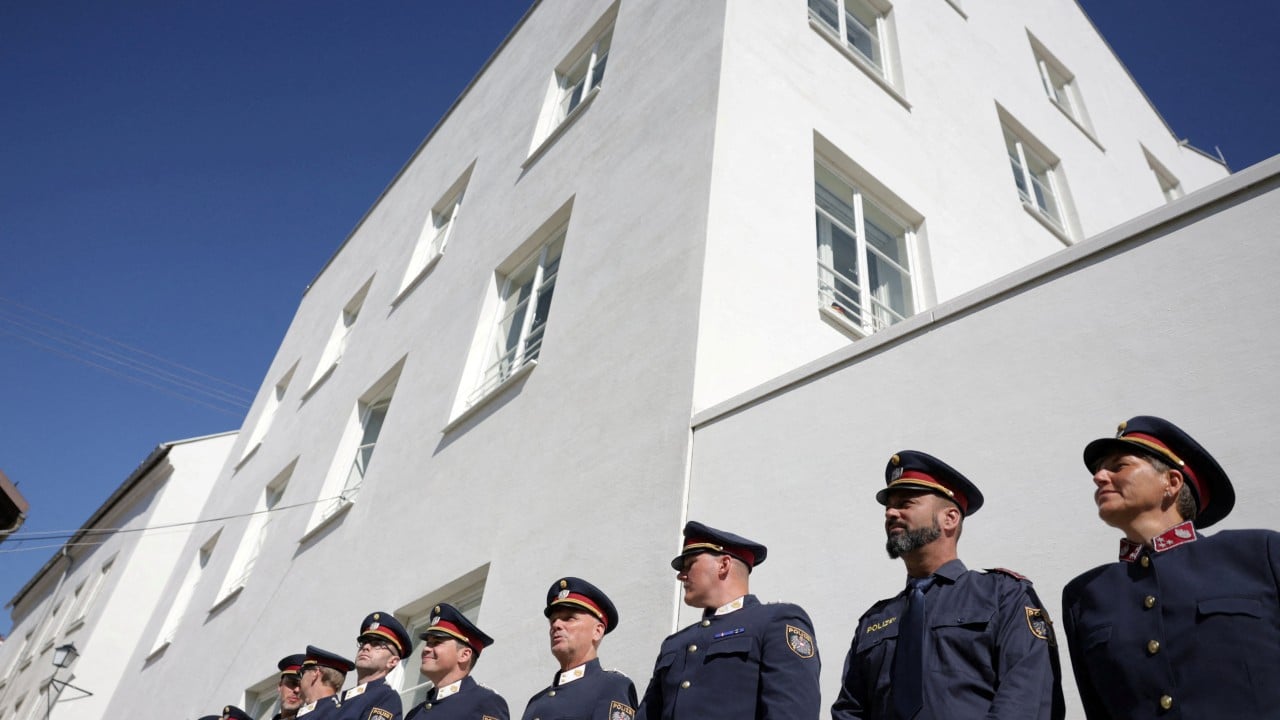
Austria finally decided what to do with the yellow three-story house in Braunau am Inn where Adolf Hitler was born in 1889. They turned it into a police station.
It sounds counterintuitive at first. Why would a nation convert the birthplace of history's infamous dictator into an active municipal police hub instead of tearing it down or building a memorial? The answer lies in a complex psychological strategy aimed at stripping the structure of its symbolic power. Austrian authorities wanted to prevent the building from remaining a pilgrimage site for neo-Nazis. They realized that erecting a traditional memorial often backfires by creating a sacred space for extremists. Converting the site into an active center of law enforcement accomplishes the exact opposite. It neutralizes the space through daily, mundane state activity.
Understanding this decision requires looking at how nations deal with dark historical heritage without glorifying the perpetrators or erasing the past.
The Decades-Long Battle Over a Yellow House
For decades, the Austrian government wrestled with what locals call the Salzburger Vorstadt 15. Hitler spent only the first few months of his life in the rental apartment inside the building, but that brief connection haunted the small town near the German border for nearly a century.
During the Nazi regime, the property was purchased by the party and turned into a cultural center. After World War II, the original owners regained possession through restitution laws. For years, the Austrian interior ministry leased the building to prevent misuse, using it as a day center for people with special needs until 2011, when the building's owner refused to allow renovations.
That refusal triggered a legal standoff.
- The building sat empty for years, attracting unwanted attention.
- Right-wing extremists secretly visited the site to pay homage.
- Demolition was debated, but heritage protection laws and historical preservationists objected.
- Expropriation became the state's only viable legal solution.
In 2016, the Austrian parliament officially expropriated the building from its private owner after a legal dispute over compensation. Once the state secured full ownership, the question shifted from legal control to architectural strategy.
Neutralization as an Architectural Strategy
In 2019, Austria launched an international architectural competition to redesign the property. The explicit goal was simple: "neutralization."
The winning design by the architectural firm Marte.Marte stripped away features added during the Nazi era, such as specific window frames and rooflines, restoring the building closer to its original, plain Biedermeier appearance. By eliminating any striking visual markers, the design renders the structure entirely unremarkable.
Historical State (Pre-2016)  --> Expropriation & Redesign --> Police Station Conversion
(Uncertain status, risk)         (Architectural stripping)   (Daily state function)
Placing a police headquarters in the building ensures a constant presence of armed officers and active patrol vehicles. Neo-Nazis looking to take photos or perform illegal gestures face immediate law enforcement intervention. The space shifts from a potential shrine to an active zone of public security.
The Debate Over Tearing It Down
Many critics argued that the building should have been razed entirely. Why preserve a structure associated with such evil?
Historians and political scientists successfully argued against total destruction. Erasing the physical footprint of the Nazi era creates a different set of problems. Demolition can be viewed as an attempt to evade historical responsibility or sweep uncomfortable truths under the rug. Austria already faced decades of international criticism for portraying itself purely as the "first victim" of Nazism, avoiding full accounting for the widespread public support Hitler received in 1938.
Destroying the house would have created an empty lot or a new public plaza. Empty spaces can easily become symbolic gatherings themselves.
On the flip side, creating a museum or a dedicated educational center carried its own risks. Experts worried that a dedicated exhibition inside the house where Hitler was born might inadvertently turn the location into a major attraction, drawing visitors for the wrong reasons. The solution was to place historical contextualization outside the building, while keeping the interior functional and unglamorized.
A memorial stone placed by the town of Braunau in 1989 remains on the sidewalk outside. The granite stone, brought from the quarry at the former Mauthausen concentration camp, reads: "For peace, freedom, and democracy. Never again Fascism. Millions of dead warn us."
How Other Nations Handle Dark Heritage
Austria's approach fits into a broader international conversation about managing sites of historical trauma. Different countries handle these physical spaces based on their unique political and cultural contexts.
Germany and the Fuhrerbunker
In Berlin, the underground bunker where Hitler spent his final days was partially destroyed by Soviet forces and later filled in by East German authorities. Today, the ground above it is an ordinary parking lot surrounded by residential apartment blocks. An informational panel stands nearby, providing historical context without creating an enclosed space for veneration.
Italy and Fascist Architecture
Italy took a very different path with its fascist-era monuments. Structures built under Benito Mussolini, including the EUR district in Rome and various public buildings across the country, remain in everyday use. The debate in Italy centers on how to contextualize these sites without celebrating the regime that built them.
Comparative Approaches to Heritage Sites
| Location | Original Significance | Current Use / Strategy | Primary Objective |
|---|---|---|---|
| Braunau am Inn, Austria | Hitler's birthplace | Police station and regional headquarters | Active neutralization through state presence |
| Berlin, Germany | Führerbunker site | Public parking lot with informational sign | Erasing physical structure while providing history |
| Nuremberg, Germany | Nazi rally grounds | Open historical site and documentation center | Educational transparency and reflection |
| Predappio, Italy | Mussolini's birthplace & tomb | Historical town with active tourism debates | Ongoing dispute over commercialization vs history |
What Happens Next for Braunau am Inn
The conversion project, representing an investment of over 20 million euros, reflects a long-term commitment by Austrian authorities. The goal is to give the citizens of Braunau am Inn back their town without the constant shadow of extremist tourism.
If you are following how governments handle historical memory and urban planning around sensitive heritage, keep these key factors in mind:
- Watch how architectural modifications alter public perception over time.
- Observe how municipal authorities balance active usage with external historical markers like the Mauthausen stone.
- Track similar heritage debates in other European cities dealing with 20th-century authoritarian legacies.