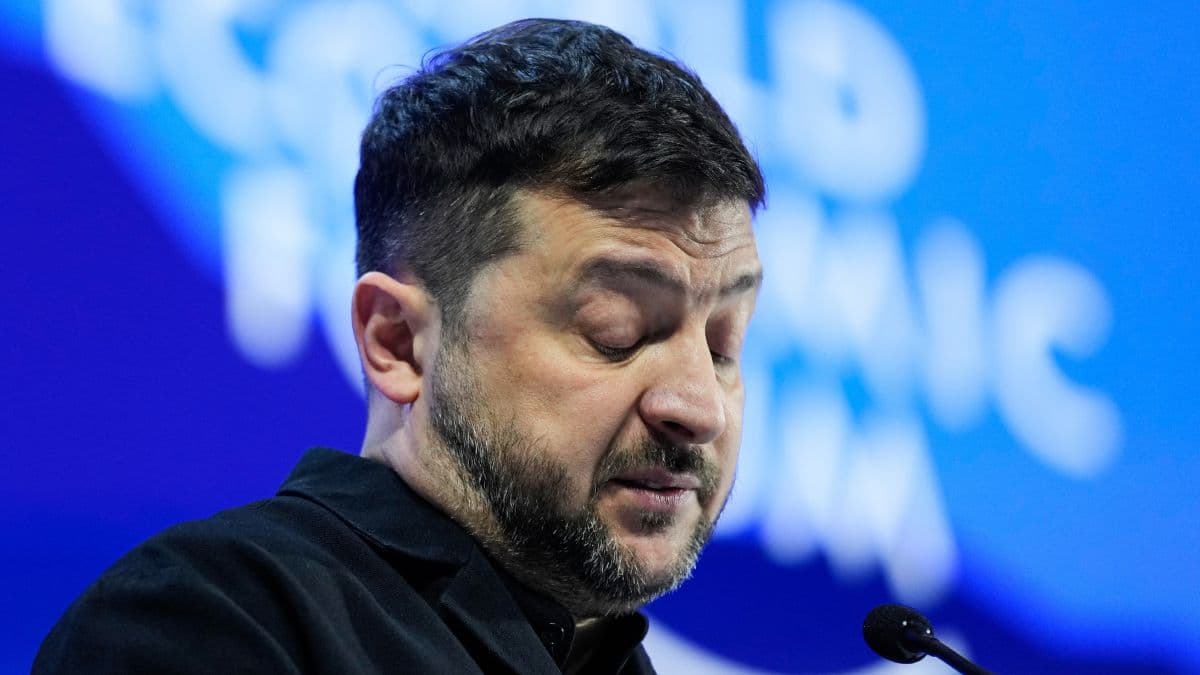
The survival of the Ukrainian state four years into a high-intensity kinetic conflict is not a product of sentiment but a result of successful defensive optimization against a superior force-to-space ratio. While Russian strategic objectives at the onset of the "Special Military Operation" prioritized the rapid decapitation of the Kyiv administration and the neutralization of Ukrainian military infrastructure, the current theater geometry reflects a grueling war of position. President Volodymyr Zelenskyy’s recent assessment that Russia failed its primary objectives serves as a qualitative baseline for a deeper quantitative reality: Ukraine has transitioned from an existential crisis to a systemic endurance challenge.
The Failure of the Decapitation Logic
Military operations are governed by the alignment of political ends with available means. In February 2022, the Russian General Staff employed a "Thunder Run" strategy—rapid, thin armored columns striking deep into enemy territory to force a psychological and political collapse. This failed due to a fundamental miscalculation of Ukrainian mobilization speed and the decentralized nature of their command and control.
The failure of this initial phase shifted the conflict into a three-dimensional attrition model:
- Territorial Integrity vs. Operational Depth: Russia currently occupies approximately 18% of Ukrainian territory. While significant, this is a regression from the highs of mid-2022. The inability to seize the Donbas in its entirety after four years of offensive operations indicates a breakdown in Russian combined arms efficacy.
- Economic Viability: Ukraine’s independence is currently subsidized by Western fiscal architecture. The maintenance of the Ukrainian state requires roughly $3 billion to $5 billion per month in external support to prevent hyperinflation and maintain essential services. Independence, in this context, is a function of logistical and financial interoperability with the West.
- Human Capital and Attrition Ratios: Standard military theory suggests that an attacker requires a 3:1 advantage to overcome a prepared defense. Ukraine has utilized the urban density of the Donbas and the natural barrier of the Dnipro River to skew these ratios. However, as the conflict enters its fifth year, the sustainability of Ukrainian manpower reserves faces diminishing returns against Russia's significantly larger mobilization pool.
The Defensive Equilibrium and its Costs
Zelenskyy’s assertion of "defended independence" must be measured against the degradation of national infrastructure. The cost function of this defense is staggering. The World Bank estimates recovery costs exceeding $486 billion. This creates a "Sovereignty Paradox": Ukraine has maintained its political autonomy at the expense of its economic self-sufficiency for the next two decades.
The current frontline stagnation is a result of the Transparent Battlefield. The proliferation of Class 1 and Class 2 Unmanned Aerial Systems (UAS) has rendered massed armored maneuvers nearly impossible. Any concentration of force is detected and struck by precision fires within minutes. This technological ceiling has forced both sides into a 21st-century iteration of trench warfare, where gains are measured in meters and losses in battalions.
Structural Bottlenecks in the Ukrainian Strategy
The primary constraint on Ukrainian operational success is no longer morale or tactical proficiency, but the Logistics of Interoperability. Ukraine operates a "museum of NATO hardware," necessitating distinct supply chains for 155mm artillery shells, Leopard 2 spares, Abrams maintenance, and Patriot interceptors.
- The Shell Gap: At peak intensity, Russia has fired upwards of 20,000–30,000 shells per day, while Ukraine has often been restricted to 2,000–5,000. This disparity is not merely a production issue; it is a manifestation of the West's "just-in-time" industrial base attempting to counter a Russian "just-in-case" command economy.
- Air Denial vs. Air Superiority: Ukraine has successfully implemented an Air Denial strategy, preventing the Russian Aerospace Forces (VKS) from operating freely over Ukrainian-held territory. However, without a modern multi-role fighter fleet (F-16s or Gripens) integrated with long-range sensor fusion, Ukraine cannot transition to an offensive posture that clears the way for ground forces.
The Geopolitical Insurance Policy
Russia's failure to achieve its stated goal of "denazification"—a euphemism for the installation of a puppet regime—has inadvertently accelerated the exact outcomes the Kremlin sought to prevent. Ukraine is now more integrated into the European security architecture than at any point in history.
The defense of independence is anchored in three specific geopolitical shifts:
- NATO Expansion: The accession of Finland and Sweden has effectively turned the Baltic Sea into a NATO lake, stretching Russian defensive resources thin in the North.
- EU Candidacy: The formal path toward EU membership provides a structured framework for Ukrainian legislative and economic reform, regardless of the kinetic outcome on the battlefield.
- Domestic Industrialization: Ukraine is pivoting toward a domestic defense-industrial base, partnering with European firms like Rheinmetall to produce ammunition and vehicles locally. This reduces the latency of the supply chain and increases long-term strategic autonomy.
Measurement of Strategic Failure
If we define Russia’s goals as the prevention of NATO eastward expansion and the re-absorption of Ukraine into the Russian sphere of influence, the four-year mark confirms a total strategic deficit. Russia has traded its professional army, its reputation as a premier energy supplier to Europe, and its access to Western high-tech components for a land bridge to Crimea and the ruins of several Donbas mining towns.
The Russian economy has pivoted to a war footing, with defense spending reaching roughly 7.5% of GDP. This creates a temporary stimulus but masks long-term structural decay. The decoupling from Western capital markets means Russia is increasingly reliant on a "No Limits" partnership with China, shifting from a global power to a junior partner in a regional bloc.
The Calculus of Persistence
The conflict has reached a stage where the "Victory" metric is being redefined. For Ukraine, victory is the preservation of the sovereign state and the continued path toward Western integration. For Russia, victory has been downgraded to the exhaustion of Western political will.
The friction in the US Congress and the varying levels of commitment across EU member states represent the true "Center of Gravity" in this war. If the flow of precision munitions and budgetary support is interrupted, the technical superiority of Ukrainian defenses will be overwhelmed by the sheer mass of Russian secondary and tertiary mobilization waves.
The Operational Pivot
To maintain the current defensive posture and eventually reclaim initiative, the Ukrainian command must solve the Mass-Precision Equation. They cannot match Russia in raw mass (men and unguided iron). They must therefore achieve a level of precision and electronic warfare (EW) dominance that renders Russian mass irrelevant. This requires:
- Electronic Warfare Density: Neutralizing the Russian "Orlan" and "Lancet" drone threat to allow for local concentrations of force.
- Deep Strike Capability: Utilizing ATACMS and Storm Shadow/SCALP missiles to degrade Russian logistics hubs (GLOCs) far behind the 17% of occupied territory, making the cost of holding that land unsustainable.
- Active Defense: Transitioning from "holding every inch" to a mobile defense that prioritizes the preservation of personnel over static geography.
The fourth anniversary marks the end of the romantic phase of Ukrainian resistance and the beginning of the institutional phase. The state has survived the initial shock, but the preservation of that independence now depends on its ability to transform from a recipient of aid into a permanent, fortified frontier of the West.
The strategic imperative for the next 24 months is not a decisive "big arrow" offensive, but the systematic dismantling of Russian internal stability through economic isolation and the persistent attrition of their most capable military units. The side that manages its domestic social contract while maintaining industrial output will dictate the terms of the eventual cessation of hostilities. Ukraine's independence is no longer a question of "if," but a question of the specific borders and the degree of militarization required to sustain it against a revisionist neighbor.