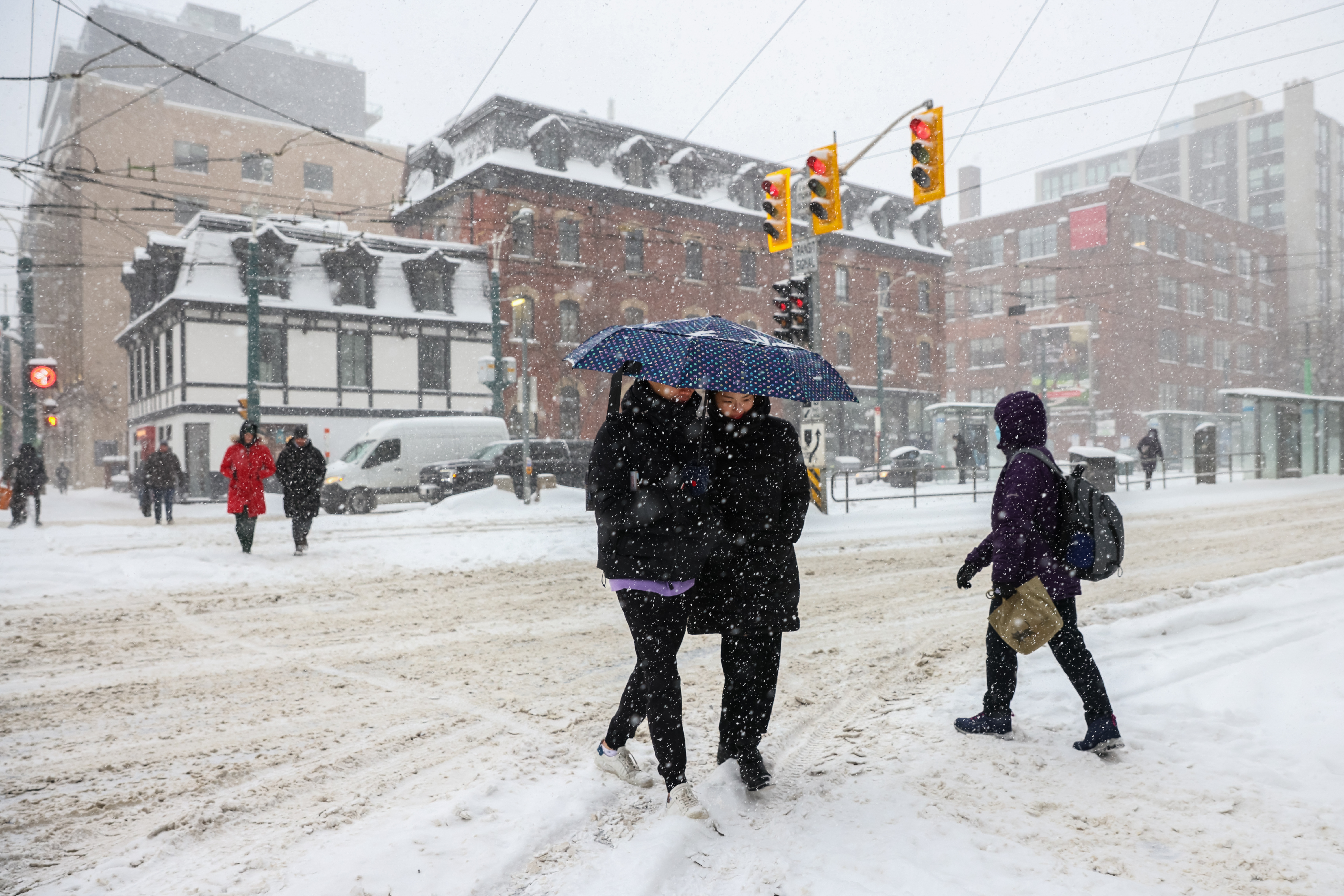
The convergence of a lingering polar vortex and moisture-rich Pacific fronts has transitioned Canada’s late-winter weather from a seasonal inconvenience into a systemic stress test for national infrastructure. While standard reporting focuses on snowfall accumulations, the critical variable is the phase-state transition—the precise moment moisture shifts between snow, freezing rain, and ice pellets. This transition is not a binary event; it is a complex thermal negotiation between atmospheric layers that dictates the failure rate of power grids and the friction coefficients of transport networks. Understanding the structural impact of this "grip" requires a breakdown of the meteorological mechanics and the resulting economic friction.
The Tri-Layer Thermal Profile
Predicting the impact of current Canadian forecasts requires an analysis of the vertical temperature profile. Freezing rain, the most destructive element of the current systems, occurs when a "warm nose" of air (above 0°C) is sandwiched between two sub-freezing layers.
- The Upper Freezer: Snow forms in the high atmosphere.
- The Melting Layer: As the snow falls through the warm nose, it turns to rain.
- The Surface Supercooling Zone: This thin layer near the ground is below freezing. The rain does not have time to refreeze into sleet; instead, it becomes "supercooled."
Upon contact with a solid surface—a transmission line, a bridge deck, or a runway—the liquid undergoes an instantaneous phase change into glaze ice. The current forecasts for Ontario and Quebec are particularly precarious because the melting layer is projected to be thick enough to ensure total saturation, while the surface layer is cold enough to ensure immediate adhesion. This creates an accumulation-to-load ratio that exceeds the design tolerances of older utility poles.
Infrastructure Load and Kinetic Friction
The "grip" of winter is quantified by two primary vectors: Static Load and Kinetic Friction Loss.
The Static Load of Glaze Ice
Ice accumulation is significantly more dangerous than snow due to its density. While fresh snow might have a density of 50 to 100 $kg/m^3$, glaze ice approaches 900 $kg/m^3$. A standard 10-meter span of utility wire coated in just 12.5 mm of ice adds approximately 25 to 30 kg of weight. When combined with high wind speeds—common in the current low-pressure systems moving through the Prairies—the result is galloping. This is a low-frequency, high-amplitude mechanical vibration caused by the aerodynamic lift of the ice-coated wire. Galloping causes cross-arm failures and "flashovers" where wires touch, triggering localized grid collapses.
The Friction Coefficient of Transport
Road safety during these storms is not a matter of "visibility" but of Coulomb friction. On dry asphalt, the coefficient of friction ($\mu$) is roughly 0.7. On packed snow, it drops to 0.2. On glaze ice, it can plummet to 0.05. This represents a 90% loss of braking efficiency. The current forecasts suggest a "flash freeze" scenario where rain-slicked roads are rapidly cooled by a trailing cold front. This creates a surface where chemical de-icers (like NaCl) lose efficacy. Sodium chloride becomes largely ineffective below -9°C, necessitating a shift to calcium chloride or abrasive additives (sand/grit) to maintain any semblance of mechanical grip.
Supply Chain Volatility and the Just-In-Time Bottleneck
The economic disruption of a coast-to-coast winter event is felt most acutely in the Just-In-Time (JIT) logistics model. Canada’s primary east-west artery, the Trans-Canada Highway, and the national rail networks operate with minimal buffer capacity.
- Rail Operations: Cold temperatures reduce the effectiveness of air brakes on long freight trains. As temperatures drop below -25°C, air leakage in the brake system increases, forcing rail operators to shorten train lengths by 25-50% to maintain safety. This creates a backlog at ports and distribution centers that can take weeks to clear.
- Trucking Transit Times: When freezing rain is forecasted, "Level 1" logistics disruptions occur. Trucks are grounded not just for safety, but because the insurance liability of operating in sub-0.1 $\mu$ environments is prohibitive.
- Energy Demand Spikes: The "grip" triggers a simultaneous surge in heating degree days (HDD). For electrical grids like Hydro-Quebec or the AESO in Alberta, this means managing peak loads that approach the nameplate capacity of the system. If a storm also damages the transmission infrastructure (the supply side) while cold weather drives up demand, the risk of rolling brownouts increases exponentially.
The Feedback Loop of Urban Heat Islands and Rural Exposure
A divergence is currently forming between urban centers and rural corridors. Urban Heat Islands (UHI) can keep surface temperatures in downtown Toronto or Vancouver 2-3°C higher than surrounding areas, often turning what would be ice into harmless rain. However, this creates a false sense of security for commuters.
The transition zone—the 30 to 50 kilometer radius outside the city—is where the thermal buffer fails. This is where most weather-related accidents occur, as drivers transition from wet urban pavement to rural black ice. The current meteorological data suggests a "tight gradient," meaning the line between a wet commute and a catastrophic one is shifting by only a few kilometers per hour of wind speed or a fraction of a degree in temperature.
Strategic Response Requirements
To mitigate the impact of the current forecast, operational managers must move beyond reactive salting and toward predictive thermal modeling.
First, logistics firms must implement "Cold Chain" protocols for all dry-van shipments. Even non-perishable goods are at risk of "sweating" and subsequent freezing damage during rapid temperature swings. Second, municipal authorities must prioritize the clearing of catch basins before the freezing rain hits. If the subsequent snow blocks drainage, the melt-freeze cycle creates "ice dams" on roadways that mechanical plows cannot remove.
The most critical strategic play for individuals and businesses is the pre-emptive grounding of assets. Attempting to "beat the storm" in a 0.05 friction environment is a statistical losing game. The focus should be on the 24-hour window following the storm, where the risk shifts from atmospheric accumulation to the mechanical failure of ice-loaded structures and the thermal shock of plunging temperatures. Success in navigating a Canadian winter is not measured by movement, but by the preservation of system integrity during peak instability.