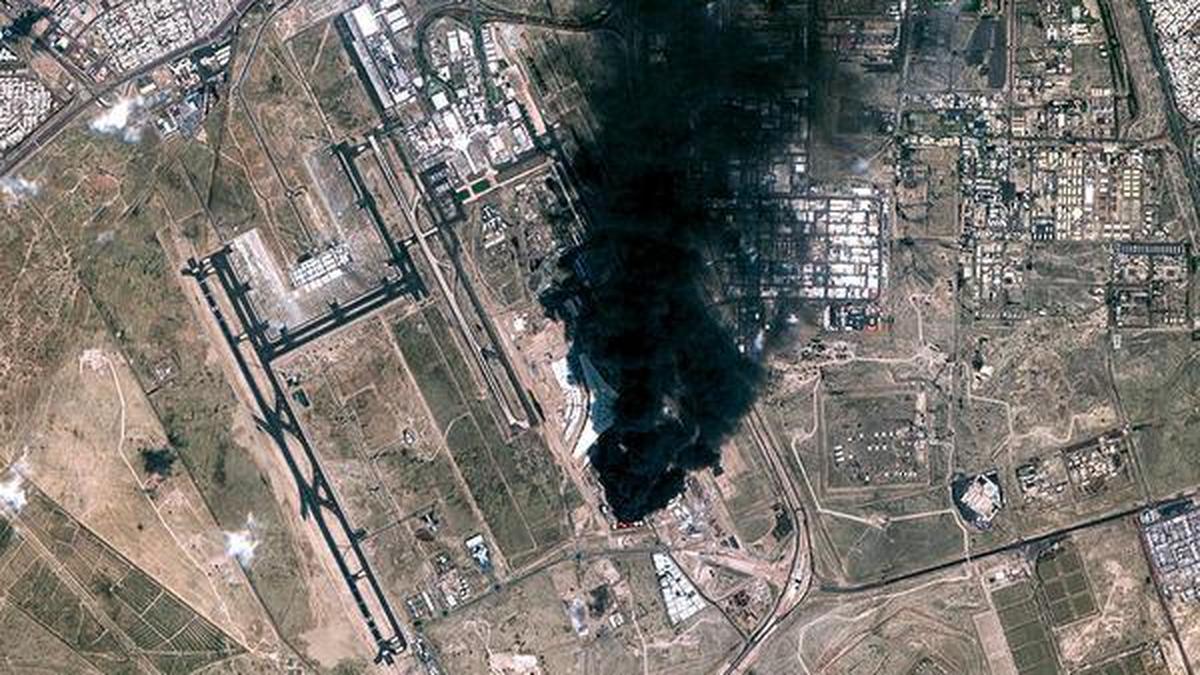
The kinetic strike on Kuwaiti airport fuel infrastructure by Iranian-sourced unmanned aerial vehicles (UAVs) represents a transition from speculative regional tension to a calculated disruption of sovereign logistics. This event provides a blueprint for understanding the vulnerability of critical energy nodes when faced with low-cost, high-precision asymmetric threats. While the absence of casualties suggests a limited escalatory intent, the precision of the strike confirms a sophisticated targeting logic aimed at maximum economic and psychological impact with minimum human collateral.
The Triad of Infrastructure Vulnerability
To quantify the impact of such an engagement, one must analyze the intersection of geography, engineering, and tactical oversight. Civil aviation fuel farms are high-value targets not merely due to their flammable contents, but because of their role as the central nervous system of regional mobility and logistics.
1. The Proximity-to-Source Gradient
The geographical location of Kuwaiti infrastructure places it within the primary strike radius of multiple launch sites across the Persian Gulf. This proximity reduces the flight time required for UAVs, thereby narrowing the window for air defense systems (such as Patriot or THAAD batteries) to achieve a radar lock and execute a successful intercept.
2. Storage Tank Structural Fragility
Fuel storage tanks are designed for volumetric efficiency and environmental safety, not for kinetic resistance. Their thin-walled construction makes them highly susceptible to shaped charges or even simple impact-detonation payloads. Once a tank is breached, the primary risk transitions from the initial explosion to a sustained thermal event that threatens adjacent infrastructure through radiant heat transfer.
3. Integrated Logistics Cascades
An airport fuel farm is not a siloed asset. It is linked to pipeline networks, pumping stations, and hydrants. A fire in one section of the tank farm necessitates a complete system shutdown to prevent the spread of fire through common fuel lines. This creates an operational paralysis that extends far beyond the physical site of the blaze.
The Mechanics of the UAV Strike Vector
Standard air defense doctrine has historically focused on high-altitude, high-velocity threats like ballistic missiles or fighter aircraft. The use of slow-moving, low-altitude UAVs bypasses traditional radar horizons and presents a "clutter" problem for automated defense systems.
The Iranian-origin delta-wing UAVs utilized in these regional theaters operate on a pre-programmed GPS/GLONASS coordinate system or via real-time optical guidance. Their low radar cross-section (RCS) allows them to exploit terrain masking or fly beneath the minimum detection altitude of long-range surveillance sensors.
The cost-to-neutralize ratio is heavily skewed in favor of the attacker. While a single interceptor missile can cost upwards of $2 million, the attacking UAV may cost as little as $20,000. This economic imbalance allows an aggressor to employ "saturation" tactics—launching a swarm of low-cost drones to overwhelm the defense’s processing capacity and magazine depth.
Quantifying Economic and Operational Fallout
The disruption of fuel supplies at a major regional hub like Kuwait International Airport triggers a sequence of economic penalties that can be modeled through the following variables:
Flight Divergence and Fuel Penalties
Aviation operators must reroute incoming flights to secondary airports (such as Dubai or Doha). This introduces significant "burn rate" increases as aircraft hold in patterns or travel longer distances. For long-haul carriers, the inability to refuel at the destination point may require a technical stop on the return leg, doubling the landing and ground handling fees.
The Insurance Risk Premium
Marine and aviation insurance markets respond to kinetic events by adjusting the "War Risk" premiums. These surcharges are applied to every hull and cargo shipment entering the affected zone. Even if the physical damage is limited to two or three tanks, the financial cost is distributed across every vessel and aircraft operating in the Northern Gulf, effectively acting as a regional tax on commerce.
Supply Chain Elasticity
Kuwait’s position as a refined product exporter means that domestic disruption can tighten global markets for specific distillates, such as Jet A-1 or ultra-low sulfur diesel. If the strike had affected the refinery-to-port pipeline rather than the airport tanks, the impact on global energy pricing would have been immediate and non-linear.
Defensive Deficiencies and the "Hardening" Requirement
The failure to prevent this breach highlights a gap in current regional security architectures. Passive defense—physical barriers and fire suppression—is no longer sufficient. Security planners must now move toward an "Active Hardening" model.
- Electronic Warfare (EW) Envelopes: Implementing local jamming and spoofing zones around high-value tanks to disrupt the drone’s satellite navigation and control links.
- Kinetic Point Defense: Deploying rapid-fire gun systems (C-RAM) or directed energy weapons (lasers) that can engage low-cost targets at a fraction of the cost of a missile interceptor.
- Decoupling and Redundancy: Physically separating storage units and creating redundant pumping manifolds. This ensures that a single "ablaze" tank does not necessitate a total facility blackout.
Geopolitical Signaling and the Threshold of Escalation
In the context of Persian Gulf dynamics, the choice of target is a form of calibrated communication. By striking airport fuel tanks rather than a military command center or a populated urban area, the aggressor signals a capability to inflict severe economic damage without crossing the "red line" of mass casualties.
This allows the aggressor to maintain a "gray zone" status—hostile enough to exert leverage in diplomatic negotiations, but restrained enough to avoid triggering a full-scale kinetic response from international coalitions. The ambiguity of the launch point (often utilizing proxies or mobile launchers) provides "plausible deniability," further complicating the legal and political justification for a counter-strike.
Structural Recommendations for Energy Security
National energy providers must transition from a reactive posture to a predictive security framework. The current incident demonstrates that "safety" and "security" are no longer separate departments; they are an integrated survival metric.
- Conduct a Multi-Modal Vulnerability Assessment: Mapping every physical asset against the flight paths and capabilities of known UAV platforms in the region.
- Invest in Distributed Storage: Moving away from centralized "super-farms" in favor of smaller, geographically dispersed underground storage units that are harder to detect and neutralize.
- Establish a Real-Time Intelligence Loop: Deepening the integration between civilian infrastructure operators and military intelligence to provide early warning of UAV launches or atypical maritime movements near the coast.
The burning of the Kuwaiti fuel tanks is a warning that the barriers to entry for state-level disruption have collapsed. The "democratization" of precision-guided munitions means that any stationary, high-visibility energy asset is now a front-line target. Failure to adapt the defensive architecture will result in repeated, low-cost victories for regional actors seeking to destabilize global energy markets through asymmetric attrition.
Immediate priority must be given to the deployment of mobile, localized electronic counter-measure (ECM) units around every critical fuel manifold within a 500-mile radius of known hostile launch corridors. This is not a military luxury; it is a fundamental requirement for continued industrial and logistical solvency in the 21st-century Gulf.