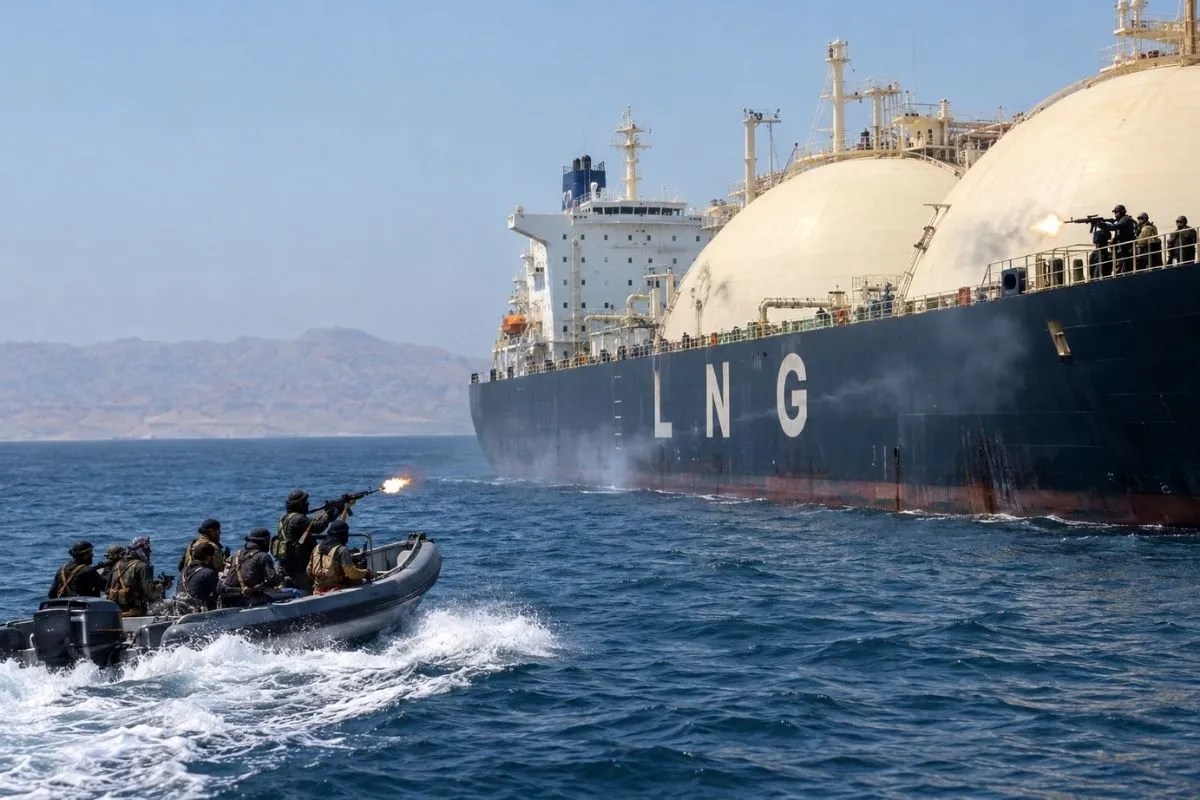
Sensational coverage of skiff encounters off Yemen reduces complex maritime security incidents to dramatic gunfights, missing the underlying economics of asymmetric deterrence, vessel freeboard physics, and overlapping regional threats. When a small craft carrying armed personnel approaches a liquefied natural gas (LNG) carrier in the Gulf of Aden or near Yemeni waters—such as the October 17, 2026 incident roughly 140 nautical miles southeast of Al Mukalla where seven people on a skiff fired two shots at an LNG tanker and embarked armed guards returned two warning shots before the skiff altered course—headline summaries focus on immediate gunfire rather than systemic risk. A rigorous analytical breakdown must separate confirmed operational facts from attribution hypotheses, map the deterrence mechanics of embarked security teams, and evaluate how energy shipping absorbs volatility across contested sea lanes.
Deconstructing the Sensationalist Narrative
Standard breaking-news reporting relies on high-emotion framing—words evoking terror, gunfire, and near-misses—because rapid publication rewards shock over structural context. That approach typically commits three analytical errors when covering maritime security incidents off Yemen.
First, it conflates proximity and tactics with confirmed attribution. In the Gulf of Aden and adjacent waters, commercial vessels face both criminal piracy and broader regional conflict dynamics. Reporting often implies a single coordinated campaign when maritime advisories instead treat individual approaches as distinct events requiring verification.
Second, it treats warning shots as an isolated tactical flourish rather than a calibrated escalation step. When an embarked armed security team fires warning shots and a small boat turns away, the critical mechanism is cost-benefit recalculation by the approaching craft under rules of engagement.
Third, it ignores vessel-class economics. An LNG carrier is not a generic tramp steamer. Its cargo value, cryogenic containment architecture, freeboard height, and schedule sensitivity change both the stakes of an approach and the operational calculus of the ship's master and security team.
Known Facts Versus Educated Hypotheses
Separating verified incident mechanics from unverified inference is the foundation of serious maritime risk analysis. Public maritime advisories from bodies such as the UK Maritime Trade Operations (UKMTO) establish specific operational contours while leaving many details unconfirmed at the initial reporting stage.
Confirmed Operational Facts
- Asymmetric craft profile: Small skiffs—sometimes carrying multiple armed individuals and boarding equipment such as ladders—can approach larger commercial vessels at speed across open waters or near coastal corridors.
- Kinetic signaling and course change: In reported LNG carrier and cargo ship encounters off Yemen, exchanges involving shots from a skiff or warning shots from embarked security personnel have frequently been followed by the small craft altering course or withdrawing without a confirmed boarding.
- Elevated regional baseline: Maritime risk monitors and industry bureaus have documented recurring small-craft approaches, boardings, and attacks across the Gulf of Aden, the eastern Somali coast, and the Bab el-Mandeb corridor, alongside broader regional maritime disruptions in adjacent waterways.
- Incomplete post-incident disclosure: Initial public advisories routinely withhold vessel identity, exact attacker affiliation, and full post-incident inspection outcomes pending investigation.
Educated Hypotheses Requiring Verification
- Mothership force multiplication: When skiffs operate far offshore or withdraw toward a suspected larger support vessel, analysts hypothesize that a mothership extends operational endurance and range beyond what a small open hull can achieve alone—though the presence, role, and identity of any mothership often remain unverified in initial reports.
- Actor attribution from geography alone: Proximity to Yemen does not by itself prove whether a specific small-craft approach stems from opportunistic piracy networks, regional militants, or hybrid actors. Inferring motive solely from coordinates risks misclassifying criminal boarding attempts as state-aligned strikes, or vice versa.
- Schedule and routing spillover: While an individual repelled approach may cause no reported hull or cargo damage, analysts hypothesize that repeated alerts can induce speed adjustments, heightened watch postures, or routing scrutiny among charterers and insurers.
The Three Pillars of Shipboard Deterrence
Why does a small skiff with weapons sometimes turn back after warning shots rather than pressing an attack? The outcome depends on three interacting operational pillars rather than luck alone.
Physical Geometry and Freeboard Friction
Large merchant ships—including LNG carriers—present steep hull sides and high freeboard above the waterline when operating in certain trim conditions. For small attackers, boarding is not merely a matter of pulling alongside; it requires overcoming height, wave motion, and vessel speed while exposed to observation. Equipment such as ladders reflects an attempt to solve that vertical access problem, yet every additional second of exposure under observation increases the attacker's risk.
Credible Embarked Force and Escalation Discipline
Privately contracted armed security teams (PCASDs) operating under flag-state laws, coastal regulations, and company rules of engagement alter the attacker's risk equation. A warning shot functions as a clear threshold signal: the target is actively monitored, armed response capability is present, and pressing closer carries a high probability of aimed fire. For actors motivated by extortion or opportunistic capture, crossing from a low-cost probe into a high-risk firefight degrades expected return.
Bridge Discipline, Maneuvering, and Early Detection
Deterrence starts before a shot is fired. Radar watchkeeping, visual lookouts, evasive or defensive maneuvering within safe navigational limits, citadel or crew-protection protocols, and rapid distress reporting to authorities such as UKMTO compress the attacker's window of surprise. The first limitation of shipboard defense is reactive: a merchant vessel cannot patrol vast sea sectors or pursue retreating skiffs once they disengage.
The Cost Function of LNG Transit Through Contested Waters
Evaluating an incident on an LNG tanker requires looking at the vessel's cost function. LNG carriers transport high-value, super-cooled cargo under strict safety and schedule parameters, making any security anomaly consequential even when physical damage is zero.
The maritime risk cost function for an operator or charterer can be expressed conceptually as:
$$C_{\text{transit}} = C_{\text{base}} + P_{\text{incident}} \cdot L_{\text{consequence}} + C_{\text{mitigation}}$$
Here, $C_{\text{base}}$ represents normal voyage fuel, crew, and capital costs. $P_{\text{incident}}$ captures the probability of a security encounter or boarding attempt along the chosen corridor, while $L_{\text{consequence}}$ represents the severity of disruption—ranging from crew injury and hull or containment damage to charter delays, off-hire disputes, and reputational scrutiny. $C_{\text{mitigation}}$ encompasses embarked security teams, enhanced watchkeeping, advisory compliance, and war-risk or transit insurance premiums.
Notice the trade-off embedded in this equation. Raising $C_{\text{mitigation}}$ through armed guards and heightened readiness lowers $P_{\text{incident}}$ of a successful boarding, yet increases fixed or voyage-specific overhead. Conversely, ignoring elevated threat advisories in an effort to save on mitigation costs exposes the operation to tail risks where $L_{\text{consequence}}$ is severe.
There is a second structural tension in this cost function: information asymmetry immediately after an event. When an advisory reports shots fired and a course change without naming the vessel or confirming attacker identity, commercial desks must price risk under uncertainty. Overreacting to every noise event inflates transit friction, while underreacting to recurring small-craft sightings near key chokepoints leaves crews and assets exposed.
Common Questions Behind the Headlines
Readers tracking these reports usually want practical clarity on four operational questions that breaking news rarely answers cleanly.
Does a warning shot guarantee a vessel is safe? No. Warning shots have repeatedly coincided with small craft breaking off approaches, but deterrence is probabilistic rather than absolute. Outcomes depend on sea state, approach speed, visibility, security team positioning, legal restrictions on weapons use, and whether attackers are willing to absorb fire.
Why do skiffs carry ladders if they are firing shots? Ladders indicate an intent or capability to board a vessel rather than purely standoff harassment, even when gunfire occurs during the approach. Firing can be used to intimidate bridge watchkeepers, suppress lookouts, or test whether the target is defended before attempting to close distance.
How much weight should be placed on "no injuries or damage reported"? Treat that phrase as an initial status marker, not a final audit. Early maritime advisories summarize what has been reported at the time of issuance; thorough verification of equipment condition, near-miss impacts, and crew well-being occurs during subsequent operational reporting and inspections.
Why do incidents cluster around Yemen and the Gulf of Aden? Geography concentrates traffic through narrow maritime arteries linking energy producers, manufacturing hubs, and Suez or Indian Ocean routes. High commercial vessel density creates predictable transit lanes, while regional instability and coastal proximity complicate rapid naval intervention across wide expanses of water.
Limitations and Counterarguments
No security measure eliminates maritime risk in contested waters, and overstating the effectiveness of current practices creates blind spots.
First, armed security teams do not solve macro-level geopolitical escalation or naval blockades in adjacent chokepoints. A shipboard team defends a single hull at close range; it cannot neutralize motherships operating beyond visual range or resolve regional conflicts ashore.
Second, strict rules of engagement and jurisdictional boundaries constrain how and when force can be used. Security personnel must balance immediate force protection against legal liability, collateral risk to nearby vessels, and flag-state or territorial rules.
Third, some analysts argue that heavy reliance on private armed guards treats symptoms rather than root causes—specifically weak coastal governance, illicit trafficking networks, and regional militarization. That critique has merit at the policy level, yet commercial shipowners operating today cannot wait for long-term geopolitical settlements before protecting crews and vessels on active voyages.
Strategic Recommendation for Maritime Risk Decision-Makers
Treat every Gulf of Aden and off-Yemen skiff encounter as a structured telemetry signal rather than a standalone thriller. Fleet operators, charterers, and marine risk managers should enforce a three-part voyage discipline before vessels enter high-risk transit zones: audit embarked security readiness and rules-of-engagement alignment against current flag and coastal requirements; pre-brief bridge and security teams on graduated escalation and immediate UKMTO reporting protocols; and log every sighting—including distance from shore, craft count, boarding gear, and mothership indicators—to track pattern shifts rather than reacting to isolated headlines.