A headline reporting that three oil tankers are burning after striking naval mines in the Strait of Hormuz represents far more than an isolated kinetic event; it is the activation of an asymmetric economic lever designed to paralyze global energy logistics without engaging in conventional fleet-on-fleet combat. The operational blueprint behind such an incident relies on a severe cost-asymmetry ratio: deploying rudimentary, low-cost contact or influence mines forces the world’s largest maritime insurers, energy traders, and naval powers into immediate defensive paralysis. When an announcement originates from the Islamic Revolutionary Guard Corps (IRGC) rather than independent maritime tracking networks, the immediate strategic objective is information dominance—establishing perceived denial of access (A2/AD) before physical verification is even possible.
To understand the true operational impact of three damaged vessels in this corridor, analysts must strip away sensationalist reporting and examine the underlying mechanics of maritime chokepoints, hull survivability, war-risk underwriting, and physical commodity bottlenecks.
The Information Verification Matrix and Attribution Mechanics
In modern maritime conflict, the initial claim of an attack is itself a weapon system. When state or paramilitary forces announce that commercial vessels have struck mines, intelligence and logistics teams immediately divide the incoming data into verified physical telemetry and unverified strategic messaging.
Relying solely on a belligerent’s press release introduces fatal analytical errors. Maritime practitioners evaluate these incidents across four distinct verification layers:
- Automated Identification System (AIS) Anomalies: Commercial tankers broadcast their position, speed, and heading via VHF transponders. A genuine kinetic strike produces an immediate, involuntary deviation: a sudden drop in speed over ground (SOG) to zero, erratic heading changes indicating loss of rudder control, or the abrupt cessation of transmission if power generation fails.
- Optical and Synthetic Aperture Radar (SAR) Satellite Imagery: Cloud cover and smoke often obscure optical sensors. Analysts rely on SAR satellites to detect changes in radar backscatter. A burning tanker produces a distinct thermal anomaly (detected via infrared bands) and a visible surface sheen from leaking bunkers or cargo, which dampens capillary waves on the water's surface and appears as a dark patch on radar imagery.
- Hull Design and Damage Tolerance: Modern Very Large Crude Carriers (VLCCs) and Suezmax tankers are constructed with double hulls mandated by international maritime law (MARPOL). A single naval mine rarely sinks a modern double-hulled tanker outright. The outer hull absorbs the primary blast wave and hydrostatic shock, while the inner cargo tanks remain intact unless the detonation occurs directly adjacent to a seam or structural bulkhead. Fires typically erupt not from the crude cargo itself—which has a relatively high flashpoint—but from ruptured fuel oil bunkers, hydraulic lines, or volatile refined products (naphtha, gasoline) if the vessel is a product tanker.
- Hydrographic and Acoustic Signatures: Naval mine warfare leaves distinct physical footprints. If the detonation occurred near the waterline, it suggests a drifting contact mine—a violation of the 1907 Hague Convention VIII, which prohibits unanchored automatic contact mines unless they become harmless within an hour of losing control. If the explosion originated beneath the keel, causing the hull to whip and fracture structurally, it indicates a bottom-laid influence mine triggered by the vessel’s magnetic, acoustic, or pressure signature.
Distinguishing between these mine types is critical. Drifting mines create an unpredictable, moving hazard zone that disrupts all commercial traffic indiscriminately, including vessels bound for ports friendly to the minelayer. Bottom-laid influence mines allow for selective targeting, as modern microprocessors can be programmed to ignore smaller coastal craft and detonate only when the specific acoustic and magnetic profile of a deep-draft VLCC passes overhead.
Chokepoint Geometry and Traffic Separation Schemes
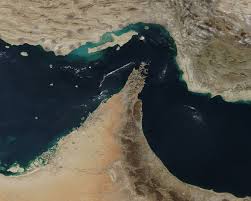
The Strait of Hormuz is not an open sea; it is a tightly constrained navigational funnel. At its narrowest point between Oman’s Musandam Peninsula and Iran, the waterway spans roughly 21 nautical miles (39 kilometers). However, deep-draft oil tankers cannot utilize the entire width of the strait due to bathymetric constraints—shallow water and submerged shoals restrict where fully laden VLCCs can safely transit.
To prevent collisions, the International Maritime Organization (IMO) enforces a strict Traffic Separation Scheme (TSS) routed entirely through Omani territorial waters. The TSS consists of:
- An inbound lane (for empty tankers entering the Persian Gulf) approximately two miles wide.
- An outbound lane (for laden tankers exiting the Gulf) approximately two miles wide.
- A two-mile-wide buffer zone separating the opposing lanes.
This extreme spatial compression is what makes mine warfare uniquely effective here. A VLCC can carry up to two million barrels of crude oil and draws upwards of 20 meters (65 feet) of water. Operating within a two-mile-wide channel leaves zero room for evasive maneuvering. If three tankers are disabled or burning within the outbound TSS lane, their hulks become physical obstructions. The channel effectively narrows, forcing subsequent vessels to reduce speed, bunch up at the anchorage points outside Fujairah or inside the Gulf, and present stationary, high-value targets for follow-on harassment.
The Cost Function of Asymmetric Sea Denial
From a military-economic perspective, naval mining is the ultimate asymmetric equalizer. A basic moored contact mine or a rudimentary bottom influence mine costs between $5,000 and $25,000 to manufacture and deploy using converted commercial dhows, fast attack craft, or midget submarines. In contrast, a single modern VLCC represents an asset value exceeding $100 million, carrying a crude oil cargo worth an additional $140 million to $180 million depending on benchmark pricing.
The asymmetry extends directly into the countermeasures required to restore normal transit. Mine Countermeasures (MCM) represent one of the slowest, most resource-intensive operations in naval warfare. Clearing a suspected minefield does not happen in hours; it takes weeks.
- Hunting vs. Sweeping: Modern MCM vessels must slowly transit the suspect area using high-frequency variable-depth sonar to locate bottom objects, deploy remotely operated vehicles (ROVs) to visually identify the object as a mine rather than a discarded shipping container or rock formation, and then place a disposal charge to neutralize it.
- The Ambiguity Trap: The strategic power of mining lies in psychological deterrence rather than total physical destruction. To close the Strait of Hormuz, an actor does not need to lay thousands of mines. Laying twenty real mines mixed with two hundred concrete-filled dummy shapes forces opposing naval forces to treat every single sonar contact as a live munition. The clearance timeline expands exponentially while the cost to the minelayer remains negligible.
Financial Contagion: War-Risk Premiums and Chartering Freeze
Before a single barrel of oil is physically missing from global refineries, the financial architecture of maritime trade reacts to the incident. Shipping companies do not operate based on naval assurances; they operate based on the mathematical tolerances of Protection and Indemnity (P&I) clubs and the London insurance market, specifically the Joint War Committee (JWC).
When three tankers catch fire in a designated Listed Area, the following financial chain reaction triggers within hours:
- Immediate Breach of Institute Warranties: Standard hull and machinery insurance policies exclude war perils. To enter the Persian Gulf, shipowners must purchase Additional War Risk Premiums (AWRP), which are typically valid for a seven-day transit window.
- Exponential Repricing: Prior to a kinetic incident, AWRP rates might sit at a fraction of a percent of the vessel's hull value—perhaps 0.05% to 0.1%. Following confirmed mine strikes, underwriters immediately reprice the risk, driving rates up to 0.5%, 1.0%, or higher per transit. For a $120 million vessel, a 1% premium adds $1.2 million to the cost of a single voyage, instantly erasing the charterer's profit margin.
- Withdrawal of Cover and Force Majeure: If the threat involves unanchored drifting mines—which cannot be localized—underwriters may temporarily suspend coverage altogether. Without valid P&I insurance, port authorities will not allow a vessel to dock, and financial institutions holding mortgages on the ships will order owners to halt operations immediately.
- Spot Charter Rate Spikes: Available tonnage evaporates. Shipowners refuse to fix vessels for Persian Gulf loading, causing Worldscale freight rates (the benchmark pricing mechanism for tanker charters) to surge. Simultaneously, the cost of maritime security—hiring armed embarkation teams and routing vessels in naval convoys—adds fixed operational overhead to every ton of cargo moved.
Global Supply Chain Mechanics and Bypass Limitations
The Strait of Hormuz handles roughly 20% of global petroleum liquids consumption and a massive share of global Liquefied Natural Gas (LNG) trade, predominantly from Qatar. When transit through this bottleneck is degraded, the global energy market faces a rigid physical constraint: there is insufficient bypass infrastructure to absorb the displaced volume.
While land-based pipelines exist to circumvent the Strait, their nameplate and spare capacities fall drastically short of total Gulf exports:
- Saudi Arabia’s East-West Pipeline (Petroline): Connects the Abqaiq processing facilities in the Eastern Province to the Red Sea port of Yanbu. While its total capacity is roughly 5 million barrels per day (bpd), a significant portion is already utilized for domestic consumption and regular Red Sea exports, leaving limited surge capacity.
- The UAE’s Habshan-Fujairah Pipeline (ADCOP): Carries crude from onshore fields in Abu Dhabi directly to the port of Fujairah on the Gulf of Oman, bypassing Hormuz entirely. Its maximum capacity is approximately 1.5 million to 1.8 million bpd, most of which is routinely committed under normal operating conditions.
- Iraq and Kuwait: Neither country possesses functional pipeline infrastructure capable of bypassing the Strait of Hormuz at scale. Their exports are effectively landlocked if the waterway is closed.
- Qatar’s LNG Vulnerability: Unlike crude oil, which can be stored in tank farms or rerouted via pipelines, LNG requires specialized cryogenic liquefaction terminals and membrane-tank carriers. Qatar has zero pipeline alternatives to reach global markets; every cubic meter of its seaborne LNG must pass through the Strait of Hormuz.
This structural deficit means that any sustained disruption forces an immediate drawdown of global commercial inventories and Strategic Petroleum Reserves (SPR). However, SPR releases are a temporary bridge, not a structural fix. Refineries in Asia—particularly in China, India, Japan, and South Korea, which absorb the vast majority of Persian Gulf crude—are specifically configured to process the medium-sour crude grades characteristic of the Middle East. Replacing medium-sour crude with light-sweet crude from the Atlantic Basin (such as US WTI or West African grades) is not a seamless one-to-one swap; it alters refinery yields, reduces middle distillate (diesel and jet fuel) output, and degrades refining margins.
Operational Limitations of Naval Escort Models
When commercial shipping stalls due to mine threats, the standard geopolitical response is the formation of multinational naval coalitions to escort tankers through the chokepoint. Practitioners recognize that while naval escorts are effective against surface swarms (fast inshore attack craft) and aerial drones, they offer severely limited protection against naval mines.
A guided-missile destroyer equipped with advanced Aegis radar systems is blind to a moored contact mine sitting three meters below the surface or a stealthy bottom mine buried in the silt. In fact, placing high-value surface combatants in front of commercial tankers in an un-swept channel merely exposes the warships to the same subsurface hazard.
Effective transit under a mine threat requires a strict, resource-draining operational sequence:
- Lead-Through Operations: Specialized MCM vessels must physically precede the convoy, sweeping a narrow cleared channel immediately prior to transit.
- Acoustic and Magnetic Deperming: Vessels must undergo degaussing to minimize their magnetic signature, a process that requires specialized shore facilities unavailable to commercial tankers on short notice.
- Speed Reductions: Convoys must transit at drastically reduced speeds to minimize the hydrodynamic pressure wave generated by the hull, which is the primary trigger for modern pressure-sensitive mines that cannot be spoofed by simple magnetic or acoustic sweeps.
This slow-motion transit reduces the daily throughput of the Strait of Hormuz even if no further vessels are struck. A reduction in transit speed from 14 knots to 6 knots more than doubles the time each tanker spends inside the high-threat envelope, compounding scheduling delays across global ports for months.
Strategic Execution for Energy and Logistics Operators
Organizations exposed to Persian Gulf maritime transit cannot rely on diplomatic resolution timelines or generalized news reporting to manage operational risk. When kinetic incidents occur in the Strait of Hormuz, executive teams must execute a rigid, decoupled risk-management protocol immediately:
- Decouple Physical Procurement from Paper Hedging: Do not wait for confirmed physical shortages to adjust financial exposure. Immediately shift crude procurement strategies toward Atlantic Basin and West African grades to secure refinery feedstock, while simultaneously utilizing Brent-Dubai Exchange of Futures for Swaps (EFS) contracts to hedge against the widening spread between regional benchmarks.
- Audit Force Majeure and Charterparty Clauses: Legal and chartering desks must immediately review all active voyage and time charter contracts for specific "War Risk" and "Safe Port" warranties (such as CONWARTIME or VOYWAR clauses). Identify which party bears the financial burden of sudden AWRP spikes and establish clear triggers for rerouting vessels to Fujairah or Khor Fakkan for ship-to-ship (STS) transfers outside the chokepoint.
- Establish Independent Telemetry Feeds: Terminate reliance on public news wires for vessel status. Integrate direct AIS terrestrial and satellite feeds alongside commercial SAR imagery providers to independently verify vessel draft changes, speed anomalies, and localized maritime exclusion zones before authorizing any vessel to cross the 26°N latitude line into the Gulf of Oman approach.