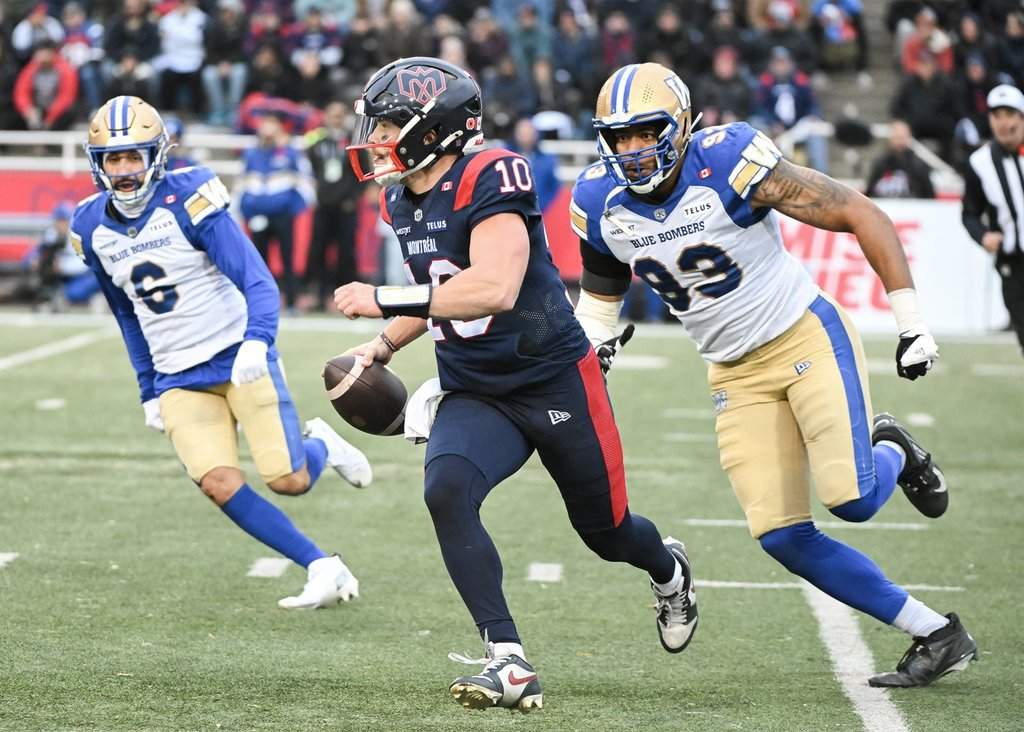
The Montreal Alouettes defeated the Winnipeg Blue Bombers through a deliberate decoupling of offensive risk management and defensive edge containment. Standard sports reporting reduces this outcome to individual heroics by quarterback Davis Alexander and linebacker Tyrice Beverette, missing the underlying structural mechanics that dictated field position and possession efficiency. By analyzing the game through operational frameworks—specifically constraint theory on offense and spatial compression on defense—the victory emerges not as an anomaly, but as the predictable result of tactical asymmetry.
The Offensive Constraint Model Under Davis Alexander
When a backup or emerging quarterback like Davis Alexander enters a high-leverage Canadian Football League (CFL) matchup against a veteran defensive unit, the primary operational risk is variance. High-variance passing attacks generate explosive plays, yet they simultaneously expose the offense to negative expected points added (EPA) through sacks, interceptions, and stalled drives.
Montreal’s coaching staff neutralized this variance by shifting from a vertically dependent passing tree to a horizontal distribution network. Rather than forcing Alexander to process complex post-snap coverage rotations across the wide CFL field, the offensive architecture relied on three core mechanisms:
- Pre-Snap Spatial Identification: Utilizing motion at the line of scrimmage to force Winnipeg’s linebackers into declaring man versus zone responsibilities before the ball was snapped.
- Time-to-Throw Compression: Restricting primary reads to routes breaking under 2.2 seconds, which effectively nullified Winnipeg’s interior pass rush before defensive tackles could penetrate the pocket.
- Run-Pass Option (RPO) Conflict: Placing Winnipeg’s weak-side defensive ends and strong-side linebackers in binary bind states, forcing them to defend either the inside zone dive or the flat bubble screen, never both simultaneously.
This approach altered the cost function of the offense. Instead of trading low-probability deep shots for high-probability third-and-long situations, Alexander operated within a high-floor, medium-ceiling efficiency band. Every completed short pass functioned as an extension of the running game, maintaining manageable second-and-short scenarios. In three-down football, staying ahead of the chains is the primary determinant of time of possession. By eliminating negative plays, Montreal kept Winnipeg’s offense off the field, starving the Blue Bombers of the rhythm required to establish their physical ground game.
Limitations of the Low-Variance Passing Framework
This tactical blueprint carries inherent structural vulnerabilities. Compressing the field vertically invites defensive backs to squat on underneath routes, shrinking the available grass near the line of scrimmage. If an offense cannot occasionally punish over-aggressive safeties with vertical concepts, the horizontal windows eventually close. Montreal avoided this trap not through sheer volume of deep passes, but through strategic sequencing—using early horizontal success to pull Winnipeg’s secondary forward before targeting the vacated intermediate zones between the linebackers and deep half-field defenders.
Defensive Disruption and the Beverette Variable
While Alexander managed offensive risk, Tyrice Beverette anchored a defensive scheme designed to dismantle Winnipeg’s offensive cadence. Traditional defensive analysis tracks tackle totals, which often rewards players who make stops six yards downfield after an offense has already achieved a successful play. A rigorous evaluation isolates disruption rate—the frequency with which a defender alters the offensive play's intended timing, angle, or gap integrity.
Beverette’s impact stemmed from his deployment as a hybrid overhang defender, operating in the space between the defensive box and the boundary receivers. In the CFL, the 65-yard width creates massive horizontal stress on linebackers. Most defenders are forced to choose between stepping up to fill interior run gaps or widening out to cover boundary flats. Beverette’s lateral speed allowed Montreal to delay this commitment until the ball carrier was already committed to a lane.
- Gap Integrity and Scrape Exchanges: When Winnipeg ran outside zone concepts, Beverette maintained outside shoulder leverage, forcing the ball carrier to cut back into the teeth of Montreal’s interior defensive linemen. This eliminated the cutback lanes that Winnipeg’s running game historically exploits.
- Simulated Pressure Packages: Montreal frequently showed six-man fronts before dropping defensive linemen into coverage and sending Beverette on delayed blitzes from the boundary. This overloaded Winnipeg’s pass protection rules, creating free runners against a quarterback forced to hold the ball.
- Turnover Creation via Angle Pursuit: Force fumbles and tipped passes rarely occur by accident; they are the byproduct of convergent pursuit angles. By closing space faster than Winnipeg’s blockers could establish second-level contact, Beverette consistently arrived at the point of attack while the ball carrier was still transitioning from runner to protector.
The causal link between Beverette’s disruption and Winnipeg’s offensive stagnation is direct. Winnipeg relies on early-down rushing efficiency to set up play-action shots downfield. When Beverette neutralized first-down runs for minimal gains, Winnipeg was forced into obvious passing situations on second-and-long. Once a CFL offense becomes one-dimensional, defensive coordinators can deploy dime packages, flood the passing lanes with defensive backs, and pin their ears back against offensive tackles who no longer have the threat of the run to slow down edge rushers.
The Compounding Effect of Field Position Asymmetry
Football games are rarely won in a single phase; they are won when advantages in one phase systematically degrade the opponent's options in another. The synergy between Alexander’s ball security and Beverette’s defensive stops created a compounding field position advantage that standard box scores obscure.
Consider the mechanics of a typical sequence in this matchup:
- Montreal executes a seven-play drive that stalls near midfield—failing to score, yet flipping the field by 35 yards and consuming four minutes of game clock.
- Montreal’s punting unit pins Winnipeg inside their own 15-yard line.
- Faced with a long field, Winnipeg’s offensive coordinator calls conservative first-down runs to avoid a catastrophic turnover deep in their own territory.
- Beverette and the front seven diagnose the predictable run tendency, stuffing the play for a one-yard gain.
- On second-and-nine, Winnipeg throws an incomplete pass under pressure, forcing a punt from their own end zone.
- Montreal takes over near midfield, starting their next drive with a short field and minimal defensive resistance.
This cycle illustrates why raw yardage totals often misrepresent game control. Montreal did not need to outgain Winnipeg by 200 yards to dominate the contest. They needed to win the hidden yardage battle—the delta between starting field positions—and eliminate self-inflicted errors. Every drive that ended in a punt rather than a turnover preserved Montreal's defensive structure, ensuring Beverette and the front seven never had to defend a short field with fatigued personnel.
Tactical Adjustments for Upcoming Divisional Matchups
The blueprint established by Montreal against Winnipeg exposes a clear vulnerability in how veteran CFL defenses prepare for non-traditional quarterback profiles, as well as how physical, run-first offenses struggle against lateral defensive speed. However, replicating this success requires continuous adaptation, as divisional opponents will immediately adjust their film study to counter these exact mechanisms.
Defensive coordinators facing Alexander will abandon passive zone shells in favor of aggressive press-man coverage on the boundary, combined with late-rotating safeties designed to jump horizontal routes. To counter this, Montreal must install double-move concepts—specifically hitch-and-go and bubble-and-wheel variations—early in the first quarter. Punishing an aggressive cornerback once in the opening fifteen minutes will force the entire secondary to play three yards deeper for the remainder of the game, reopening the underneath distribution network.
Simultaneously, opposing offensive coordinators will attempt to neutralize Beverette by attacking him directly in the run game rather than running away from his side. By utilizing heavy personnel groupings—bringing an extra offensive lineman or fullback onto the field—and running downhill power concepts straight at Beverette’s gap, offenses can force him to absorb block after block from 300-pound linemen. Montreal must preempt this fatigue factor by rotating their defensive front aggressively and using pre-snap shifts to move Beverette out of the primary point of attack on obvious heavy-run downs, preserving his lateral explosiveness for high-leverage passing situations.