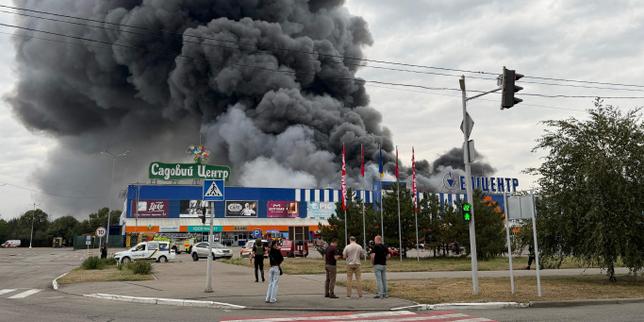
Modern aerial campaigns are defined less by raw kinetic destruction than by economic asymmetry. When a state actor launches a mixed salvo of cruise missiles and loitering munitions against a decentralized grid, the defending apparatus faces a multi-variable optimization problem under severe time constraints. The recent operational report from the Ukrainian Air Force detailing a coordinated strike of seven missiles and ninety-six attack drones illustrates a precise tactical mechanism. This is not merely a kinetic bombardment; it is a systemic test of interception cost functions, sensor saturation thresholds, and logistics pipelines.
To understand the mechanics of this deployment, one must deconstruct the operational architecture into three distinct functional phases.
The Saturation Phase
Low-cost loitering munitions serve a dual purpose in modern force employment. Primarily, they impose a severe financial and resource drain on air defense networks. When deployed in batches approaching one hundred units, these systems force defenders to expend high-value interceptor missiles whose unit cost often exceeds the target by an order of magnitude. Secondarily, these platforms act as volumetric probes. They map radar horizons, identify tracking gaps in legacy electronic warfare systems, and consume immediate interceptor ready-stocks.
The strategic objective of the initial drone wave is the degradation of the defender's response elasticity. If an air defense sector depletes its localized inventory on low-value targets, subsequent missile waves encounter a compromised density gradient. The economic mismatch forces commanders into a defensive triage where civilian population centers and critical infrastructure must be prioritized against military-industrial assets, fundamentally altering the calculus of national resilience.
The Precision Layer
Embedded within the larger volumetric swarm, high-velocity cruise missiles represent the kinetic execution tier. While the drones exhaust readiness and draw sensor attention, cruise missiles exploit the residual blind spots or the depleted reload windows of point-defense systems. These munitions are selected for specific terminal profiles—low-altitude terrain masking, pre-programmed waypoint adjustments, and high-frequency radar cross-section reduction.
The integration of disparate weapon types creates a timing dependency. The launch sequence must account for the velocity delta between slow-moving propeller-driven drones and supersonic or high-subsonic missiles. By staggering launch vectors and entry angles, the attacking force attempts to compress the defender's decision cycle, forcing automated tracking systems to choose between conflicting threat vectors simultaneously.
The Defense Optimization Function
Defending against this operational model requires a dynamic resource allocation algorithm that operates across three operational layers: detection, tracking, and interception.
Detection Architecture
Early warning relies on a fused network of passive acoustic sensors, overlapping radar bands, and satellite telemetry. The primary vulnerability in this layer is false-positive management. A swarm mixed with decoys and operational units forces constant radar emissions, making emitter sites susceptible to anti-radiation tracking.
Interception Economics
Kinetic interception using surface-to-air missiles is mathematically unsustainable if matched one-to-one against low-cost drones. Consequently, defenders must pivot to kinetic-cheap alternatives, including mobile gun teams, electronic jamming arrays, and short-range laser or microwave prototypes where operational. The transition from missile-based air defense to gun-based kinetic defense dictates the success metric of the entire operation.
Logistics Resilience
The long-term viability of high-volume aerial operations depends on industrial capacity and supply chain security. An attacking force sustains these rates through standardized manufacturing protocols, readily available commercial-off-the-shelf microelectronics, and geographically dispersed launch sites. Conversely, the defending force is tethered to external supply lines for sophisticated interceptor components, creating a systemic vulnerability in long-duration campaigns.
Resource allocation must shift from reactive engagement to predictive interception. By modeling historical attack trajectories, meteorological impacts on drone flight paths, and electronic intelligence signatures, defense planners can pre-position mobile counter-UAS teams along high-probability transit corridors before the swarm crosses the engagement boundary. This minimizes the expenditure of strategic air defense assets and preserves interceptor depth for high-payload vectors.