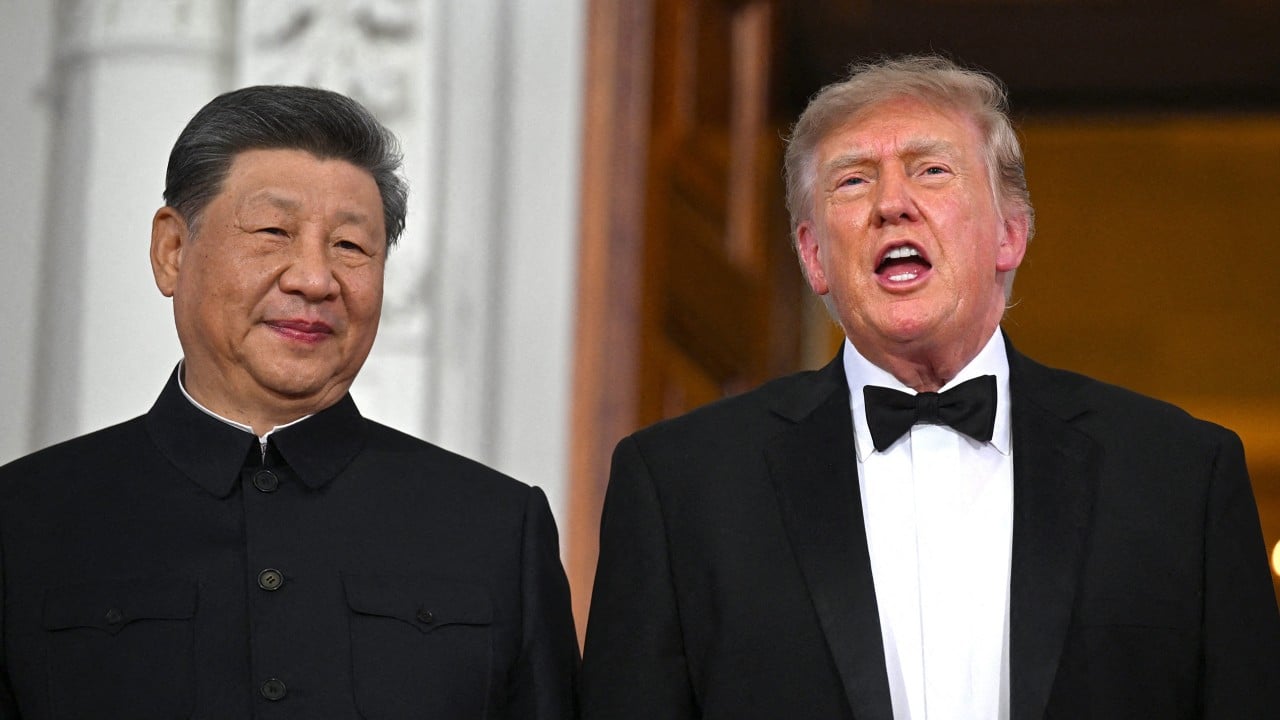
Hosting an outgoing American president in Shenzhen is not a gesture of bilateral goodwill; it is a calculated exercise in temporal arbitrage. When Beijing schedules high-level diplomacy in its premier technology and manufacturing hub during the final months of a US administration, the Chinese leadership exploits a structural divergence in political time horizons. Washington operates on a compressing four-year electoral clock that reduces an outgoing executive’s enforcement capacity to near zero, while Beijing operates on a multi-decade industrial planning cycle. Understanding this dynamic requires stripping away diplomatic theater and analyzing the underlying game theory, institutional incentives, and capital allocation signals embedded in the venue choice itself.
The Game Theory of Lame-Duck Diplomacy
In international relations, a "lame-duck" executive is defined by a terminal loss of domestic political capital following the election of a successor—or the final months of a constitutional term limit. From a strictly operational perspective, an outgoing president faces a severe commitment problem. Any bilateral agreement, working group, or regulatory freeze negotiated during this window lacks binding force on the incoming administration, which faces zero political cost for repudiating non-treaty executive commitments on January 20.
Rational actors in Beijing recognize that an outgoing US administration cannot extract structural concessions because it lacks the legislative runway and bureaucratic discipline to enforce compliance. Instead, the US delegation arrives with a narrow, defensive objective: legacy stabilization. Outgoing presidents seek to prevent an acute geopolitical crisis—such as a kinetic incident in the South China Sea or a sudden tariff escalation—that would tarnish their historical record during the transition period.
Beijing prices this desperation into its diplomatic strategy. By offering the optics of high-level dialogue and crisis management, China extracts immediate, tangible benefits while offering only reversible, rhetorical assurances in return. This creates an asymmetric payoff matrix:
- China’s Immediate Payoff: Beijing secures a temporary reduction in US regulatory velocity (delaying pending export controls or outbound investment screening rules) and projects domestic economic stability to foreign direct investors spooked by capital flight.
- America’s Deferred Liability: Washington trades away immediate policy momentum for a "floor" in the relationship that evaporates the moment the successor takes the oath of office, leaving the next administration to either absorb the diplomatic fallout of re-imposing stalled restrictions or accept a degraded baseline.
Why Shenzhen Functions as a Strategic Signal
Selecting Shenzhen over Beijing as the primary venue alters the semiotic and economic framing of the summit. Beijing is the seat of ideological control, state-owned enterprises, and bureaucratic friction. Shenzhen is the physical manifestation of China’s private-sector dynamism, supply-chain density, and technological self-reliance.
Historically, Chinese leadership has deployed Shenzhen as a theatrical backdrop during moments of acute macroeconomic anxiety. When Deng Xiaoping conducted his Southern Tour in 1992, the objective was to signal to domestic cadres and international capital that market reforms would survive the political freeze following 1989. When Xi Jinping visited Shenzhen in 2012 upon assuming power, and again in 2020 for the 40th anniversary of the Special Economic Zone, the messaging shifted from "opening up" to "indigenous innovation" and supply-chain resilience.
Hosting a lame-duck US president in Shenzhen serves three distinct operational functions:
- Countering the "Uninvestable" Narrative: Global institutional investors and multinational corporations have spent the past several years executing "China Plus One" diversification strategies, driven by arbitrary regulatory crackdowns, opaque national security laws, and slowing GDP growth. Putting an American president on the ground in China’s Silicon Valley creates a visual counter-narrative—implying that the world’s largest consumer market remains constructively engaged with China’s primary manufacturing engine.
- Demonstrating Immunity to Export Controls: Shenzhen is the headquarters of Huawei, BYD, DJI, and Tencent—the exact firms targeted by US semiconductor restrictions, entity lists, and tariff walls. Showcasing Shenzhen’s operational continuity sends an unmistakable signal to Washington’s national security apparatus: US containment architecture has accelerated domestic substitution rather than collapsing Chinese technological capacity.
- Bypassing Washington to Lobby Corporate America: Diplomacy in Shenzhen allows Chinese officials to engage directly with the executive leadership of US multinational corporations whose supply chains remain deeply entangled in the Pearl River Delta. By framing the summit around commercial pragmatism, Beijing recruits American corporate lobbyists to pressure the incoming US administration against aggressive decoupling measures.
Historical Precedents and the Structural Repeat
The pattern of outgoing US presidents engaging in late-term, high-visibility China diplomacy demonstrates a recurring failure to account for institutional discontinuity. While the specific venues and geopolitical temperatures vary, the underlying mechanics remain constant.
Consider the final months of the George H.W. Bush administration in late 1992. Following his November electoral defeat to Bill Clinton, Bush approved the sale of F-16 fighter jets to Taiwan—a major strategic move—yet simultaneously dispatched Commerce Secretary Barbara Franklin to Beijing in December to restore high-level commercial ties frozen since 1989. The administration attempted to lock in a managed commercial engagement model before handing power to a Democratic successor who had campaigned on linking China’s Most Favored Nation trade status to human rights benchmarks. Within sixteen months, the economic gravity of the bilateral relationship forced the Clinton administration to abandon its campaign posture and delink trade from human rights, validating Beijing’s strategy of waiting out electoral transitions.
A parallel dynamic emerged during the final weeks of the Barack Obama administration in late 2016 and early 2017. Facing an incoming president who had explicitly threatened punitive tariffs and a confrontation over currency manipulation, the outgoing team prioritized institutionalizing climate cooperation and maintaining military-to-military communication channels. Beijing engaged constructively with the outgoing administration’s framing, securing praise as a responsible stakeholder in global governance, even as it continued militarizing artificial islands in the South China Sea. When the Trump administration took office, it dismantled the bilateral dialogue mechanisms entirely, rendering the late-term diplomatic groundwork operationally irrelevant.
In both historical instances, the outgoing US team mistook procedural engagement for strategic progress. Beijing used the transition window to buy time, consolidate factual changes on the ground, and force the incoming American team to spend its first six months simply conducting policy reviews rather than executing offensive initiatives.
The Institutional Cost Function of Transition Summits
For multinational enterprises, institutional investors, and policy analysts attempting to model geopolitical risk, late-term summits generate dangerous false positives. Evaluating these meetings requires calculating the true cost function imposed on US strategic posture during a presidential transition.
The primary cost is bureaucratic paralysis. When the White House announces a presidential-level summit in the final quarter of a term, the interagency process across the Departments of State, Commerce, Treasury, and Defense immediately shifts into risk-aversion mode. Career officials and political appointees freeze pending regulatory actions—such as expanding the Entity List, tightening outbound investment rules on artificial intelligence and quantum computing, or enforcing forced-labor import bans—to avoid "poisoning the atmosphere" prior to the leader's arrival.
This self-imposed regulatory moratorium hands Beijing a unilateral concession without requiring a single reciprocal policy shift. Worse, because the outgoing political appointees will vacate their desks within weeks, the stalled regulatory packages are left incomplete for the incoming team. The new administration must then appoint new sub-cabinet officials, obtain Senate confirmations, re-establish interagency consensus, and restart the administrative rulemaking process. A two-week diplomatic freeze in November routinely translates into a nine-to-twelve-month operational delay in US policy execution.
The second cost is allied misalignment. US allies in the Indo-Pacific and Europe—particularly Japan, South Korea, the Netherlands, and Germany—incur substantial domestic economic pain when they align with Washington’s export controls and technology restrictions. When those allies observe a lame-duck US president traveling to China’s premier tech hub to project stability and commercial normalcy, it undermines Washington’s credibility. Foreign ministries in Tokyo and Brussels immediately question why their domestic semiconductor equipment makers should forfeit Chinese market share if Washington itself is signaling a tactical truce.
Limitations of the Strategic Decoupling Framework
Analyzing Beijing’s Shenzhen gambit through a purely adversarial lens exposes a critical blind spot in Washington’s current strategic orthodoxy: the assumption that time inherently favors the United States if it simply restricts technology transfers.
Beijing’s willingness to host a lame-duck president is not purely a position of unassailable strength; it is also a tacit admission of domestic macroeconomic vulnerability. China faces severe structural headwinds, including a protracted real estate deflationary cycle, high youth unemployment, local government debt overhang, and demographic contraction. Export-led manufacturing—centered in Shenzhen and the broader Guangdong province—remains the primary engine keeping Chinese GDP growth afloat.
If the incoming US administration follows through on threats of universal baseline tariffs or the revocation of Permanent Normal Trade Relations, China’s export engine will absorb a direct demand shock. Consequently, Beijing’s hospitality in Shenzhen reflects an urgent need to stabilize external demand expectations and prevent a synchronized retreat of Western capital. Washington’s error lies not in engaging with China, nor in acknowledging this mutual economic vulnerability, but in conducting high-level optics during the exact window when American leverage is at its mathematical nadir.
Operational Playbook for Capital Allocators and Policy Strategists
Because late-term summits produce high noise and low signal, corporate boards, supply-chain operators, and policy strategists must discount the diplomatic communiqués emerging from Shenzhen and anchor their decisions to structural realities.
- Treat Late-Term Agreements as Non-Binding Options: Any bilateral working group, tariff exclusion, or regulatory delay announced during a lame-duck summit carries an expiration date of January 20. Do not commit long-term capital expenditure in China based on regulatory stability promised by an outgoing administration.
- Model for the Transition Vacuum, Not the Summit: Adjust operational timelines to account for the six-to-nine-month bureaucratic lag created by the transition. Companies reliant on US export licenses or tariff exemptions should front-load compliance reviews and inventory positioning before the incoming administration reconstitutes its interagency national security apparatus.
- Track Provincial Subsidies Over Diplomatic Rhetoric: Ignore joint statements regarding "healthy economic competition." Instead, monitor capital allocation data from the Shenzhen Municipal Government and the Guangdong Provincial Development and Reform Commission. Where state-backed guidance funds direct capital—specifically in compound semiconductors, industrial robotics, and electric vehicle supply chains—expect aggressive overcapacity and margin compression for Western competitors within 24 to 36 months.
- Stress-Test Supply Chains Against Bilateral Whiplash: The ultimate consequence of hosting a lame-duck president in Shenzhen is heightened volatility in the subsequent year. When an incoming administration inevitably repudiates the perceived softness of its predecessor’s final months, the corrective policy actions—tariffs, sanctions, and investment bans—are typically sharper and less predictable than a steady-state escalation. Supply-chain diversification into Southeast Asia, India, or Mexico must proceed on the assumption that any bilateral stabilization achieved in Shenzhen is strictly temporary.