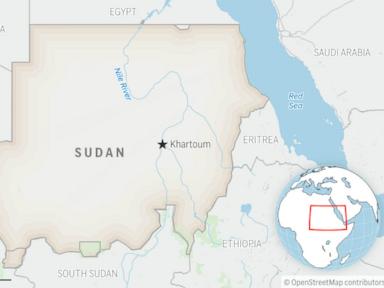
Reporting on aerial bombardments in contested territories almost always collapses complex military and evidentiary dynamics into a single casualty figure. When human rights monitors state that a Sudanese Armed Forces (SAF) airstrike killed at least thirteen people in West Kordofan, the headline captures the immediate human toll while obscuring three structural realities: the operational logic driving aerial campaigns in semi-arid borderlands, the verification bottlenecks inherent to telecommunications blackouts, and the strategic trade-offs between tactical air superiority and territorial legitimacy. Understanding these incidents requires separating verified forensic indicators from the fog of asymmetric warfare.
The Operational Logic of Air Superiority in Kordofan
West Kordofan functions as both a logistical corridor and a resource-contested buffer zone between central Sudan and the Darfur region. Unlike dense urban theaters such as Khartoum or Omdurman, where building-to-building combat negates fixed-wing aviation advantages, West Kordofan consists largely of open savannah, scrubland, and dispersed market towns. In this terrain, ground forces lacking integrated air defense systems face severe exposure along predictable transit routes.
For the SAF, air power serves as an asymmetric equalizer against the Rapid Support Forces (RSF), whose operational doctrine relies on high-mobility light infantry mounted on technicals. Because the RSF excels at rapid maneuver warfare and sustained ground sieges, the SAF uses aerial bombardment to achieve three distinct military objectives:
- Interdiction of Supply Lines: Targeting fuel depots, ammunition caches, and vehicular convoys moving through Kordofan to sustain western and central fronts.
- Area Denial: Rendering key transit hubs and regional markets uninhabitable or operationally hazardous to prevent the consolidation of rival administrative control.
- Attrition of Staging Areas: Striking settlements suspected of hosting mobile command posts or troop concentrations before an offensive can materialize.
This operational doctrine introduces a high probability of civilian harm due to the dual-use nature of rural infrastructure. Markets, water points, and transit junctions serve both local populations and mobile militias. When targeting intelligence relies on broad signals interception or outdated human intelligence rather than real-time electro-optical tracking, the distinction between a military staging area and a civilian gathering dissolves.
The Verification Architecture of Human Rights Reporting
The phrasing "at least 13" is not a stylistic hedge; it is a precise reflection of how casualty data is collected under conditions of severe information friction. Human rights organizations and local emergency response rooms operating in Sudan do not have unfettered physical access to strike sites. Instead, they rely on a multi-tiered verification pipeline designed to establish a defensible floor rather than a comprehensive ceiling.
Phase One: Initial Triangulation
Reports typically originate from local witnesses, medical personnel at surviving clinics, or community defense networks. Because the SAF and RSF frequently disrupt cellular networks and internet backbones in active combat zones, initial transmissions often travel via satellite links or physical couriers moving to neighboring regions with active connectivity. At this stage, monitors log raw claims while filtering out duplicate accounts of the same event.
Phase Two: Forensic Corroboration
To elevate an unverified report to an attributed incident, analysts cross-reference witness testimony against open-source intelligence. This includes analyzing satellite imagery for thermal anomalies and structural cratering, inspecting fragments of munitions photographed at the scene to identify weapon types, and verifying timestamps against known flight patterns. Munition remnants—such as tail fins from unguided high-explosive bombs—provide critical evidence distinguishing aerial strikes from ground-based artillery or drone attacks.
Phase Three: Casualty Floor Establishment
The "at least" metric represents individuals whose deaths have been confirmed through named registries, burial records, or direct medical attestation. Unidentified remains, individuals buried immediately due to security threats or lack of refrigeration, and victims who succumb to injuries days later outside formal medical facilities are excluded from the baseline count. The true mortality rate of an airstrike in a region with collapsed trauma care infrastructure routinely exceeds the initial verified figure.
Known Facts Versus Analytical Hypotheses
Rigorous conflict analysis requires drawing a hard boundary between documented evidence and strategic inference. Overextending conclusions beyond the available data degrades the credibility of the entire assessment.
Documented Operational Realities:
- Asymmetric Capability: The SAF maintains a near-monopoly on fixed-wing combat aircraft within the Sudanese theater, though both sides utilize unmanned aerial vehicles of varying payload capacities.
- Infrastructure Degradation: Healthcare facilities across West Kordofan operate at a fraction of pre-war capacity, meaning survivable blast injuries frequently become fatal due to the absence of surgical intervention, blood supplies, and trauma transport.
- Communication Asymmetry: Intermittent telecommunications blackouts systematically delay reporting from rural Kordofan compared to urban centers, creating a temporal lag between an incident and international documentation.
Analytical Hypotheses Requiring Further Evidence:
- Targeting Intent: Without access to military flight logs or internal targeting matrices, external analysts cannot definitively prove whether a specific strike was an intentional attack on a civilian center, a misfire caused by unguided munitions dropped from high altitudes to evade anti-aircraft fire, or a strike based on flawed intelligence regarding militant presence.
- Exact Combatant-to-Civilian Ratios: Rights groups focus on civilian harm, while belligerents routinely claim all casualties were enemy combatants. In areas where armed groups embed within residential neighborhoods, establishing an exact demographic breakdown of the dead remains practically impossible without independent on-site forensic teams.
The Strategic Cost Function of Uncalibrated Aerial Campaigns
From a purely military-strategic perspective, reliance on high-altitude, unguided aerial bombardment generates diminishing returns over prolonged conflicts. While an airstrike may temporarily disrupt a logistics node or disperse a tactical formation, the second-order effects often undermine the broader campaign objectives of the force conducting the strike.
First, indiscriminate or poorly calibrated strikes accelerate local alienation. In borderland regions like West Kordofan, where tribal allegiances and local governance structures determine long-term territorial control, civilian casualties push neutral communities toward accommodation with rival forces for physical protection. Air power can destroy infrastructure, but it cannot hold ground or administer populations.
Second, repeated civilian casualty events erode diplomatic leverage. Each documented strike reinforces international scrutiny, complicates negotiations over humanitarian access corridors, and strengthens arguments for arms embargoes or targeted sanctions against command structures. The tactical gain of destroying a localized target rarely offsets the strategic penalty of hardened diplomatic isolation.
Third, reliance on aerial bombardment incentivizes adversaries to adapt their dispersal tactics. Rather than concentrating forces in identifiable bases, mobile units break into smaller cells, embed deeper within civilian infrastructure, and conduct movements under cover of darkness or adverse weather. This adaptation forces the air-capable belligerent into a cycle of increasingly speculative targeting, which further elevates civilian casualty rates without achieving decisive operational breakthroughs.
Strategic Imperatives for Conflict Monitors and Policymakers
Evaluating aerial incidents in West Kordofan requires moving beyond reactive condemnation toward structured evidentiary and policy frameworks.
For conflict monitoring organizations, the primary operational priority is standardizing metadata collection around munition identification and trauma outcomes. Documenting the specific type of ordnance used—distinguishing between barrel bombs, standard high-explosive free-fall munitions, and precision-guided systems—shifts the analytical debate from subjective claims of intent to objective assessments of weapon accuracy and proportionality in populated areas. Integrating delayed mortality tracking into casualty databases will also provide a more accurate measure of the total human cost imposed by the destruction of regional healthcare systems.
For international mediators and policymakers, diplomatic pressure must target the specific operational mechanisms driving civilian harm rather than issuing broad, unenforceable calls for restraint. Ceasefire frameworks and humanitarian negotiations must explicitly include verifiable no-strike lists covering regional markets, water infrastructure, and surviving medical clinics, paired with independent satellite monitoring protocols to attribute violations rapidly. Without enforceable accountability tied directly to the logistical supply chains that sustain air operations, aerial bombardment will remain the default tool for managing territorial stalemates across Sudan's peripheries.