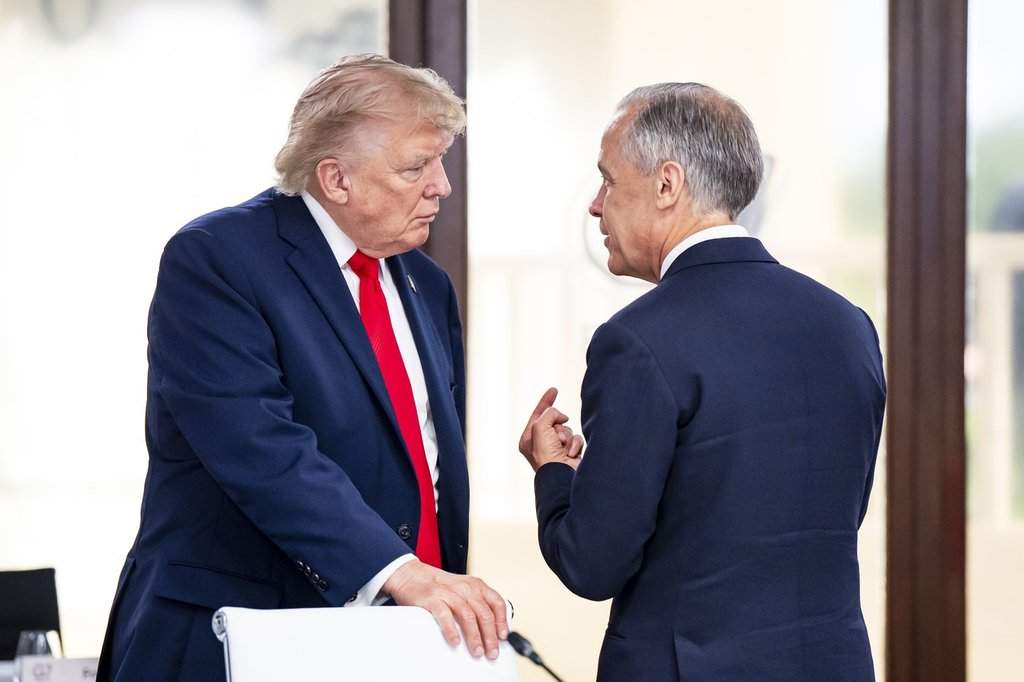
Geopolitical risk assessment requires separating diplomatic rhetoric from structural operational realities. When sovereign leaders evaluate the exposure of their state machinery or economy to United States led military engagements, the analytical framework demands an examination of systemic vulnerability, alliance friction, and economic cost functions. Mark Carney addressing the risk profile of potential U.S. military action highlights a critical intersection between grand strategy and macro-financial exposure. Deconstructing this dynamic requires analyzing how secondary actors calculate risk exposure when primary hegemonic powers contemplate kinetic interventions.
The Tripartite Matrix of Sovereign Exposure
When a superpower projects kinetic force, allied and non aligned nations absorb fallout across three distinct vectors: financial transmission channels, supply chain integrity, and security dependency burdens. Each vector operates under distinct systemic constraints. Discover more on a connected issue: this related article.
Financial Transmission and Capital Flight
Intervention by a reserve currency issuer alters global risk premiums instantly. Sovereign debt markets in secondary economies react through predictable transmission channels. First, capital flees peripheral jurisdictions toward safe asset havens, widening sovereign bond spreads. Second, energy import costs spike due to immediate risk premia injected into global commodity futures. Leaders evaluating these scenarios must quantify their current account balance sensitivity to imported energy price shocks. A nation running structural fiscal deficits combined with heavy reliance on hydrocarbon imports faces acute vulnerability during any escalation phase managed by the Pentagon.
Supply Chain Chokepoints and Strategic Bottlenecks
Military actions spearheaded by Washington invariably disrupt maritime trade lanes or regional logistical nodes. Strategic planning requires calculating the elasticity of domestic industrial inputs relative to the affected geography. If an intervention closes a vital transit corridor, inventory buffers dictate corporate survival timelines. Economies lacking strategic reserves of critical minerals, refined petroleum products, and semiconductor inputs face production halts within weeks rather than quarters. Further journalism by BBC News highlights similar perspectives on this issue.
Security Dependency and Alliance Entanglements
Nations bound by mutual defense treaties or informal security umbrellas face immediate binary choices during U.S. military escalations: provision of logistical support, diplomatic shielding, or strategic divergence. Each choice carries distinct opportunity costs. Provision of facilities invites asymmetric retaliation, including cyber operations and economic coercion from opposing coalitions. Diplomatic neutrality risks long term security decoupling from the primary security provider.
Quantifying the Cost Function of Geopolitical Friction
Strategic decision makers utilize risk matrices that weigh the probability of conflict escalation against the magnitude of economic disruption. The cost function $C$ of a military intervention on a secondary economy can be modeled across key variables:
$$C = f(E, S, D)$$
Where $E$ represents energy price volatility, $S$ denotes supply chain interruption duration, and $D$ accounts for diplomatic fallout costs and secondary sanctions exposure.
In a baseline scenario where U.S. forces engage in limited kinetic operations, $E$ experiences a transient spike, $S$ remains constrained to the immediate theater, and $D$ is managed through calibrated diplomatic messaging. However, if the intervention triggers asymmetric responses from adversary states, the exponents shift non-linearly, turning manageable friction into systemic crises.
Strategic Hedging Under Uncertainty
Governments and multinational institutions managing exposure to these flashpoints deploy specific operational adjustments to mitigate downside risks. Diversifying sovereign reserve assets away from single currency concentrations reduces vulnerability to financial weaponization. Building domestic buffer stocks of essential commodities breaks the transmission loop of short term logistical shocks. Furthermore, auditing national critical infrastructure for foreign hardware vulnerabilities prevents adversary state actors from exploiting kinetic distractions to execute widespread cyber sabotage.
The primary objective of risk analysis in these environments is not predicting the exact timing or scope of military action, but establishing structural resilience against the worst case tail risks inherent in unipolar security architectures.
Execute capital allocation reviews focusing on foreign exchange reserve liquidity, stress test supply chains against localized maritime blockades, and audit critical infrastructure resilience against state sponsored cyber incursions.